Unknown's avatar

About Sv Ice Floe

I sail on a vessel named Ice Floe

Martinique to Marigo Bay Marina, St. Lucia

Michael joins us in St. Lucia

We sailed from St. Anne, Martinique to St. Lucia on April 23rd to meet Michael.  George left at the crazy early time of 6:30 am, always mindful of the need to arrive in time to check in.  We had a beautiful sail in 14 knot winds on a beam reach.
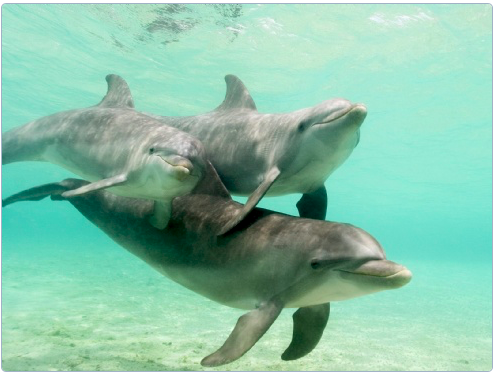
As we made the crossing to St Lucia, a pilot whale came right alongside the boat.  What a thrill to see such a massive creature feet from the cockpit on the starboard side of Ice Floe.  We learned that pilot whales, actually a type of dolphin, swim alongside boats just as we have had other dolphins play in the boat’s bow wave.  The pilot whale is distinguished from the more typical bottlenose dolphins both in its size and the shape of its head.
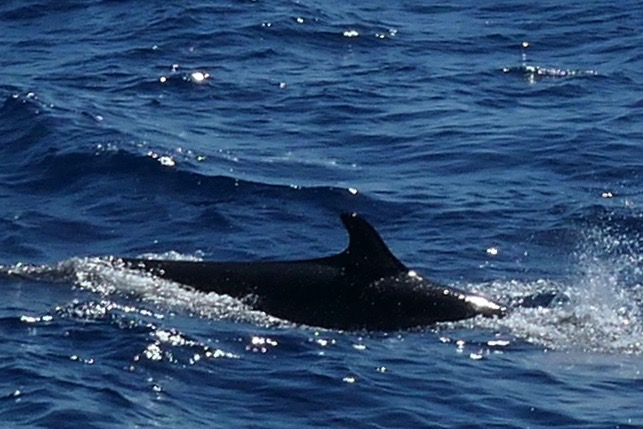
The best shot I could get of the pilot whale that visited us
750 pound short fin pilot whale – photo borrowed from awesomeoean.com
Common Caribbean bottlenose dolphins – photo borrowed from wallpaperweb.org
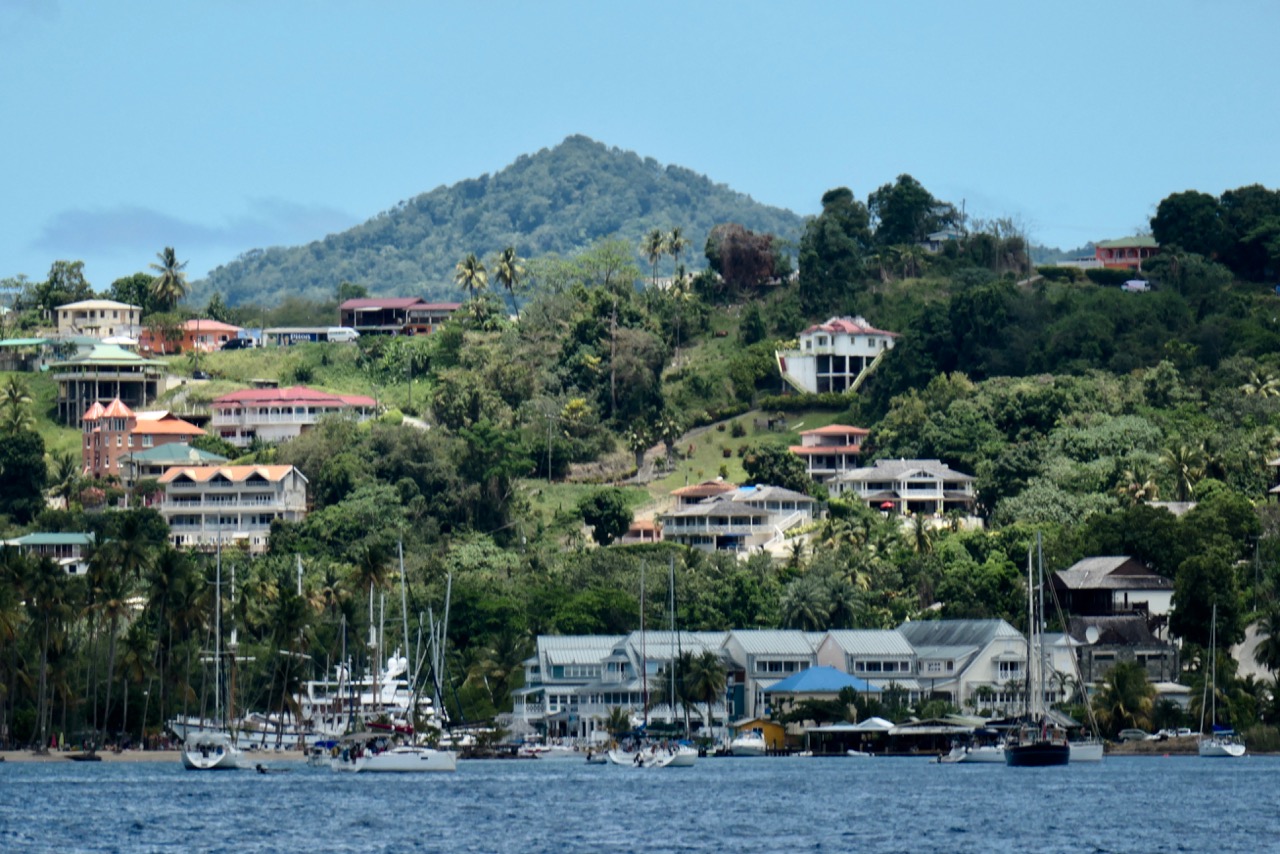
We arrived to Marigot Bay in St. Lucia early in the afternoon.  As you enter the bay, the hilltops are festooned with colorful villas/homes/rentals.
Looking down on the bay in this photo borrowed from the Marigot Bay Marina and Resort, it is easy to see why this bay is popular as a hurricane hole.  The beautiful sand beach peninsula leaves only a small opening to the outer harbor.  An interesting fact is that French ships are known to have hidden from English ships behind the sand beach having tied palm fronds to their masts as camouflage.
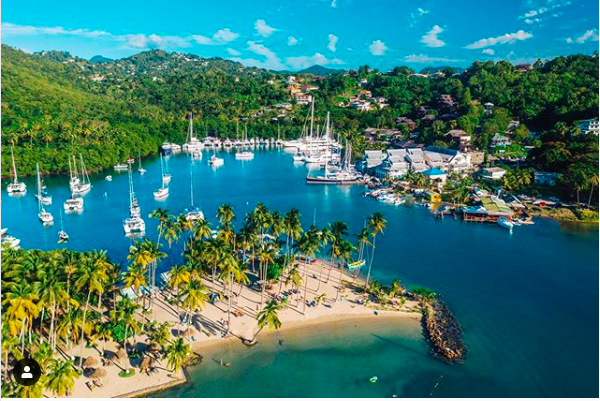
Aerial view of Marigot Bay Marina and Resort reproduced from the resort’s website
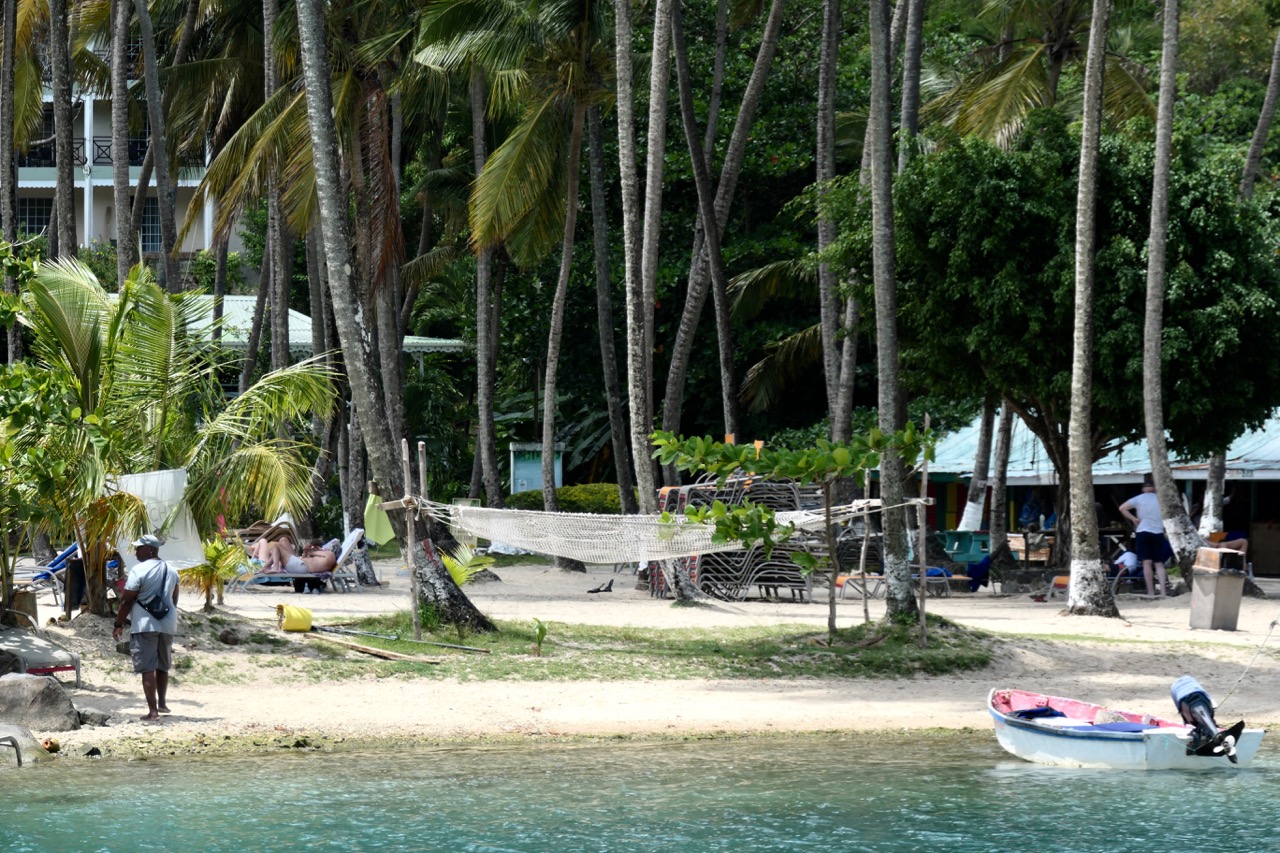
Further out, beyond the sand beach on the left the Marigot Beach Club is situated.  The beach club offers day passes and longer rental accommodations, sets up outings such as kayaking, snorkeling, diving, et al.  A beach-bar restaurant named DOOlittles offers local fare and a boat shuttles between the Marigot Beach Club and the Marigot Bay Marina and Resort, as well as many additional restaurants.  A wedding was held at the Marigot Beach Club while we were visiting.
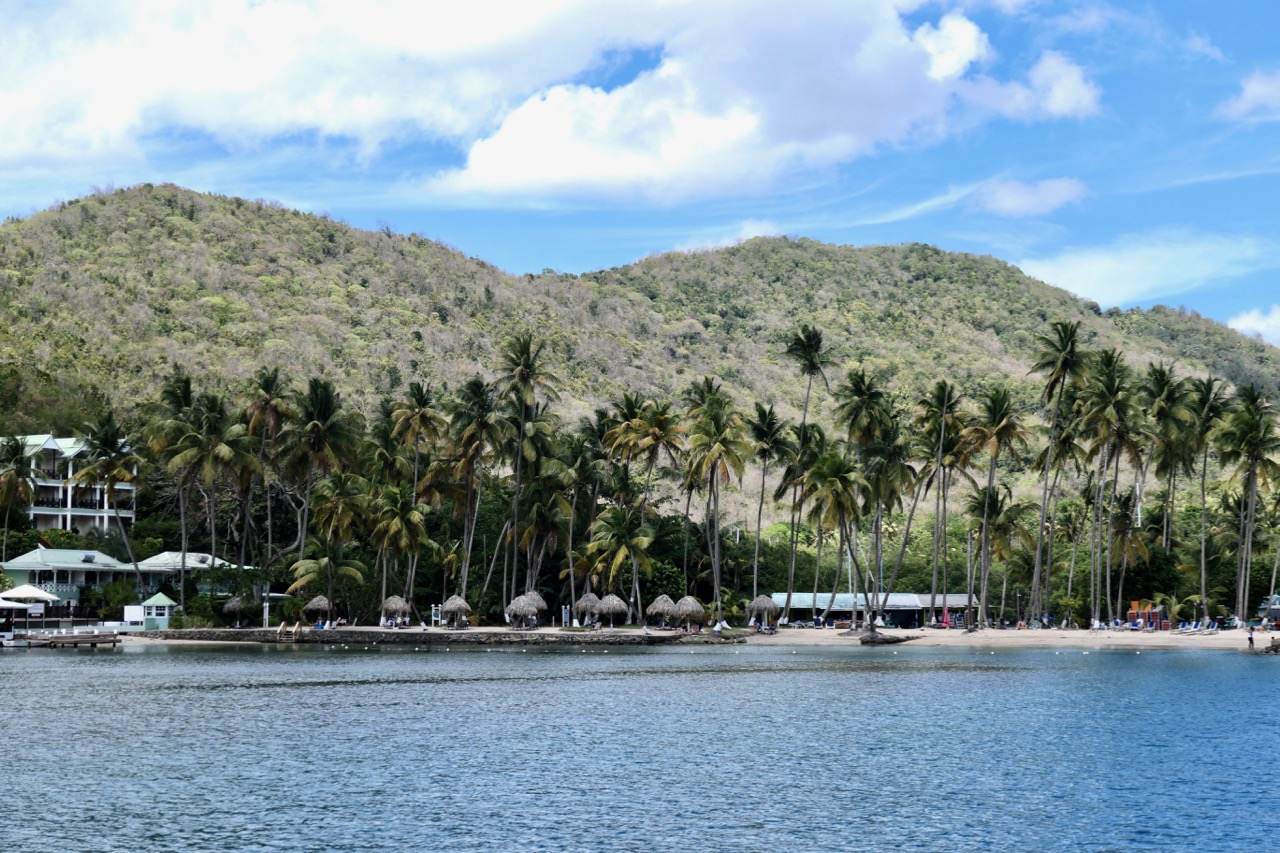
Marigot Beach Club
Marigot Beach Club
As you begin to enter Marigot Bay Marina, this duo of pale blue and white buildings house the administrative offices, marina showers, the Hurricane Hole restaurant, a bank, and some living quarters.  The two buildings are separated by a large courtyard with seating for the restaurant.  On our first evening in the marina, George and I had dinner at the Hurricane Hole that was offering a buffet of traditional Caribbean dishes and a show featuring a very talented tenor saxophone player alternating with performances of a traditional dance troupe featuring fire, fire swallowing, and fire breathing.
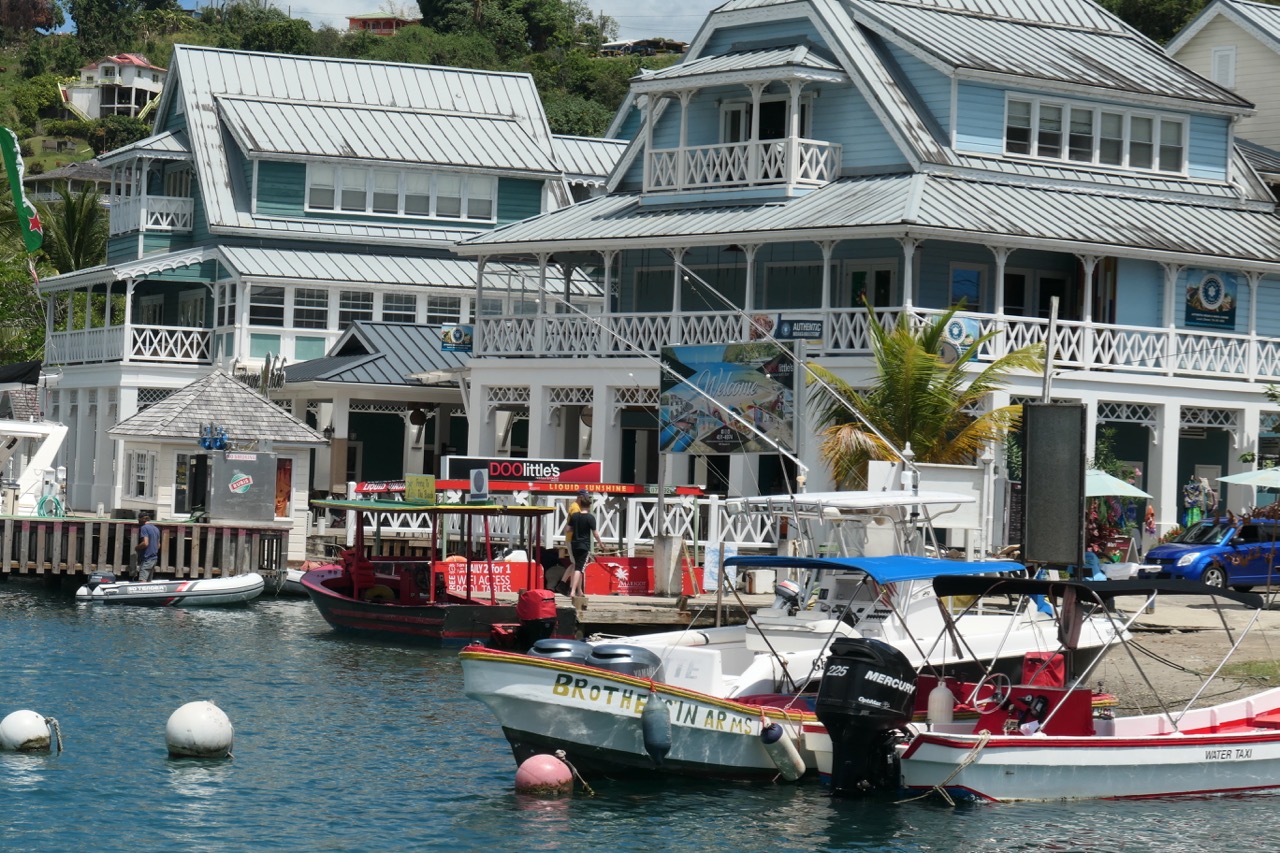
Marigot Bay Marina and Resort administrative offices, the Hurricane Hole Restaurant, et al.
We spent most of the two days before Michael’s arrival on boat chores.  However, we did allow ourselves occasions to take in the beauty and features of the Marigot Bay Marina and Resort.
Unfortunately, our application for Duhkxy to visit St. Lucia had not yet been approved so he could not leave the boat.  We took this opportunity to further our efforts to make Duhkxy at ease when we had to leave him alone.  Duhkxy made great strides in adjusting to our absence, remaining mostly calm, and assuming a lookout for us on the cockpit combing until our return.
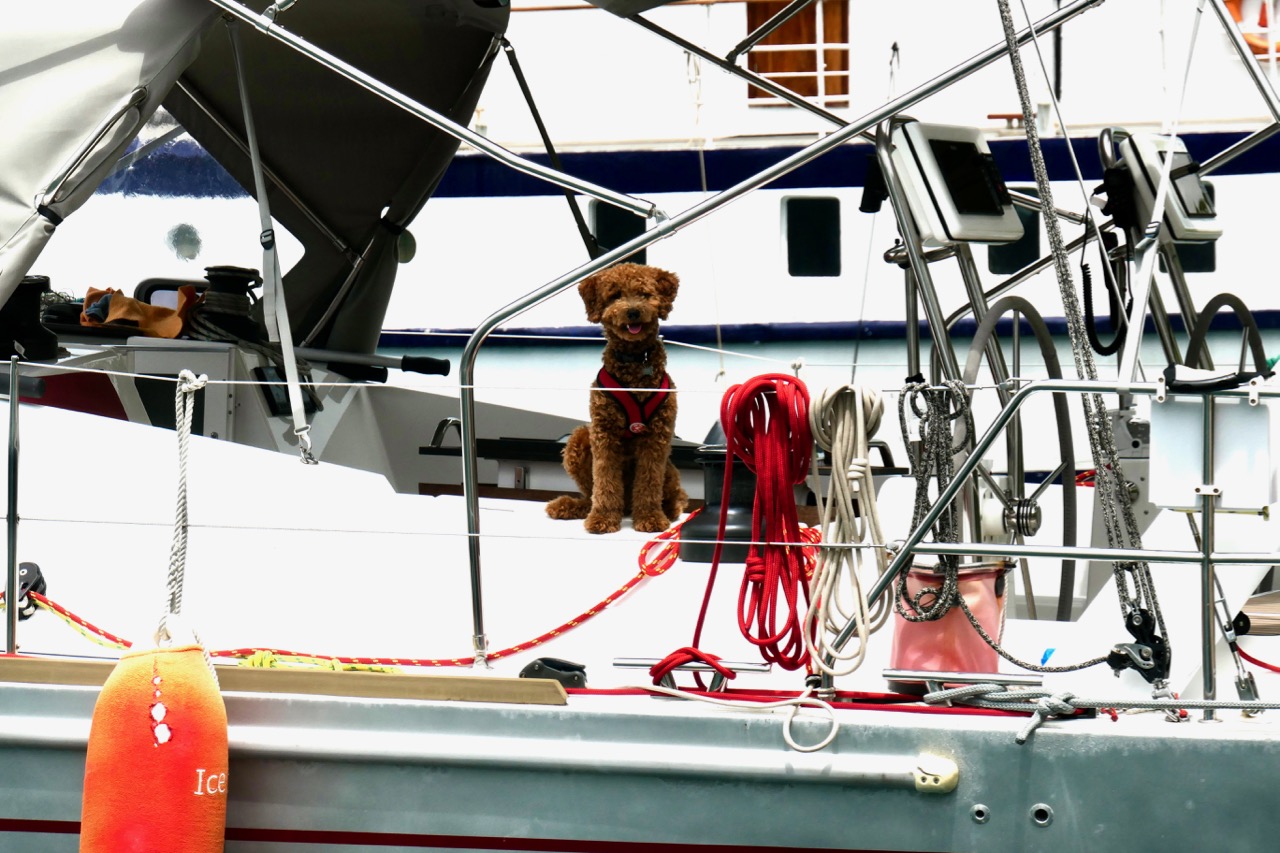
Duhkxy escaped no ones attention as he stood vigil waiting for our return.
I took a 45 minute cab ride to the Hewanorra Airport to meet Michael – another great opportunity to see more of the island during this ride from the northwest side of St. Lucia to the southeast.  We passed through banana plantations, across mountains and through the island’s rainforest.  Our driver Moses was kind enough to stop at an overlook of a beautiful fishing village and at one of the many fruit and vegetable stands so I could replenish our stores.  The homes and villages we saw were colorful and well maintained.  We will certainly visit again for a longer time once Duhkxy’s permit is approved (spoiler alert:  it was ultimately not approved this year as Duhkxy was not old enough to have some of the required tests done).
After an interminable wait at the airport, Michael finally showed up with a customs agent beside him.  He quickly said “OK, they won’t let me in because of the incident in Grenada”.  Before I could respond, he countered with “Nah, they just need to know where I am staying.”  This is an odd question when you are staying on a boat and that is not a sufficient answer.  They must have a non-moving place.  The answer of the Marigot Bay Resort and Marina was sufficient to get us on our way, understanding we would be moving on from there.
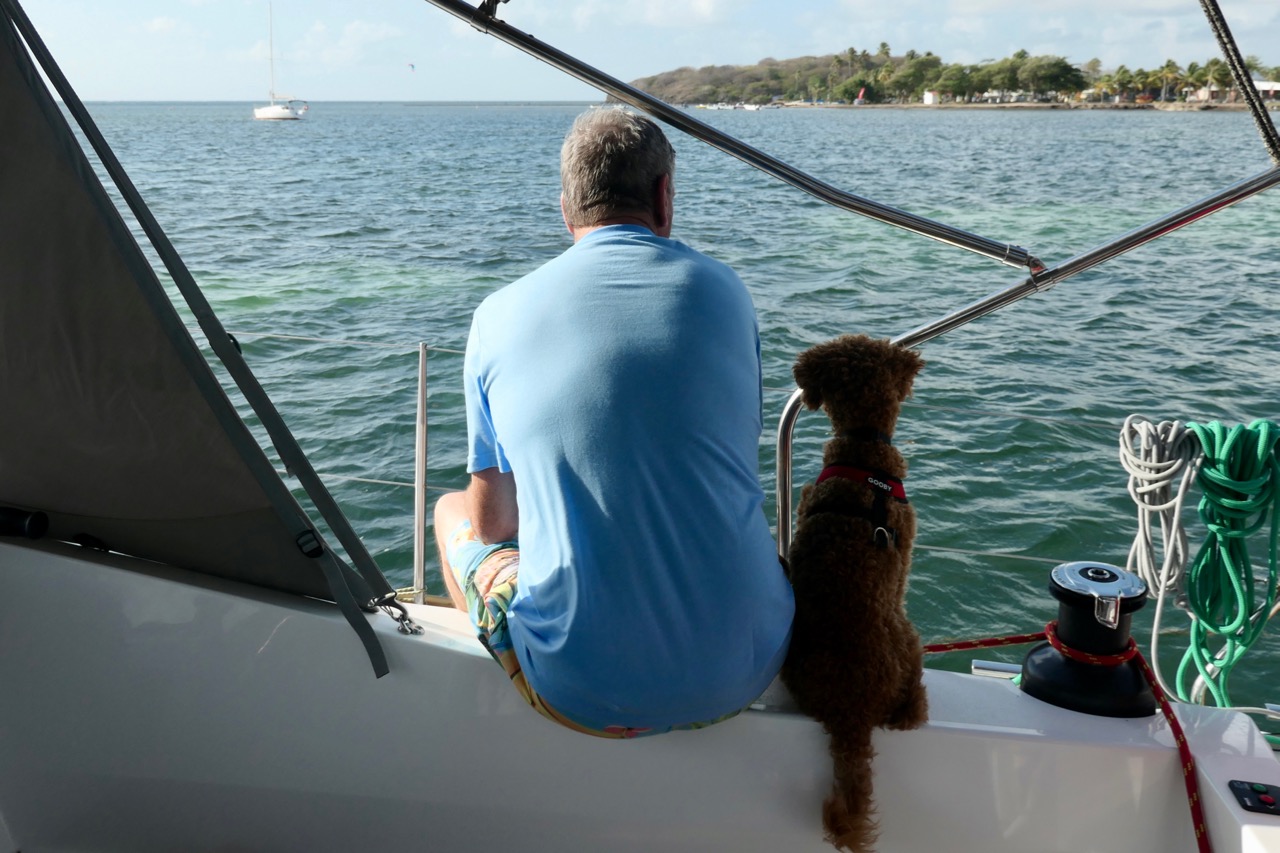
Michael and Duhkxy quickly became the best of friends.
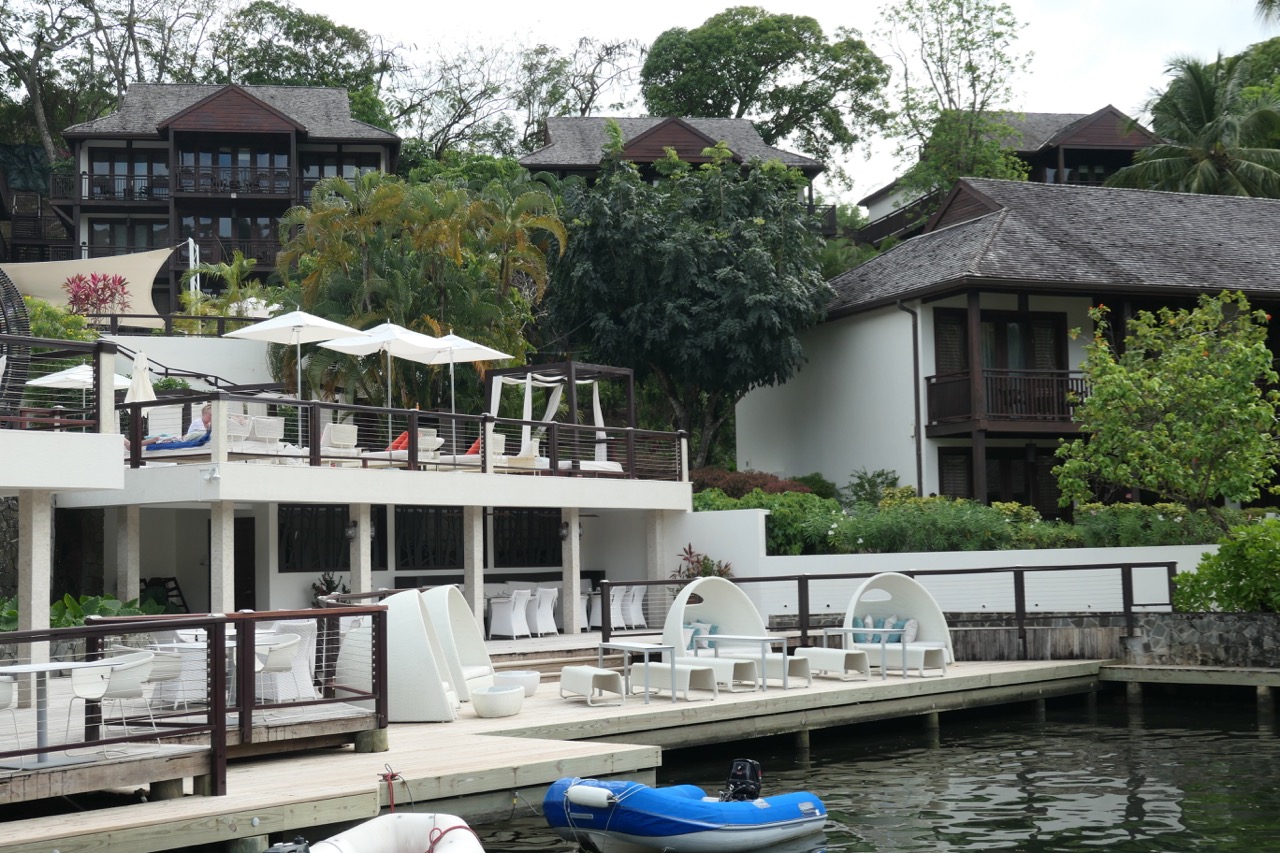
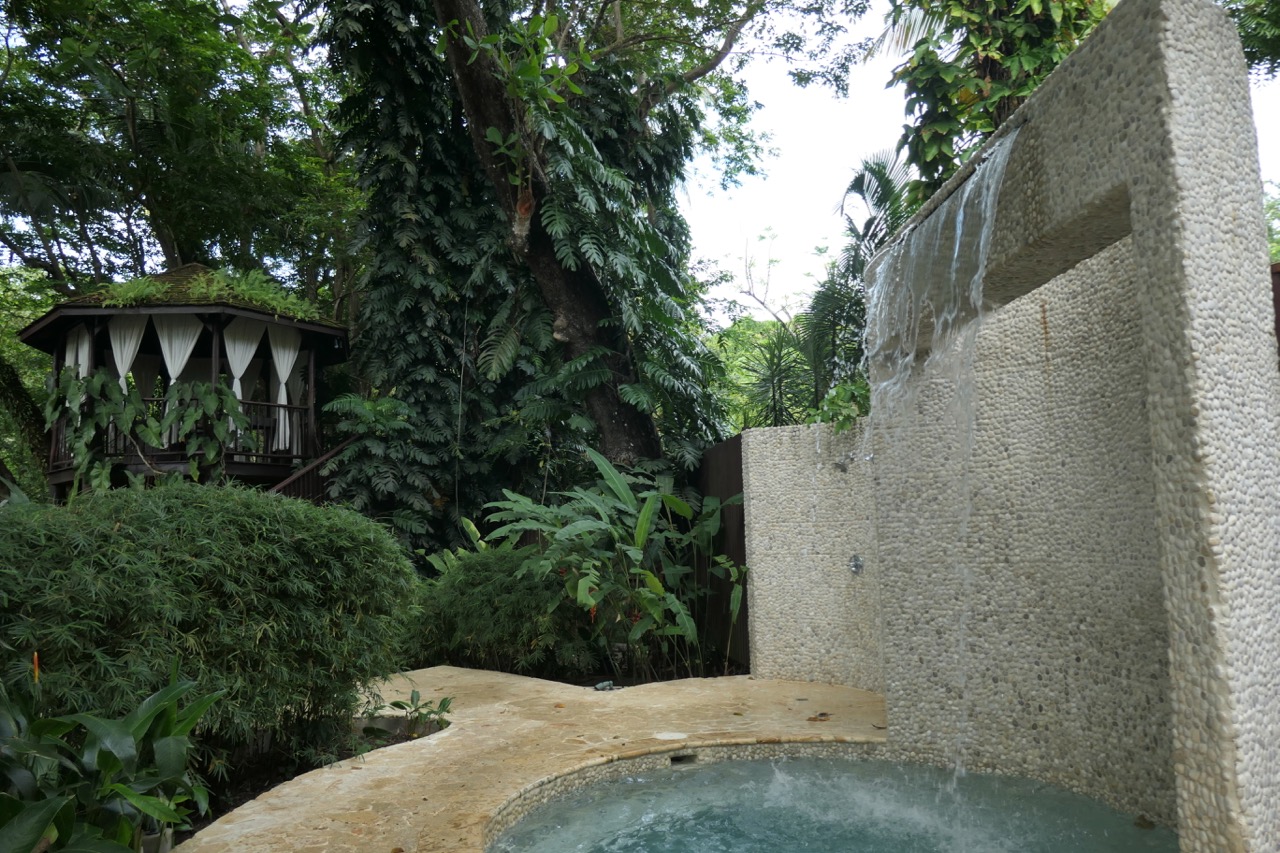
Although neither Michael nor George and I were able to enjoy the Marigot Bay Resort fully, save a couple of dips in the pool and a fabulous Indian dinner at Masala, the following pictures will give you a sense of why we aim to return next year.
In my next post, I will tell you all about Michael’s visit and our circumnavigation of Martinique. 
The Marigot Bay Marina and Resort is renowned for its beauty and accoutrements.  Accommodations include 915 square foot Junior suites starting at $390 per night in the off season and go up from there. HOWEVER, a slip on the dock ran us ~$40 per night and came with full access to the resort facilities, pools, spa, gardens and restaurants.  What a deal!  It reminded us of our great fortune staying in a marina in the heart of Paris for only 40 euro a night.  We wish all marinas were so reasonable.
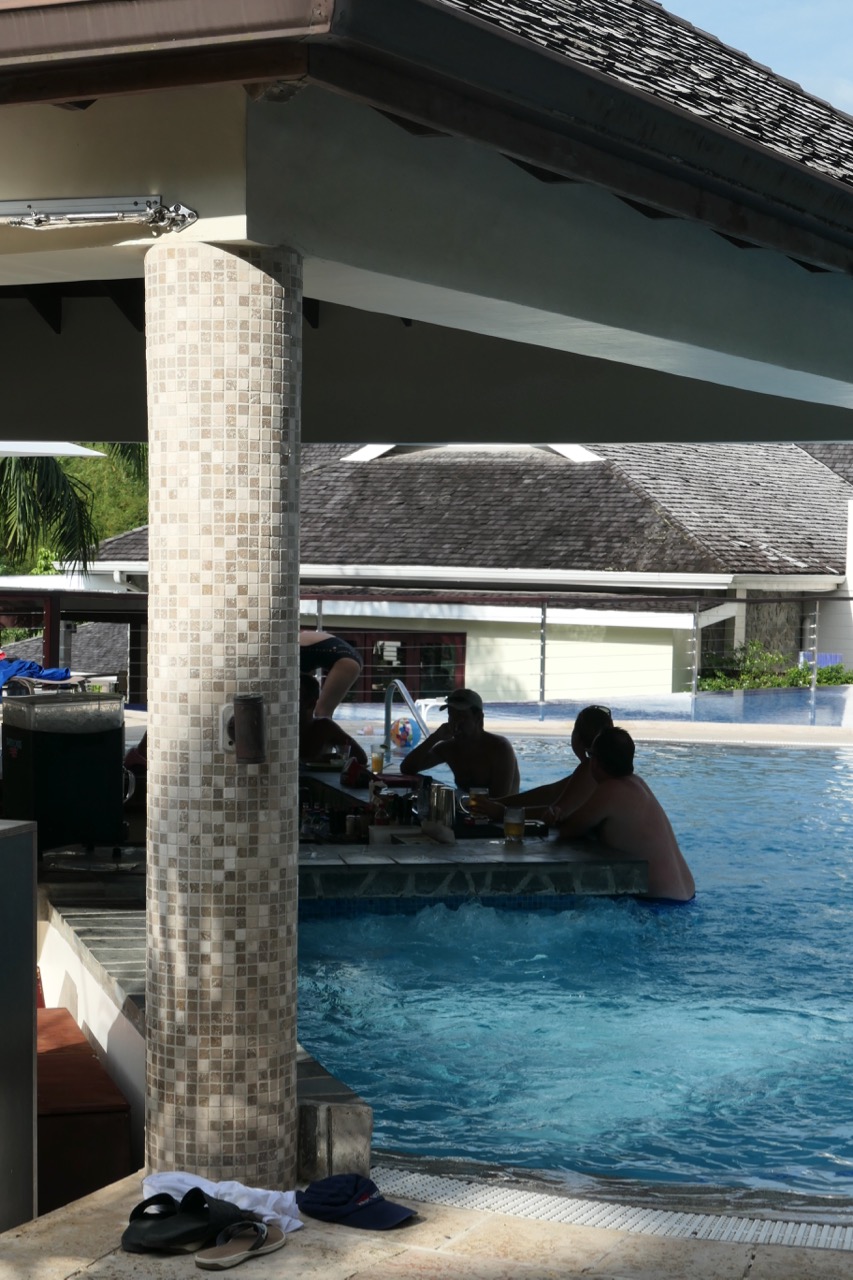
The resort has two large swimming pools, one with a swim up bar – by far the most popular.
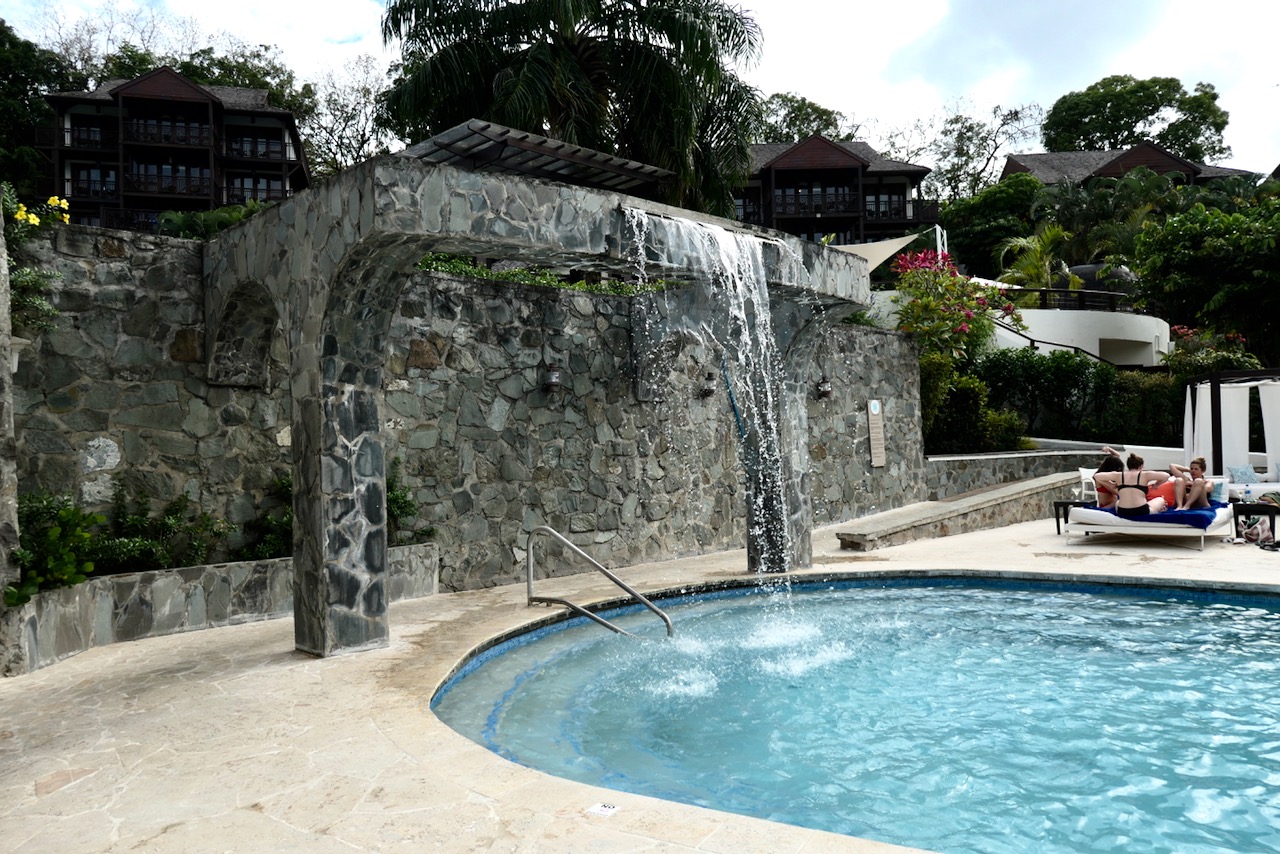
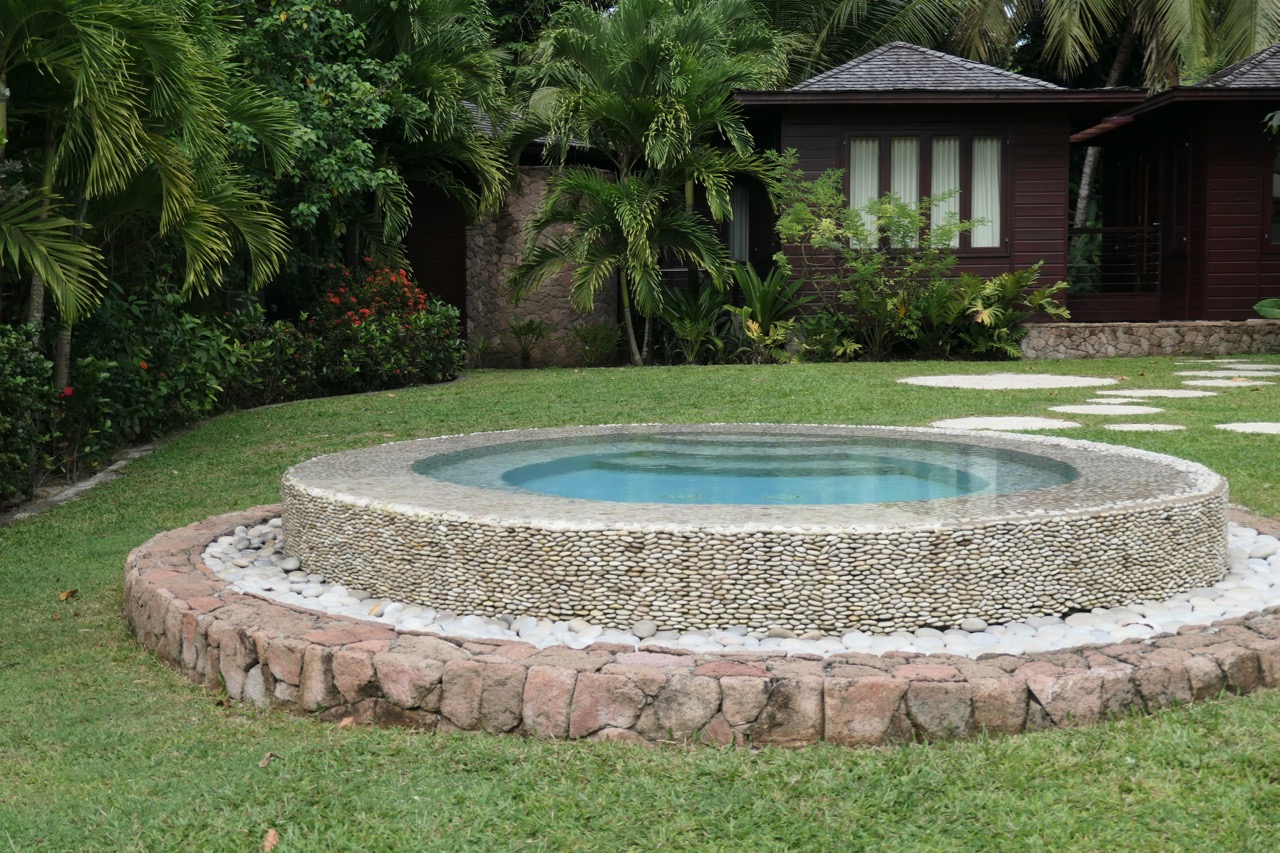
Additional water features are integrated into the grounds of the resort.
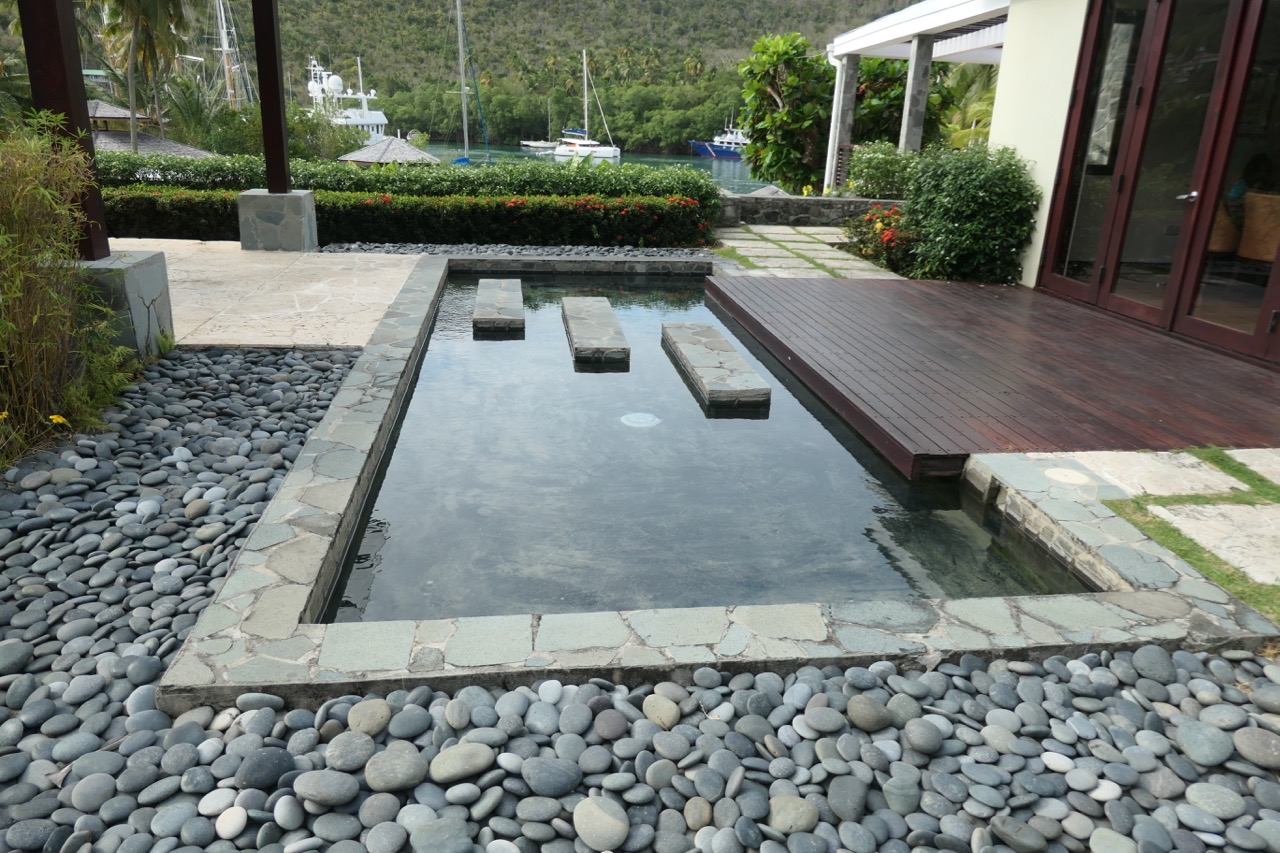
Koi pond
I luxuriated in the sitting area above this gorgeous dinghy doc writing my last post.
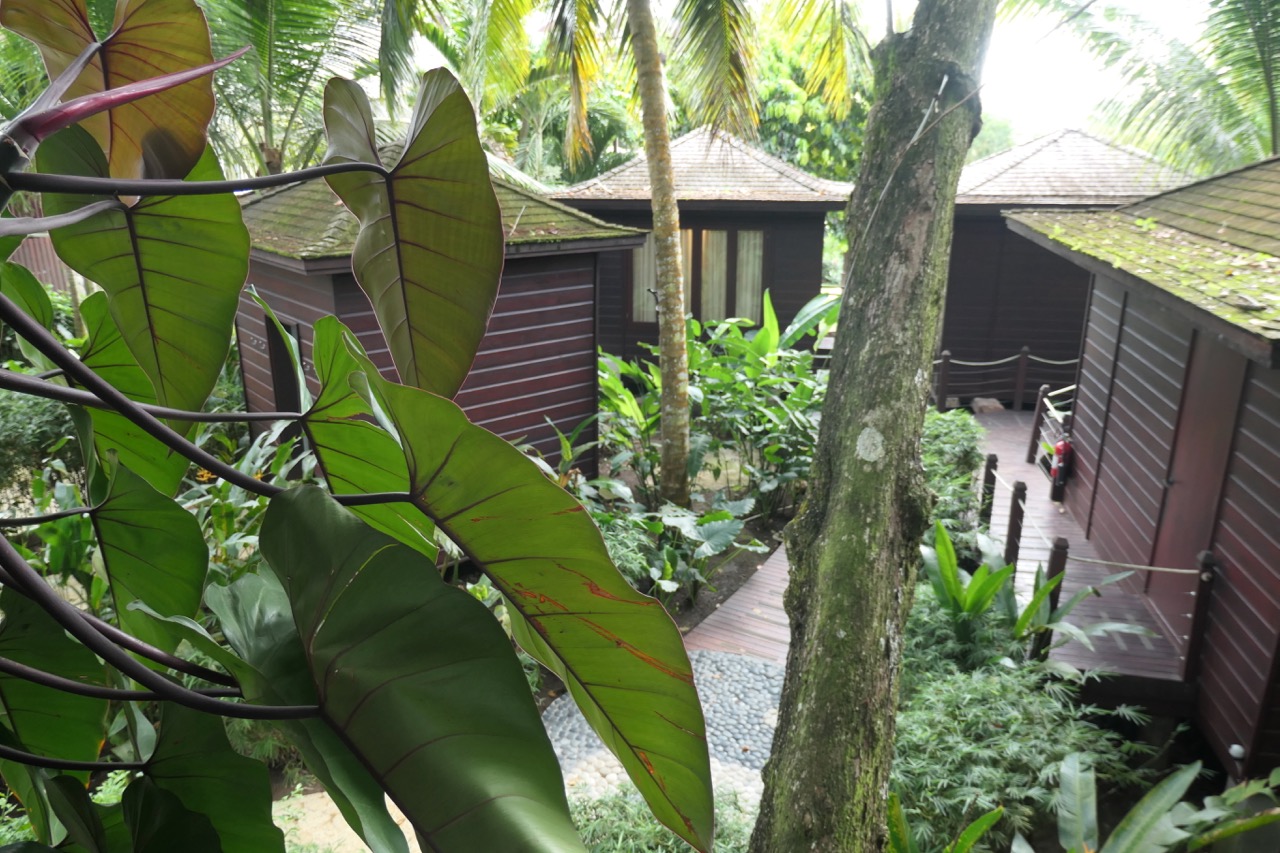
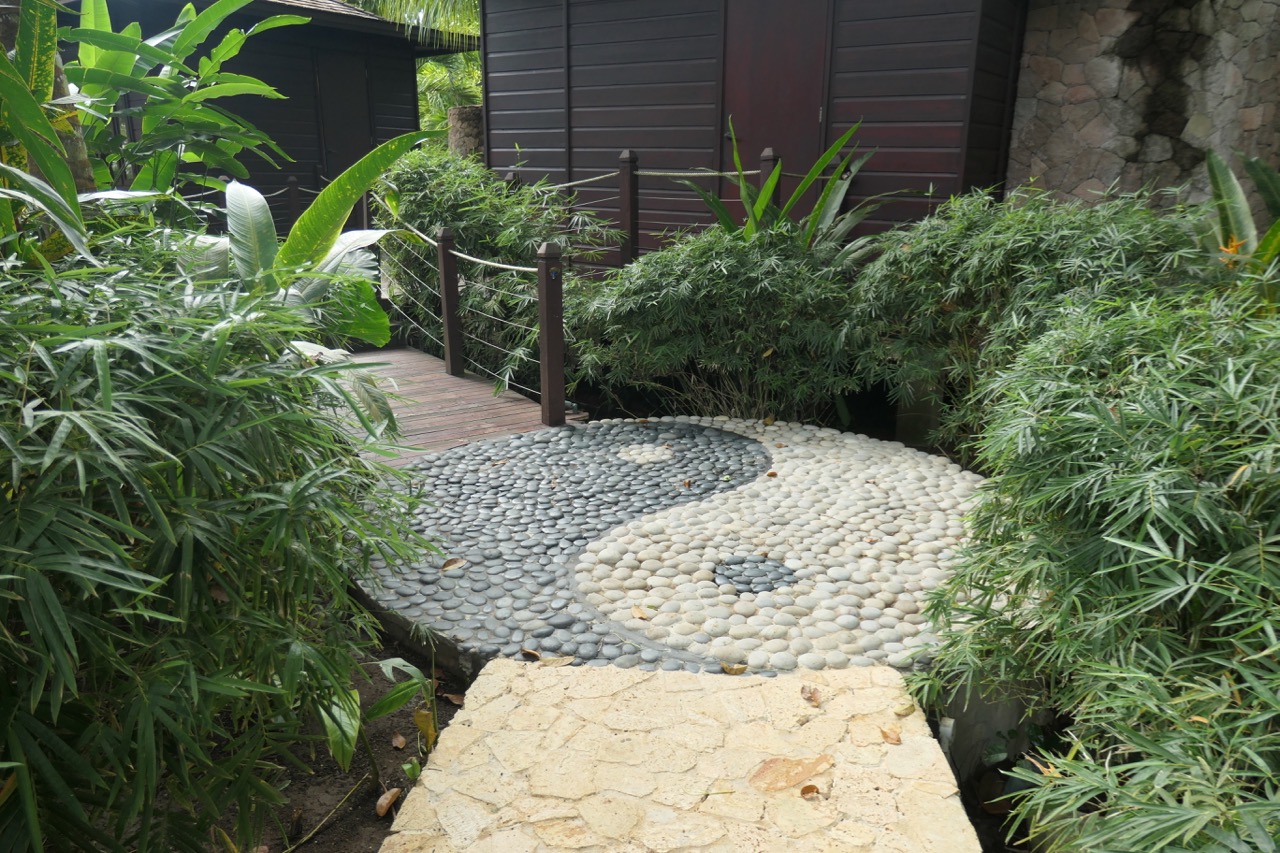
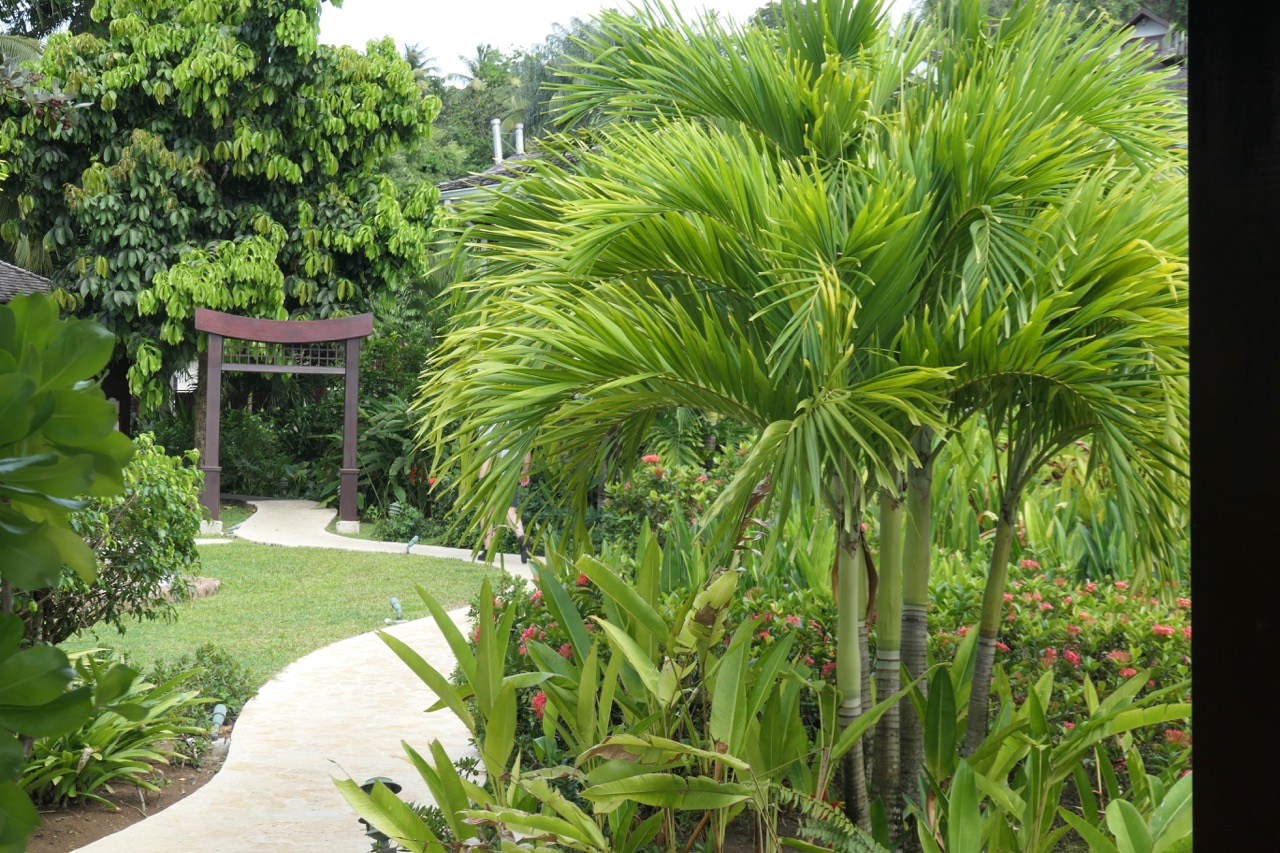
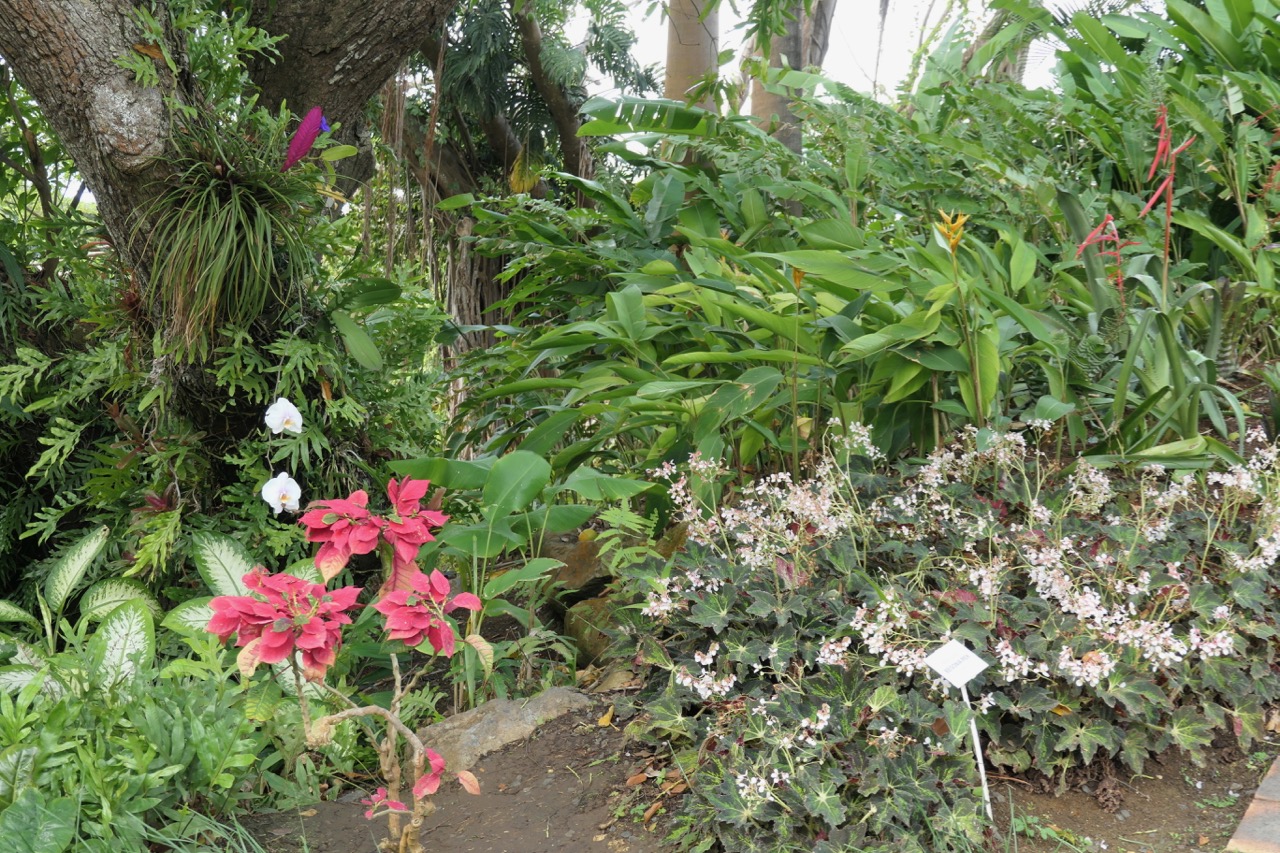
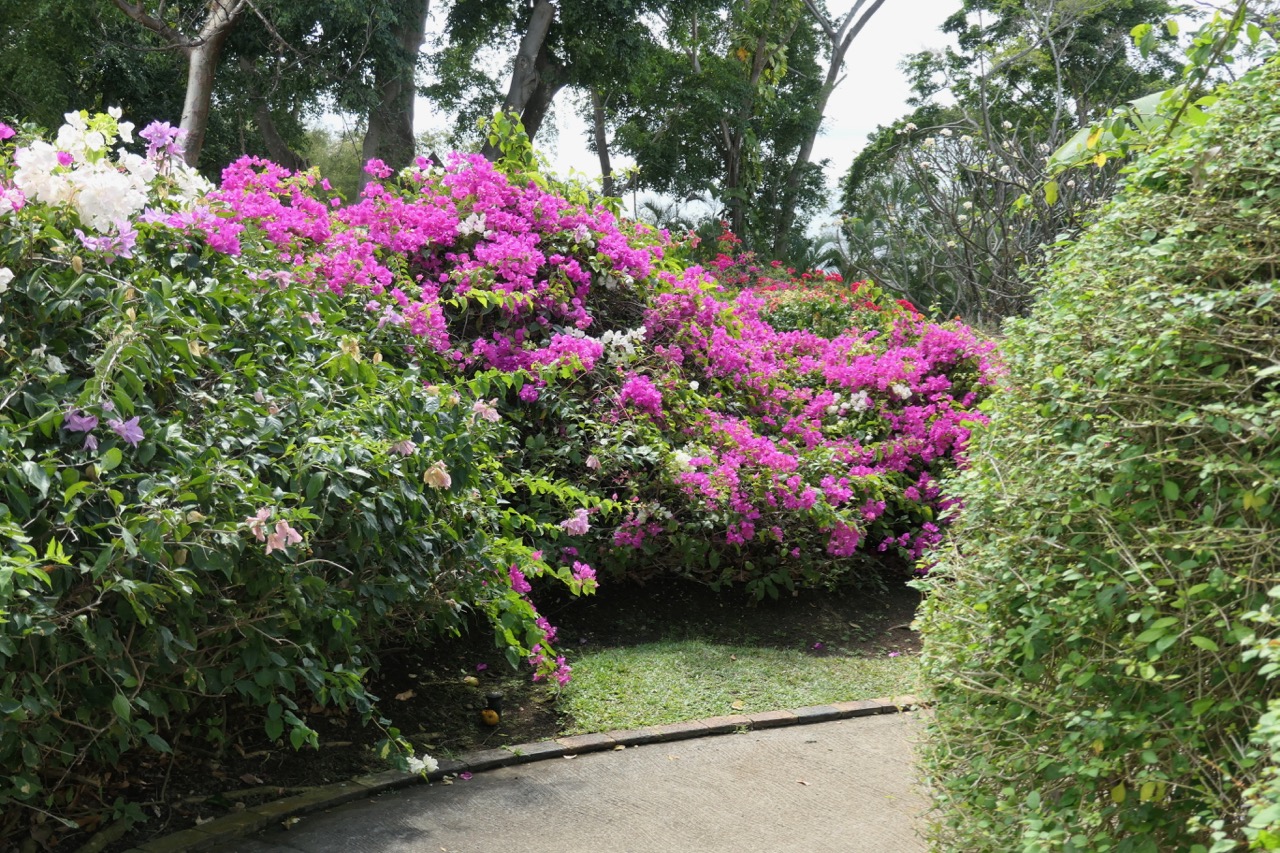
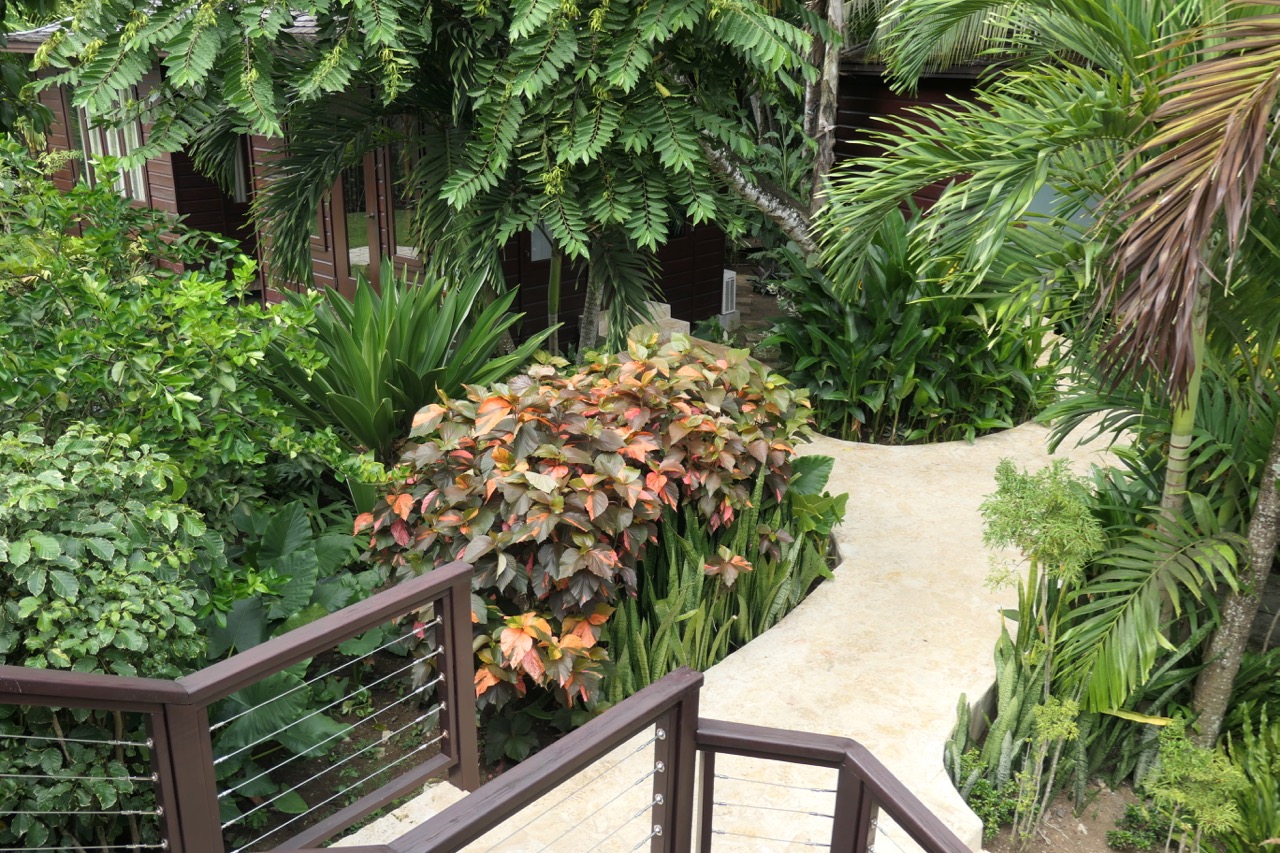
The winding paths through the resort are bordered by beautifully designed and maintained gardens and buildings.
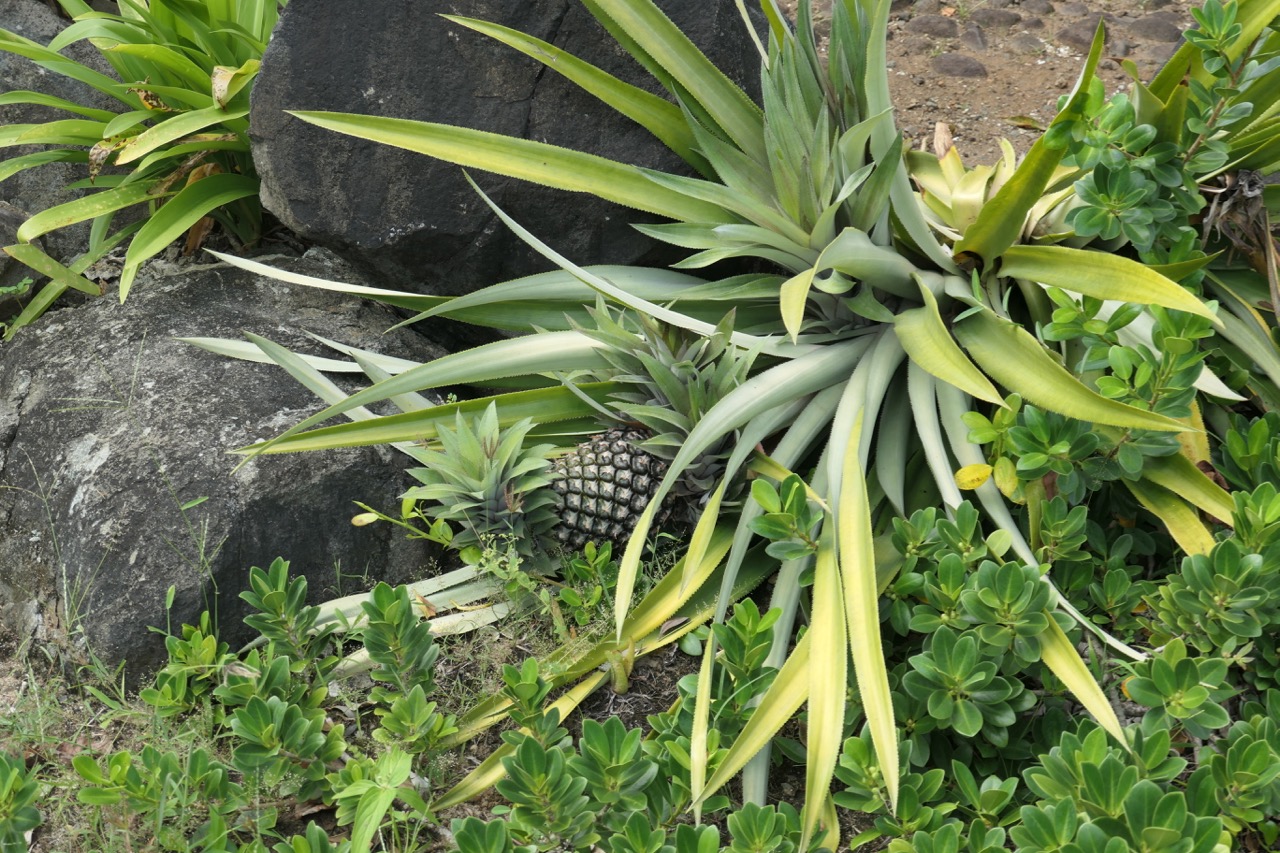
Check out this pineapple.  Marilla and Mitch – how is yours doing?
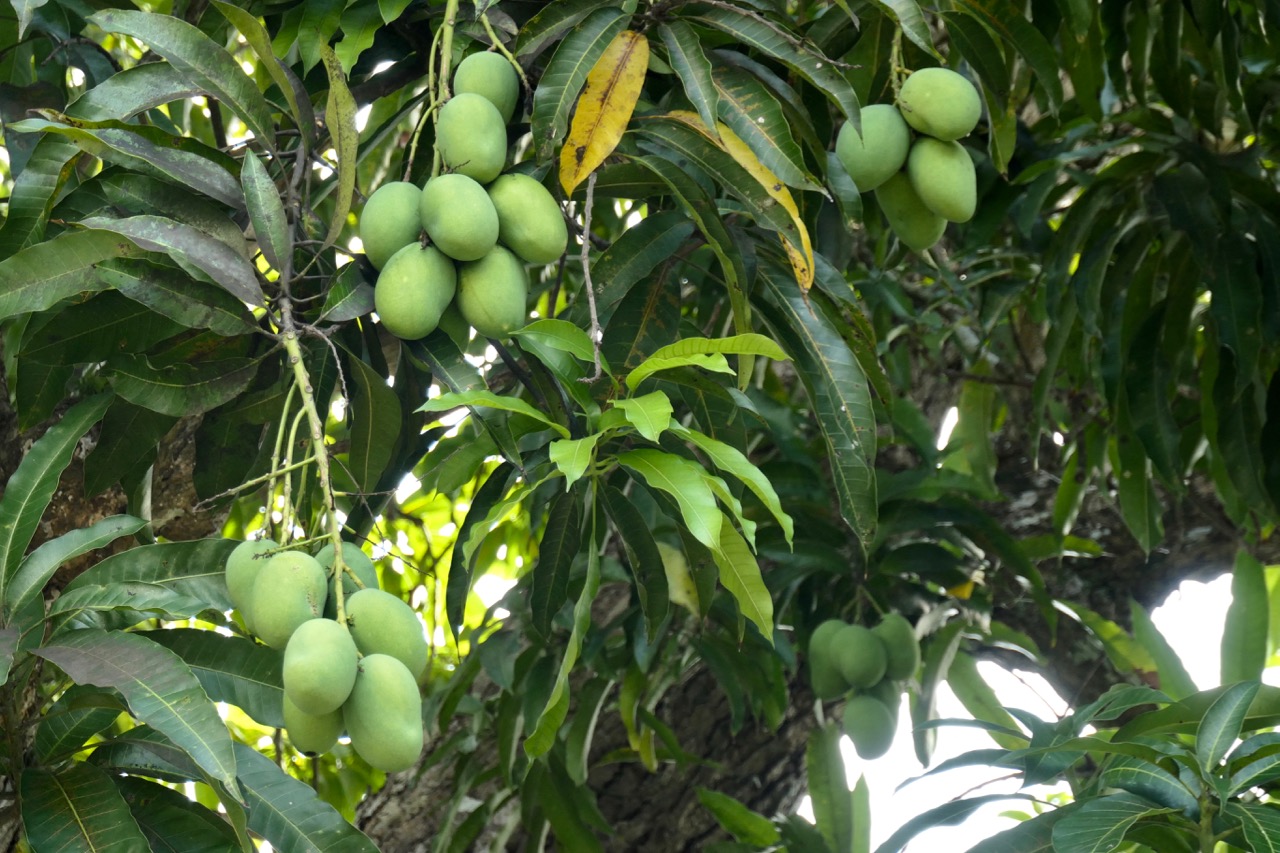
Mangos – George and I have consumed a hundred each.

Deshaies Botanical Garden, Guadeloupe

Jardin Botanique Deshaies

The Deshaies Botanical Garden sits high up on a hillside overlooking Deshaies.  We read that a free ride can be arranged to and from the garden, however when I phoned ahead to inquire about a ride and whether Duhkxy would be admitted, we were told no dogs were allowed and asked if we were looking for a taxi.  Our conversation was compromised due to our mutual shortcomings in speaking each other’s language, so we decided to walk and took along Duhkxy’s airplane carrier.
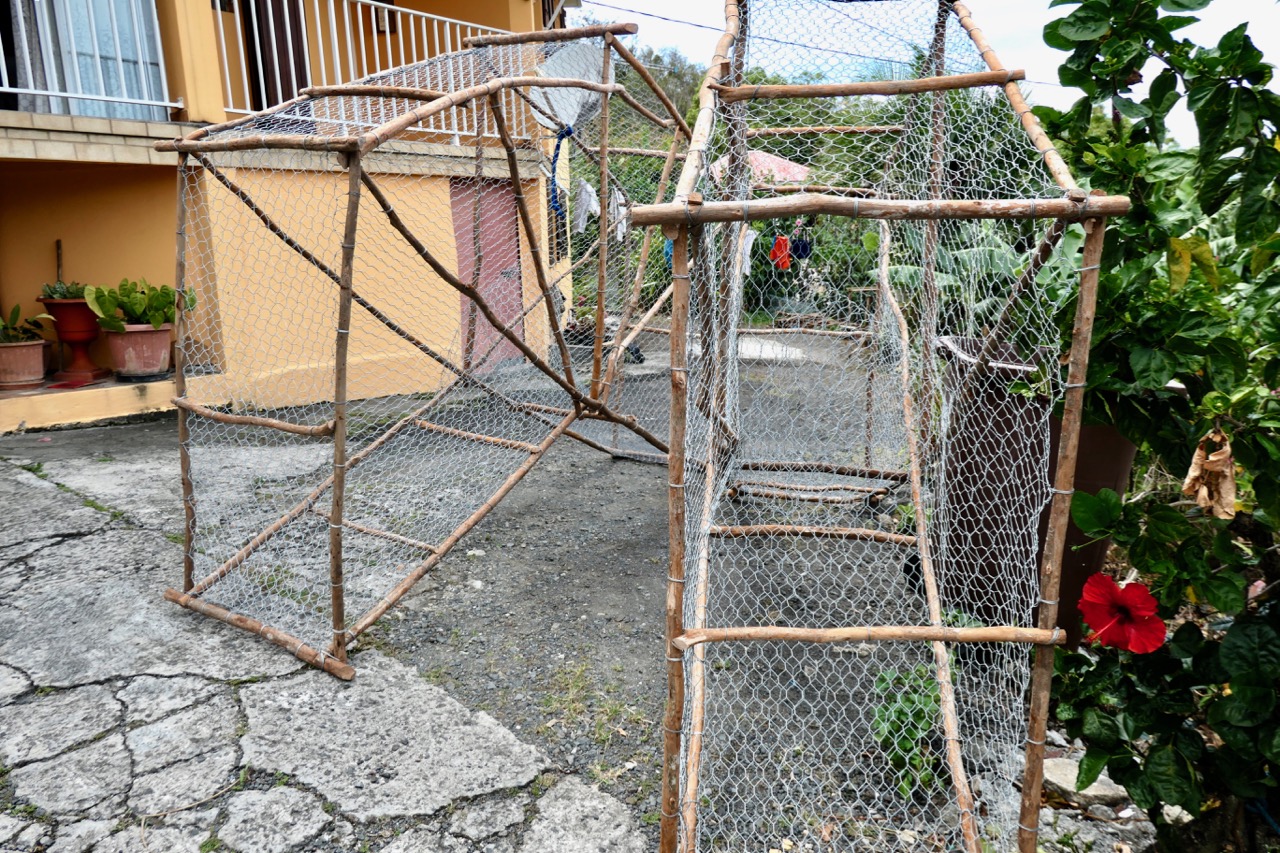
It was a steep climb to the garden, but afforded a welcome opportunity to see more of Deshaies beyond its waterfront.  In one yard, two fishing traps helped answer our questions of what was tethered below the many small floats we dodged in waters 50 to 100 feet in depth.  The floats marking underwater traps are often no more than a soda bottle – despite our best efforts we have lost two planers and several lures when trolling – always a heartbreak for their value and our unintentional contribution to the many man-made hazards to sea life in our oceans.  We hope they are retrieved by the fishermen and find their way to useful use or proper disposal.
  
Local type of fishing trap
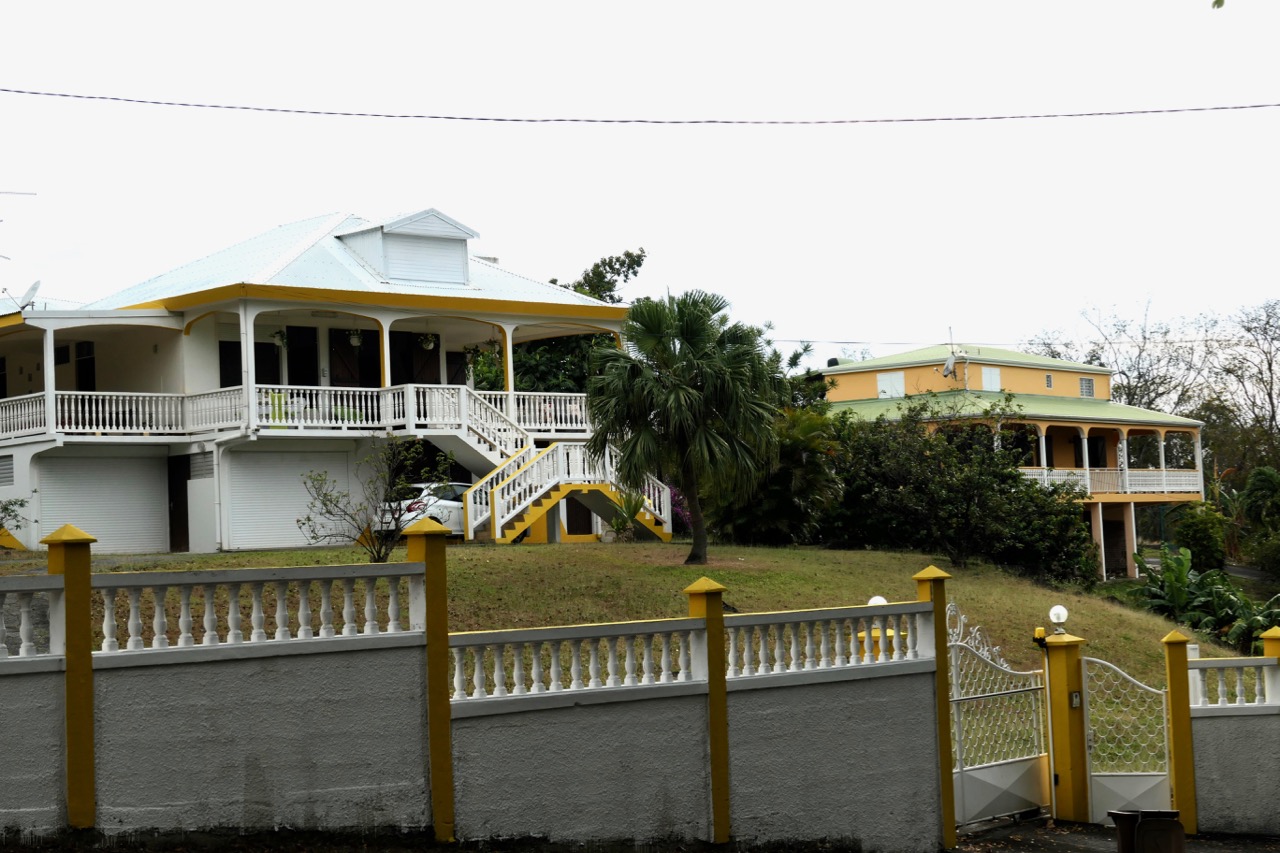
Lovely homes on road to Deshaies Botanical Gardens
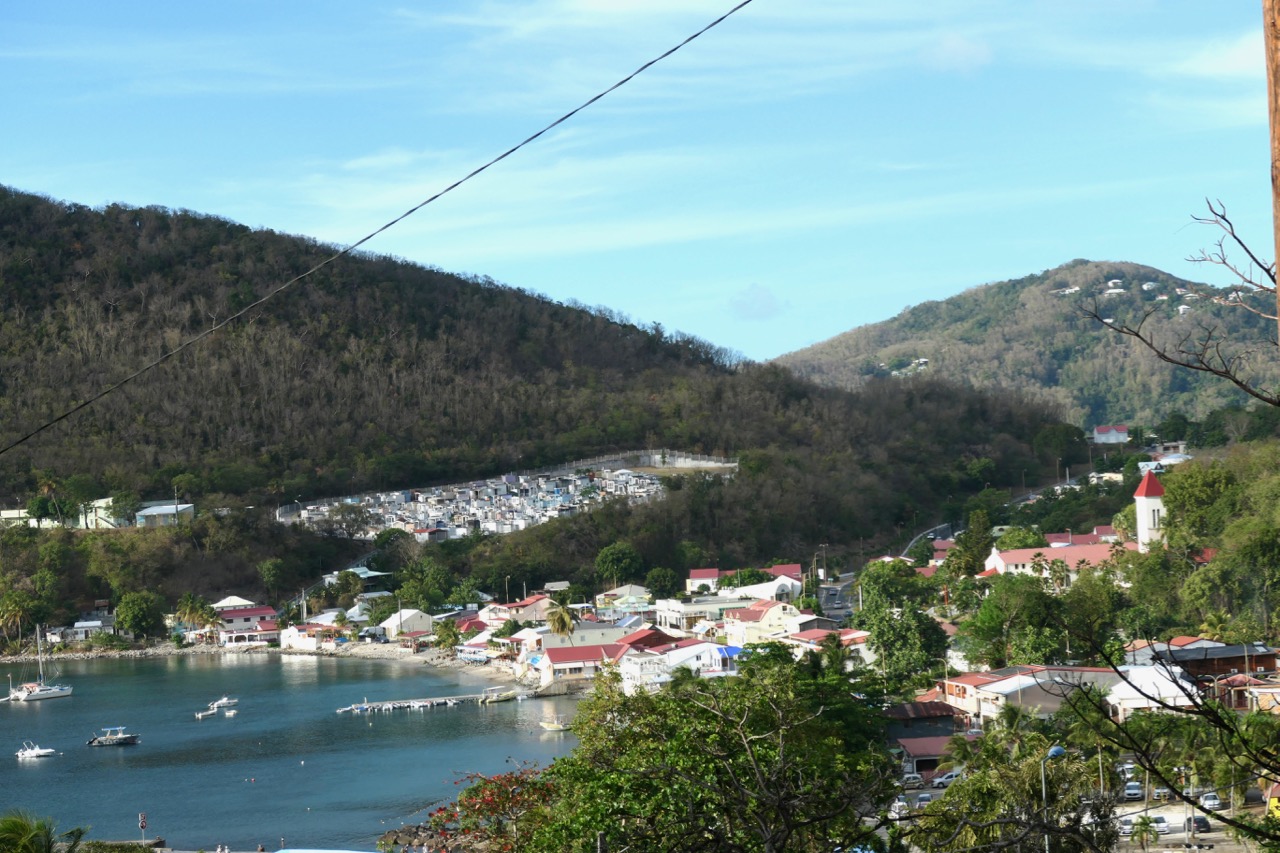
Deshaies from overlook on road leading to the Botanical Gardens (Forefront, village homes and businesses;  On hillside, beyond the town, a cemetery)
The Deshaies Botanical Garden was opened to the public in 2001.  The extraordinary beauty of the botanical garden designed by Michel Gaillard, is complemented by an infrastructure of mature indigenous and exotic trees established much earlier by previous owners of the land, Guy Blandin (until 1979), Michael Calucci (until 1986).
Upon arrival, we were told Duhkxy could not enter the botanical garden, but could remain on leash in the reception area.  We were uncertain that this would be possible as Duhkxy had routinely responded with ear-shattering and relentless yips, and hysteria whenever either George or I moved beyond 10 feet of him.  Much to our surprise, he remained calm as we handed him over to the woman at the reception area and remained so.  We found him fast asleep when we finished our tour.
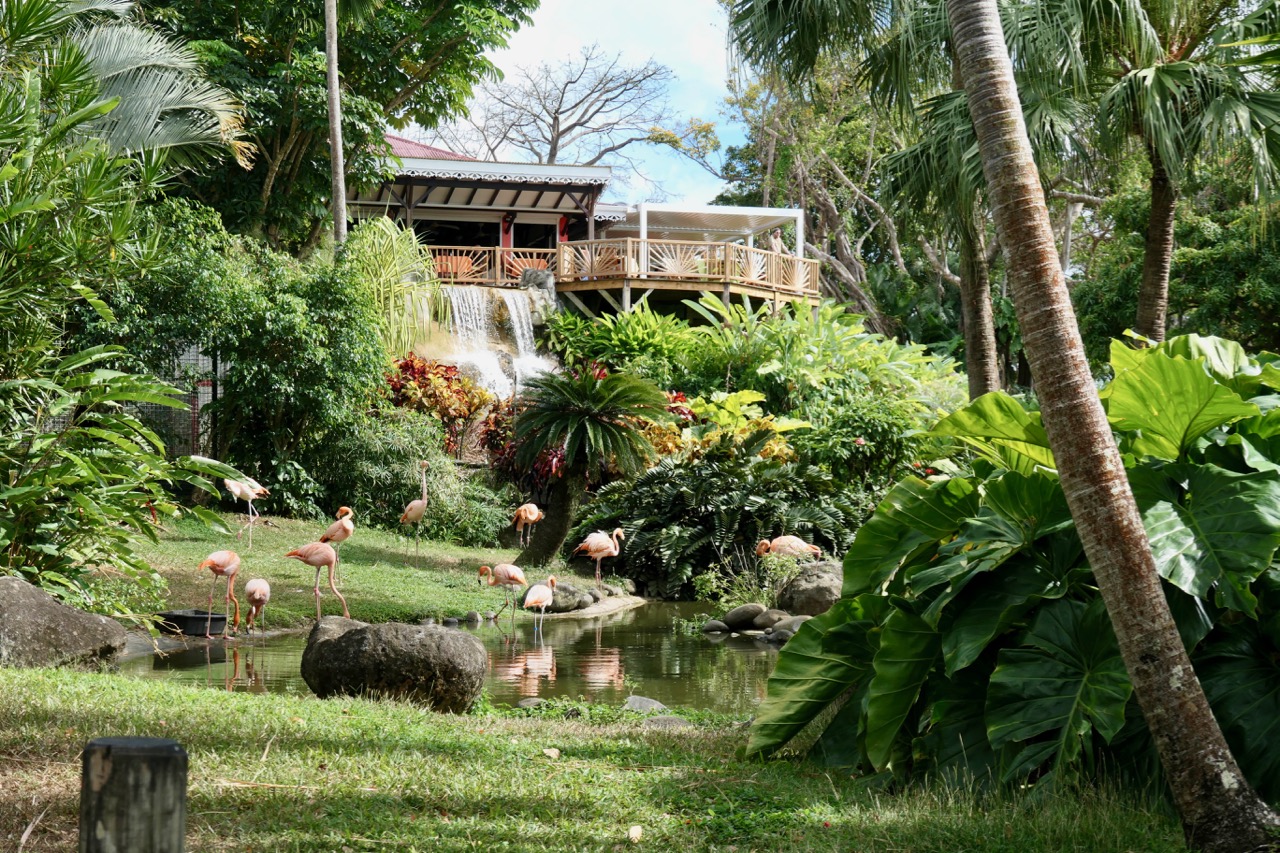
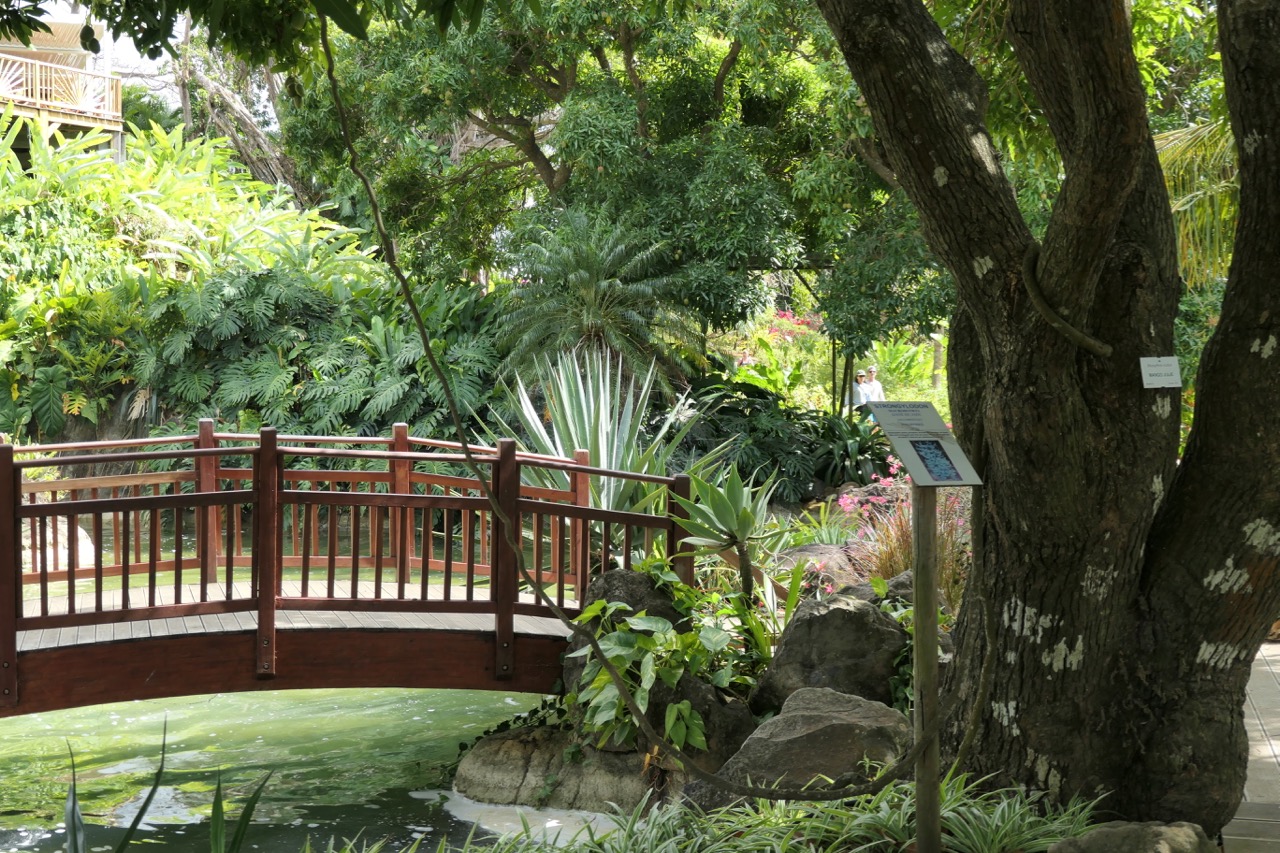
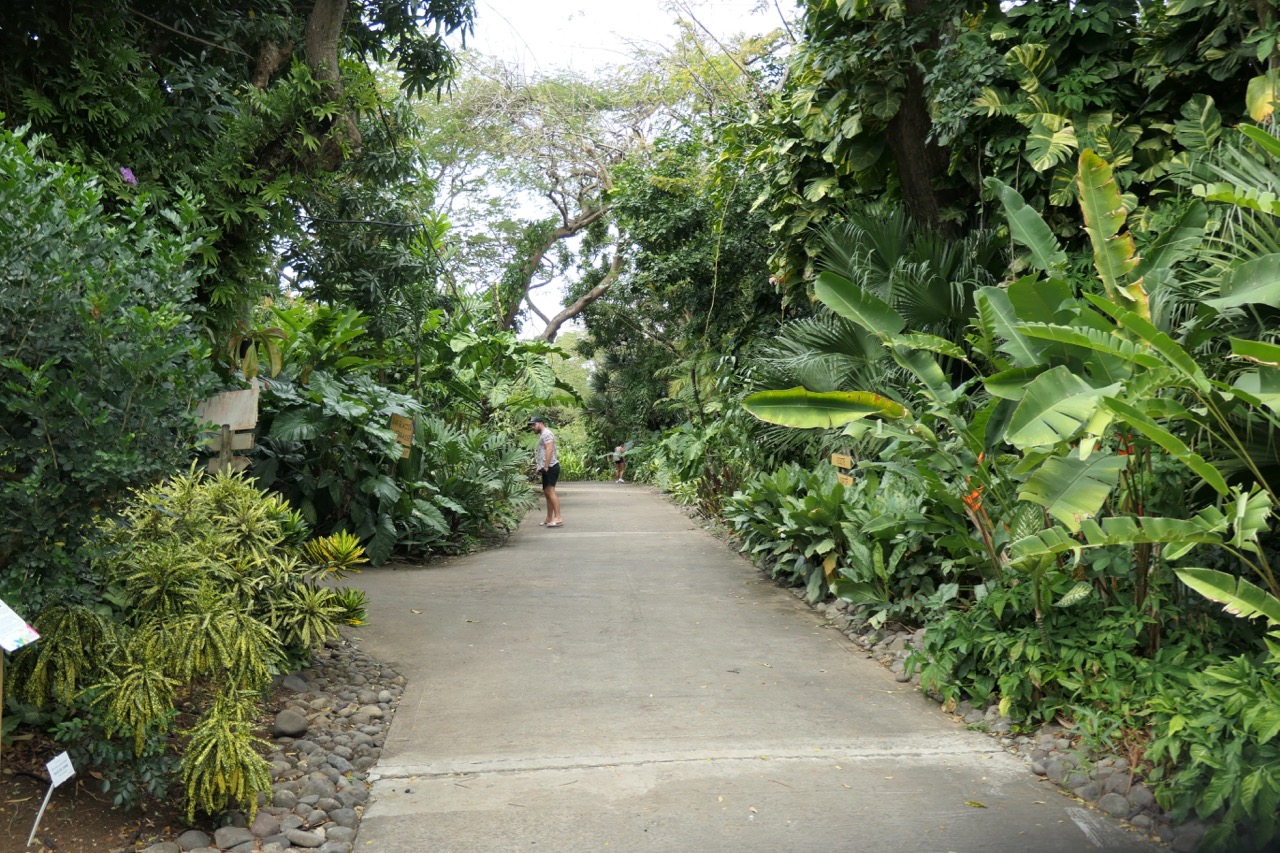
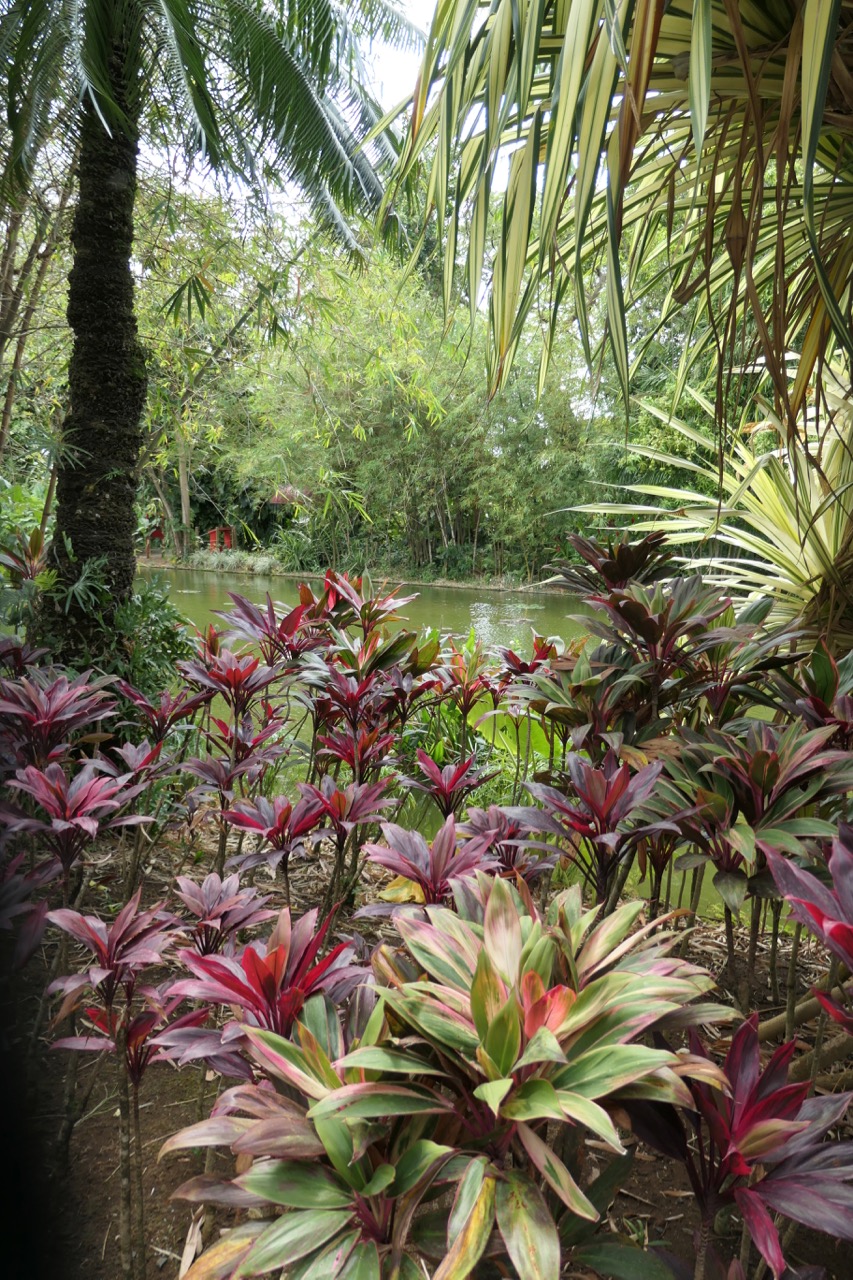
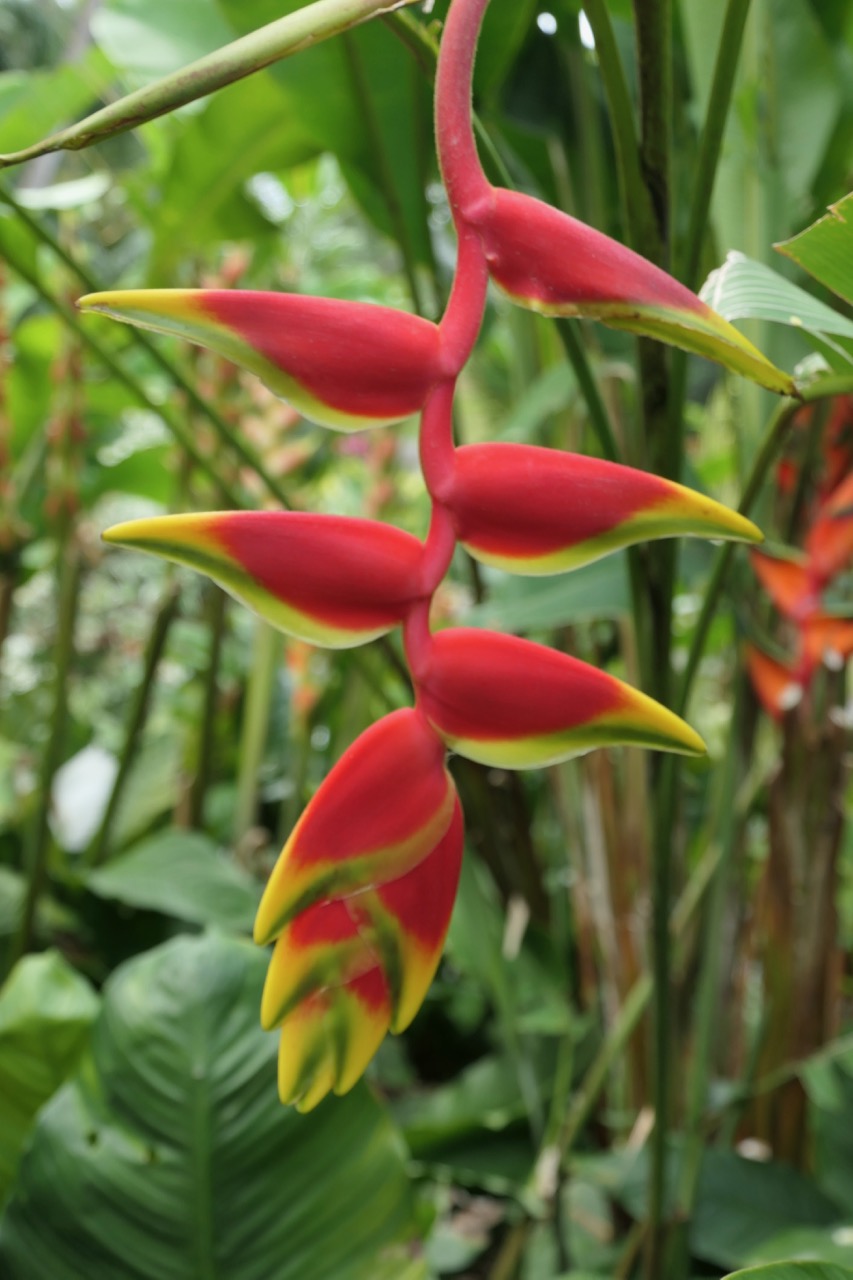
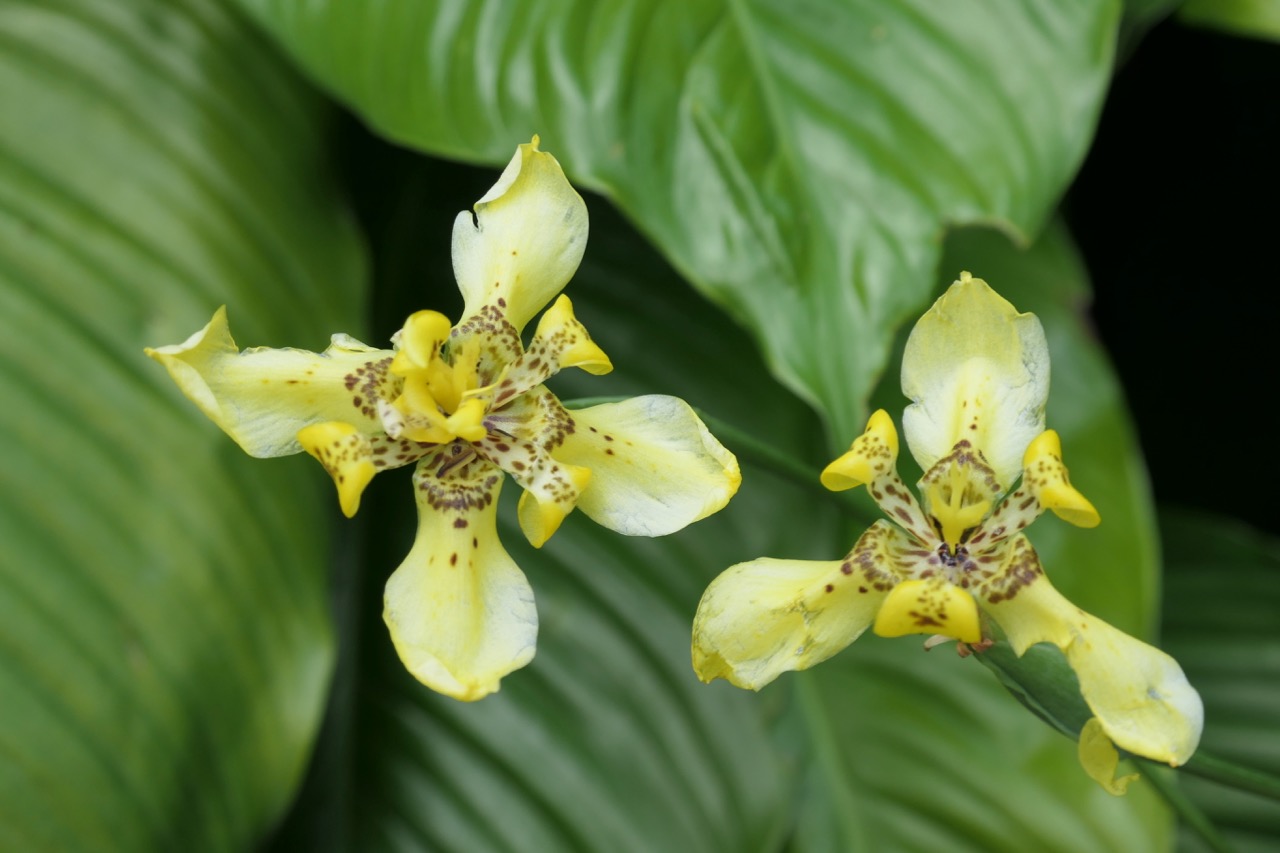
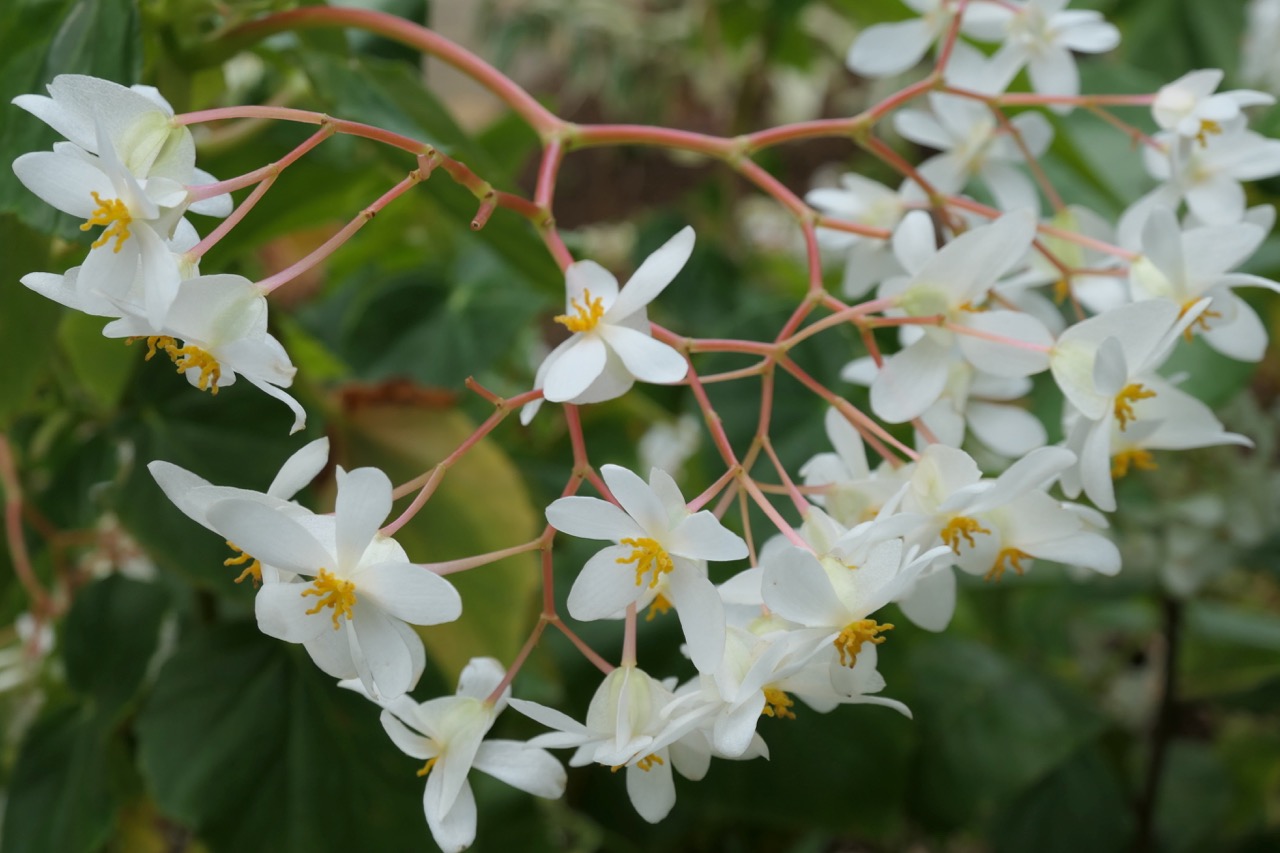
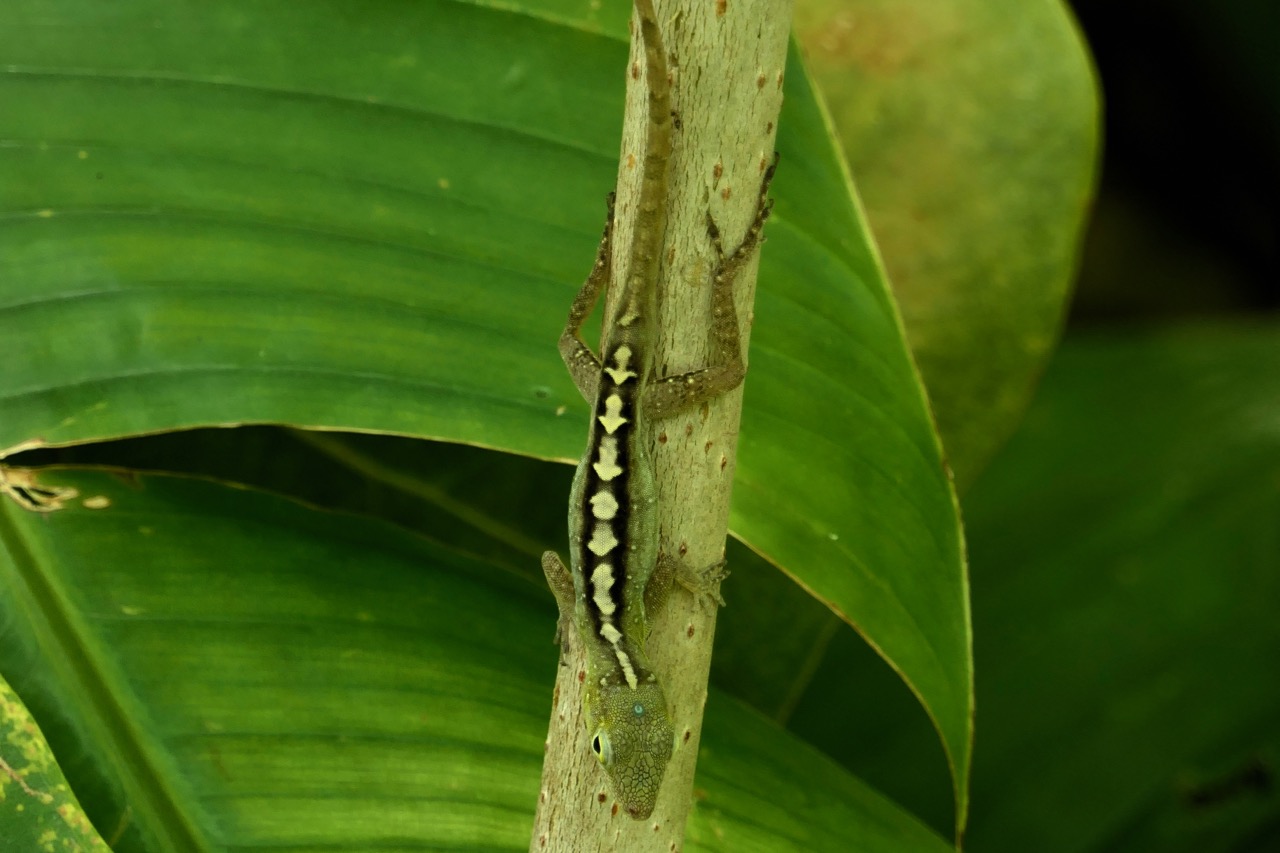
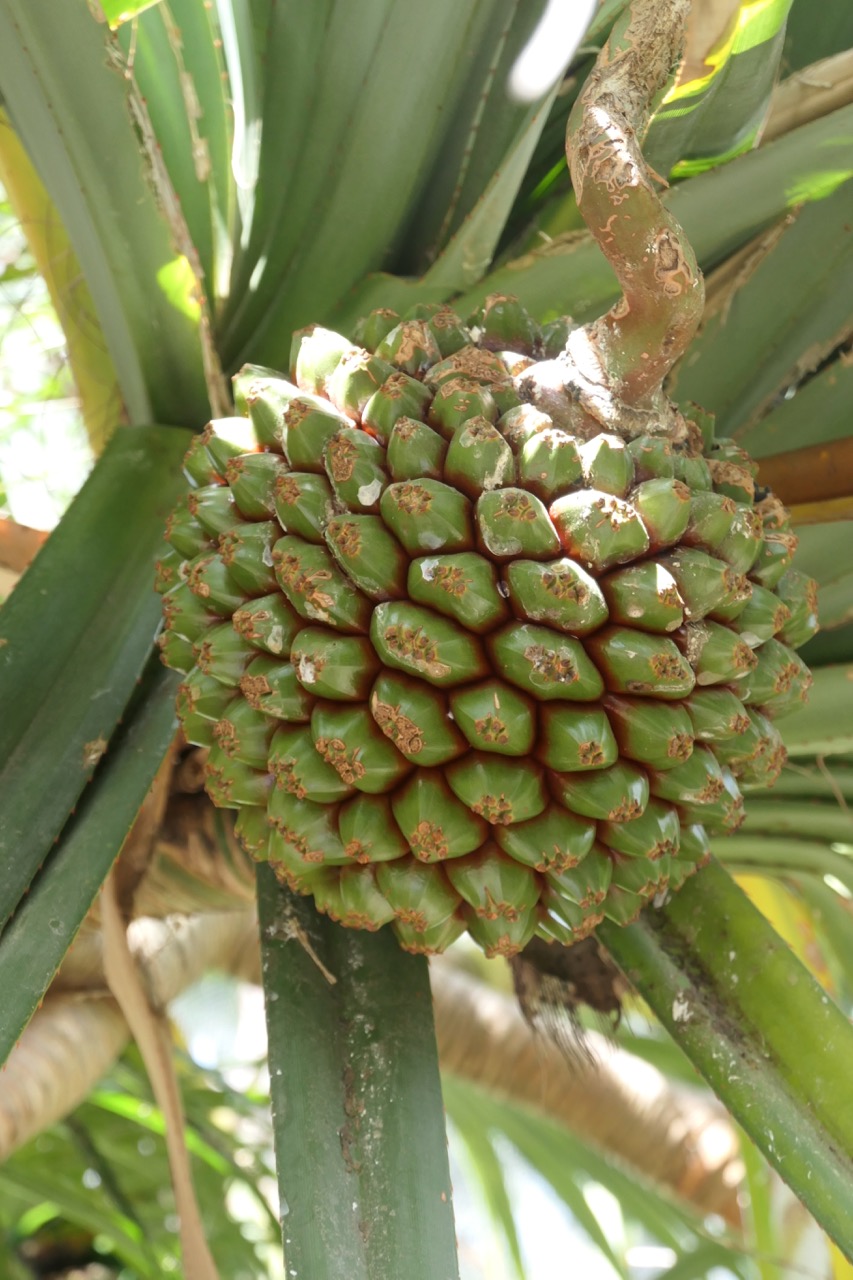
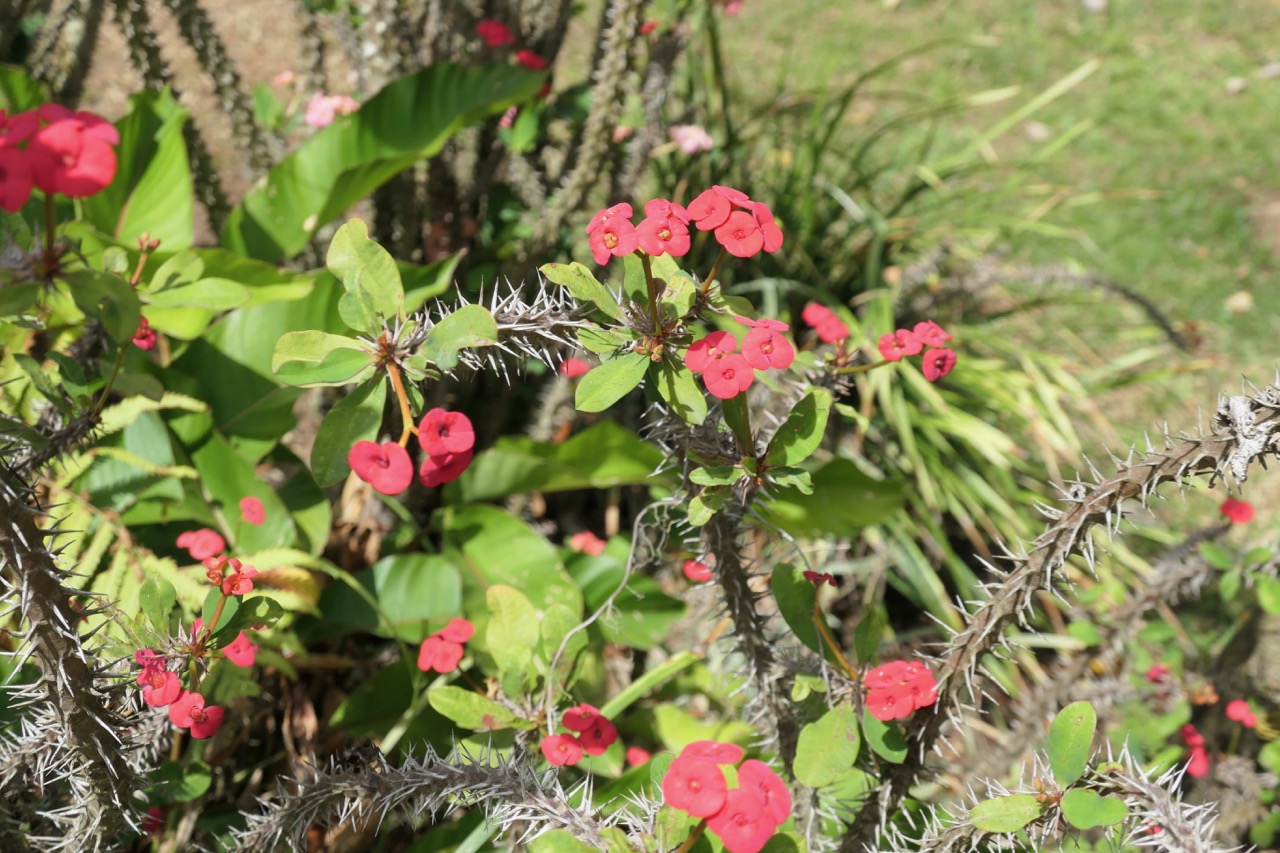
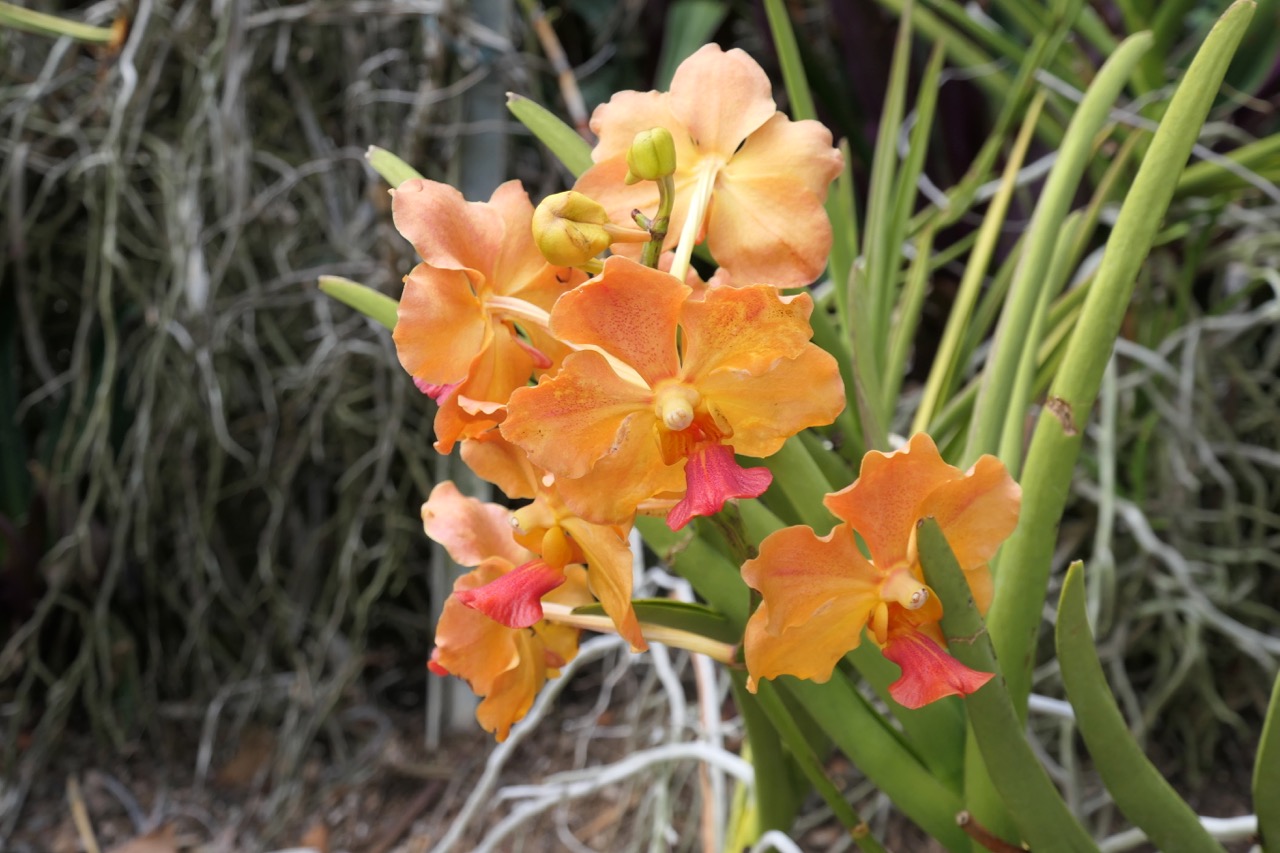
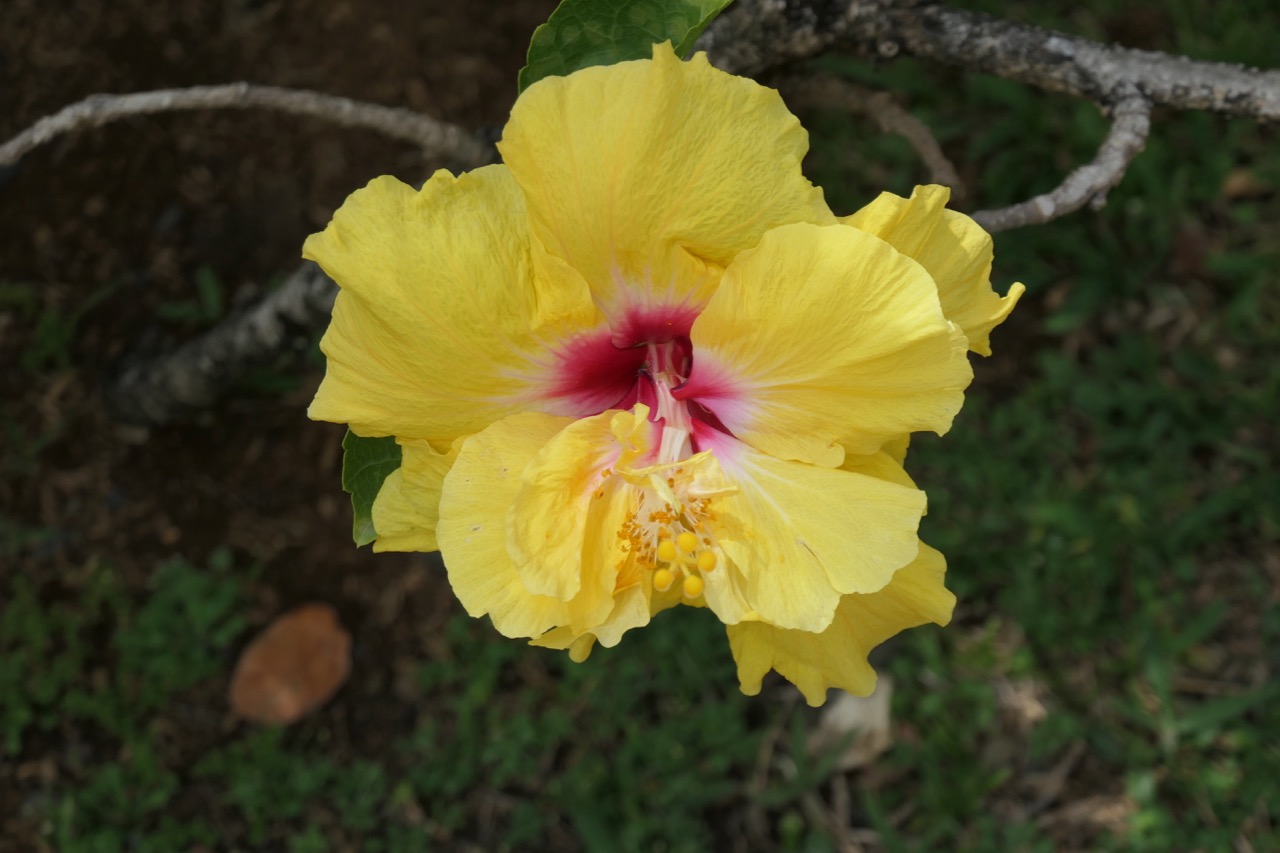
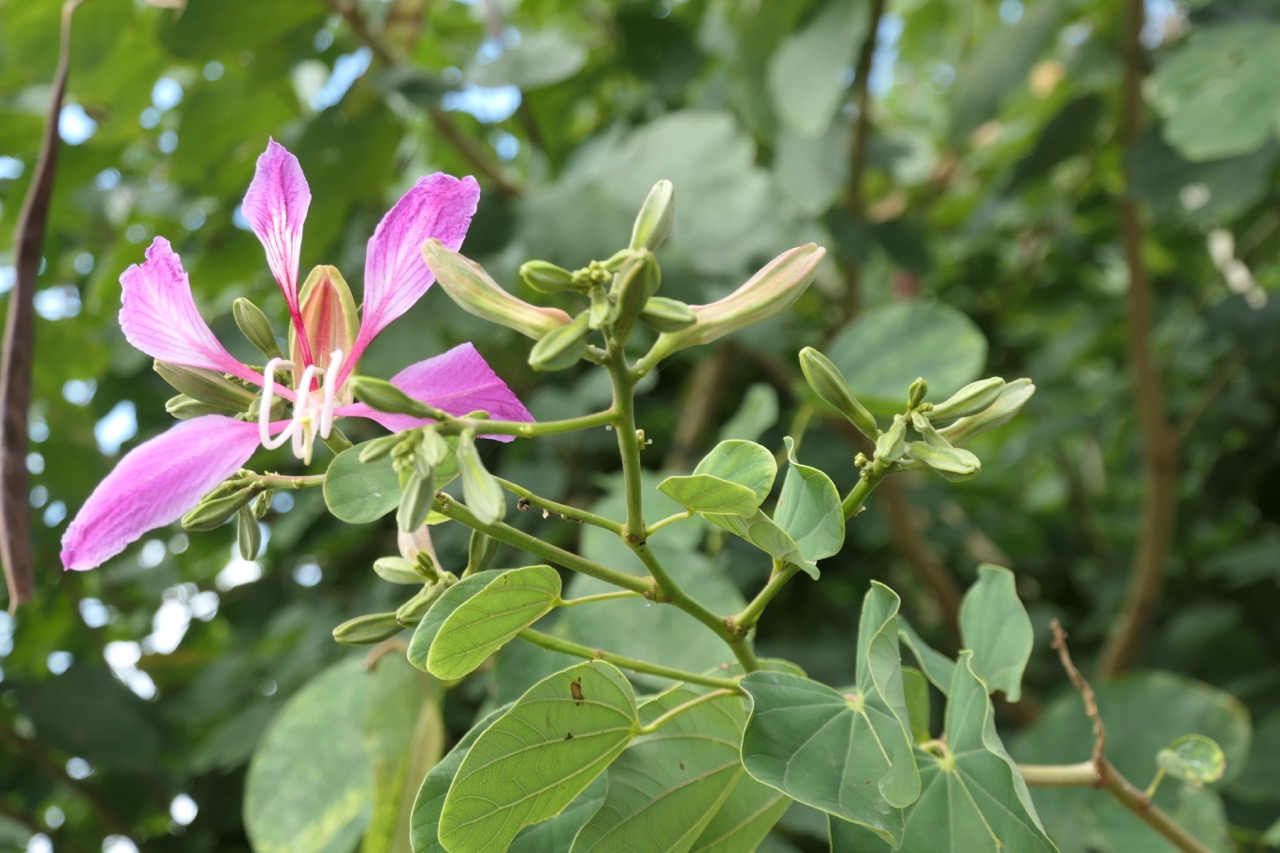
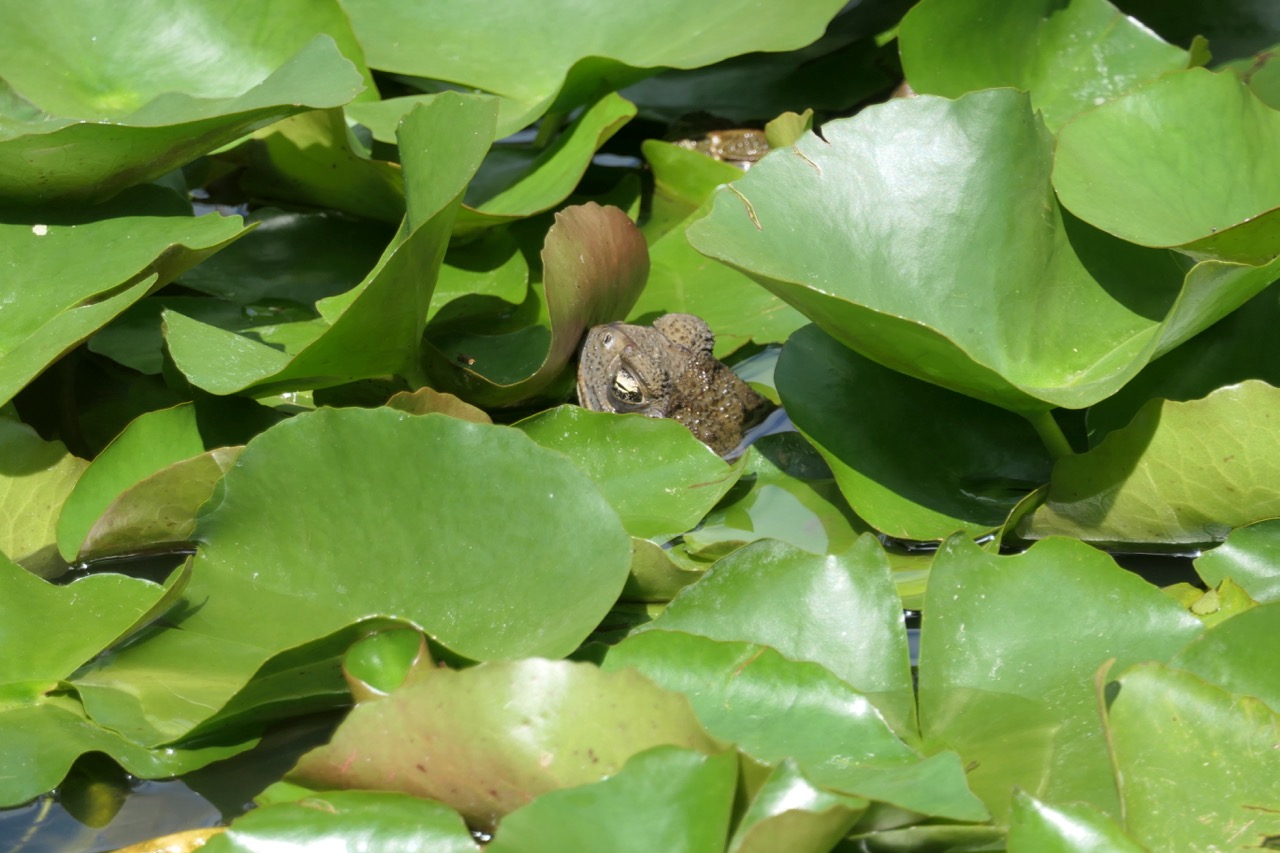
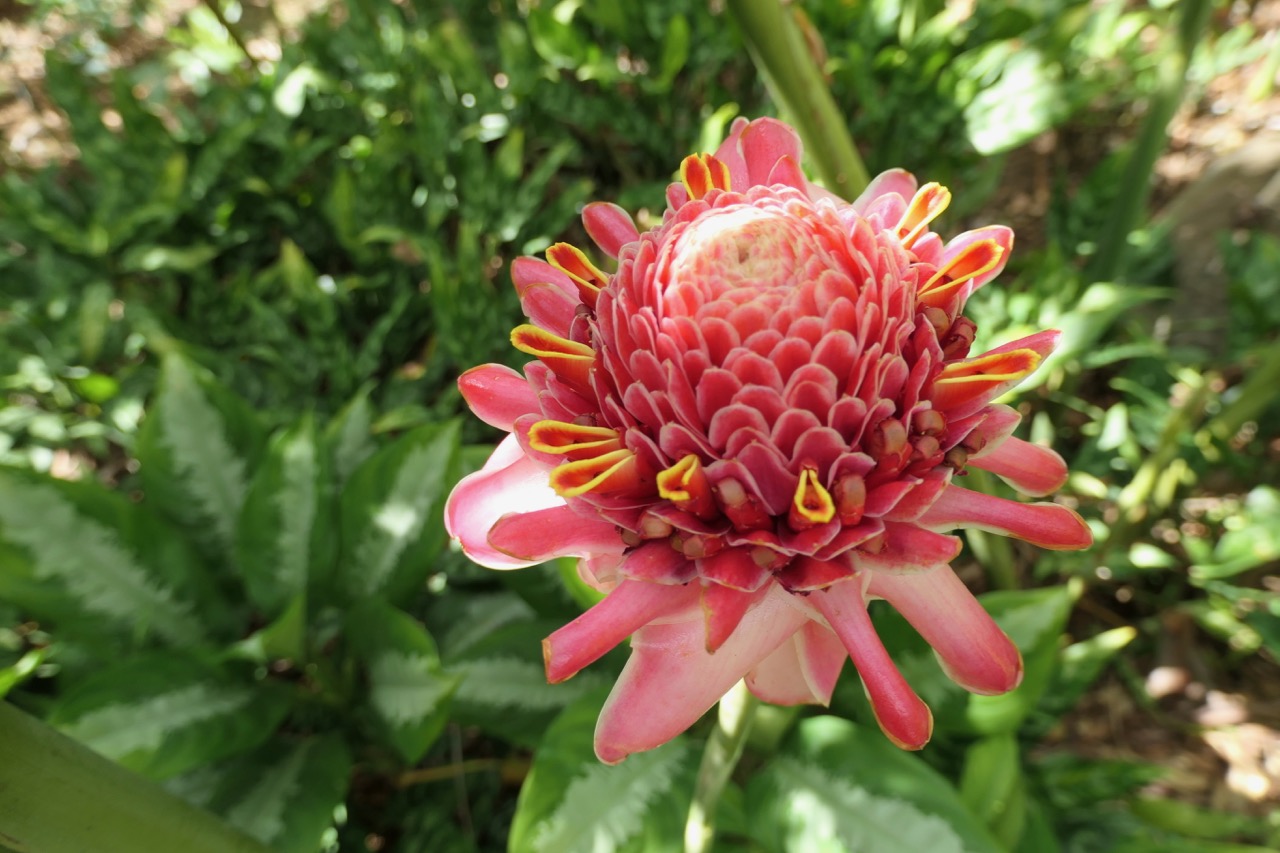
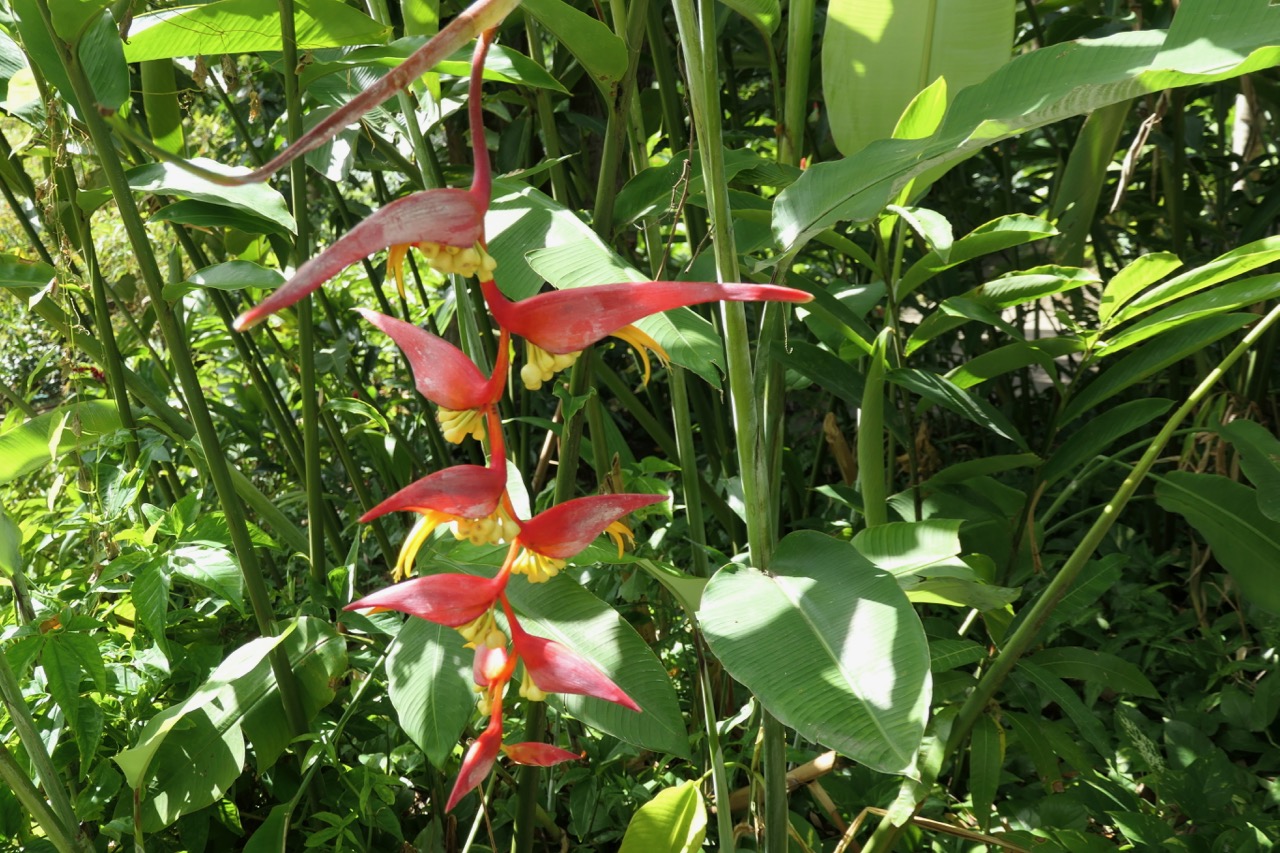
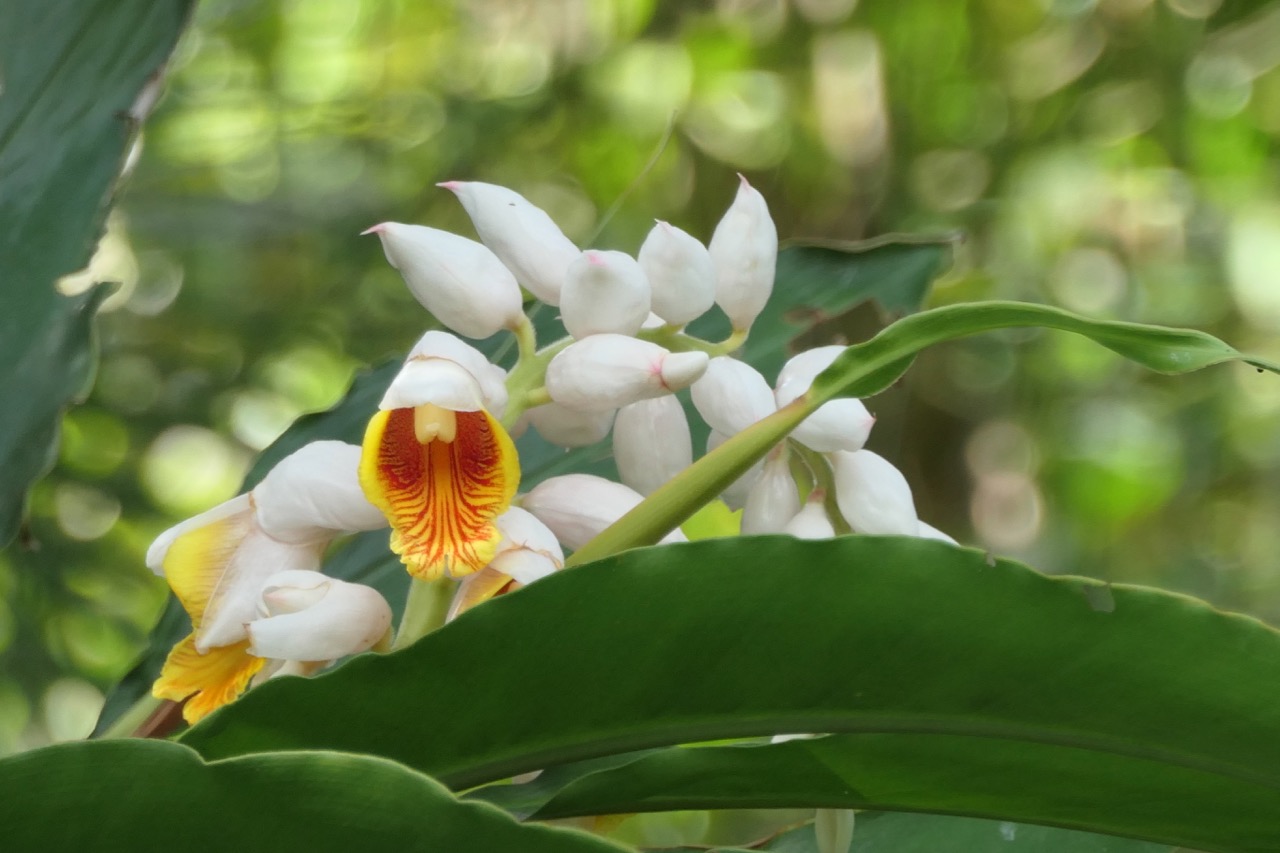
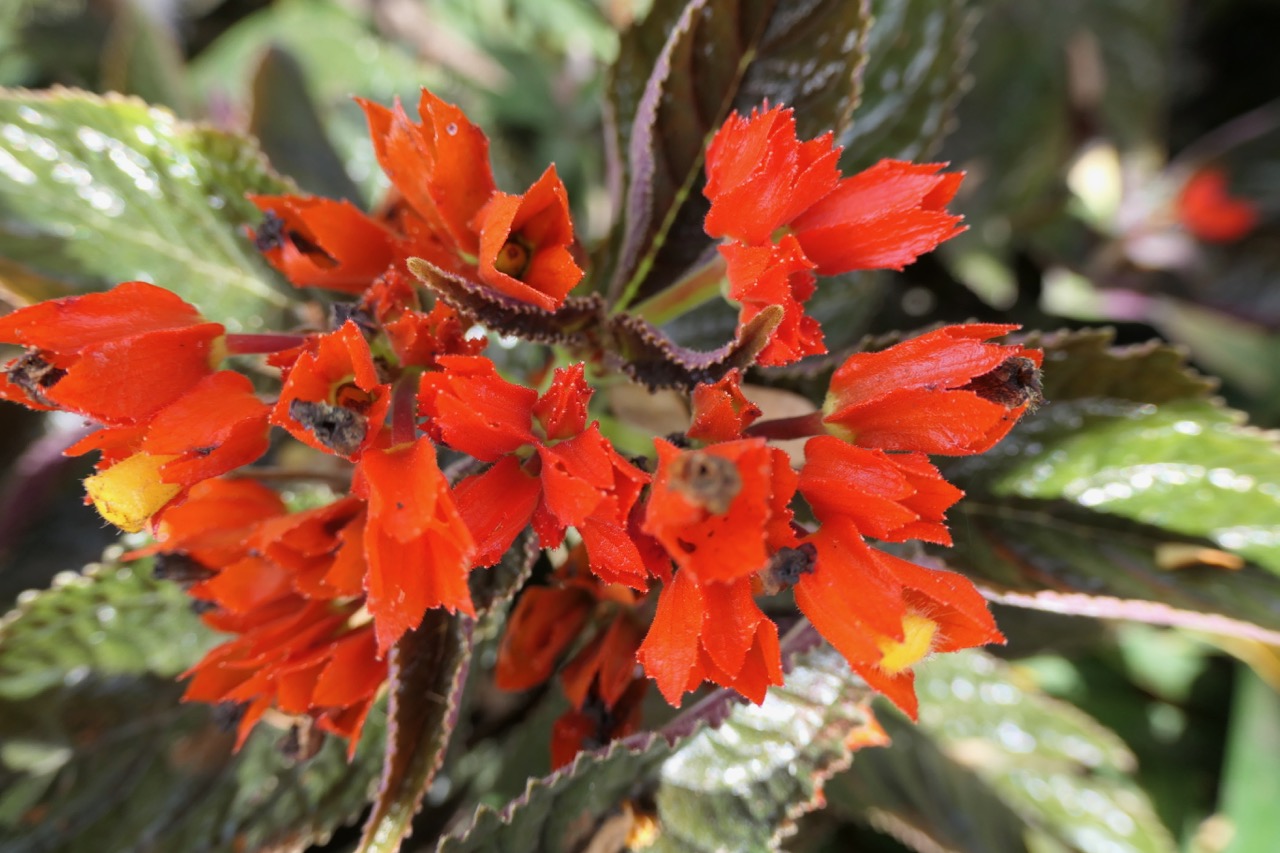
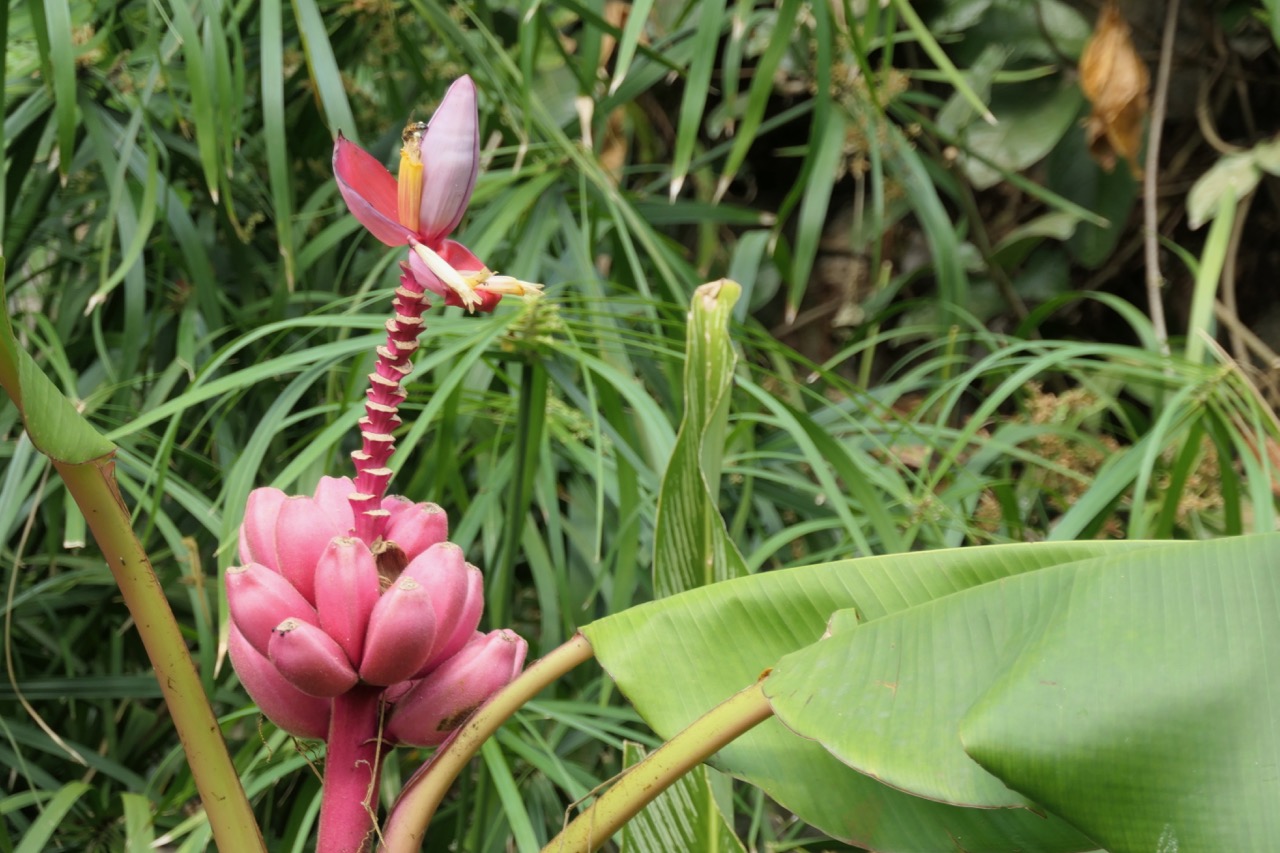
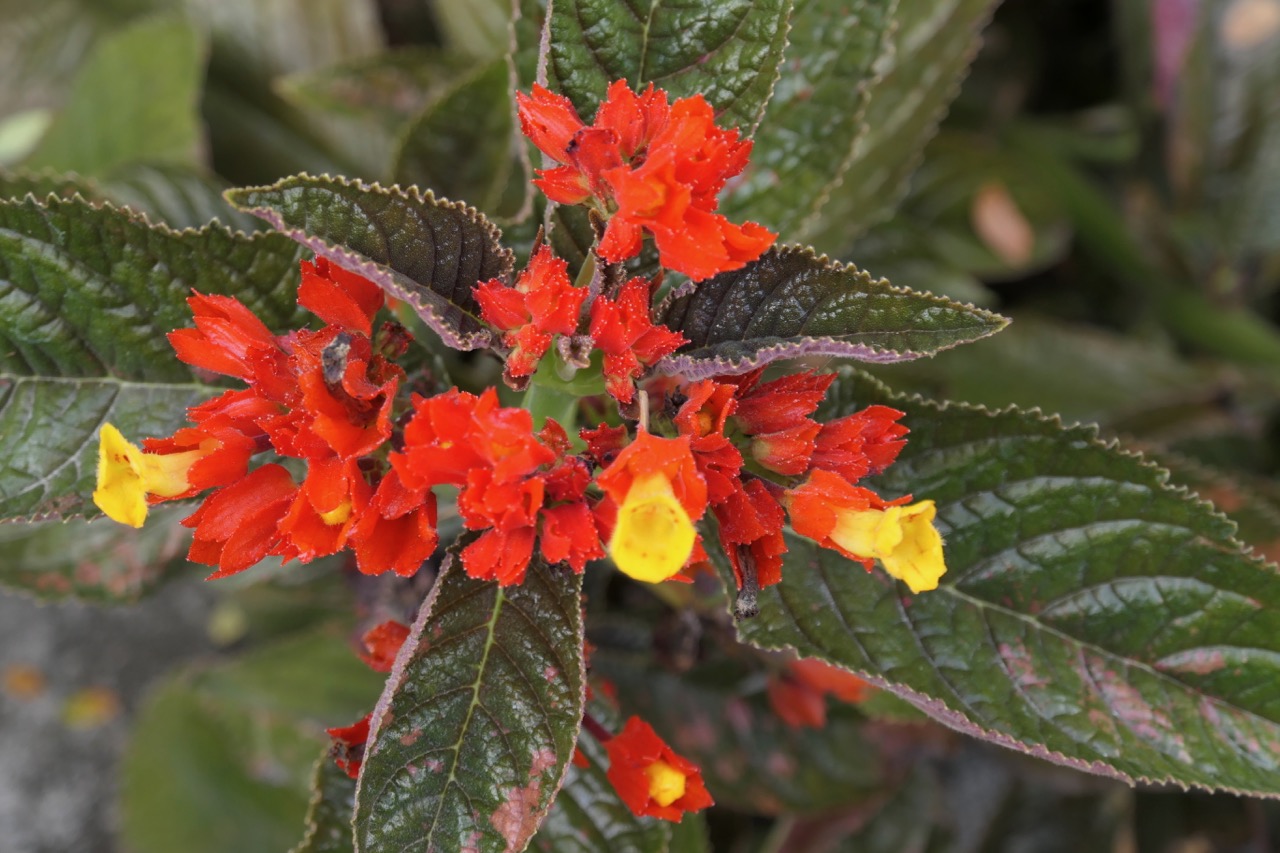
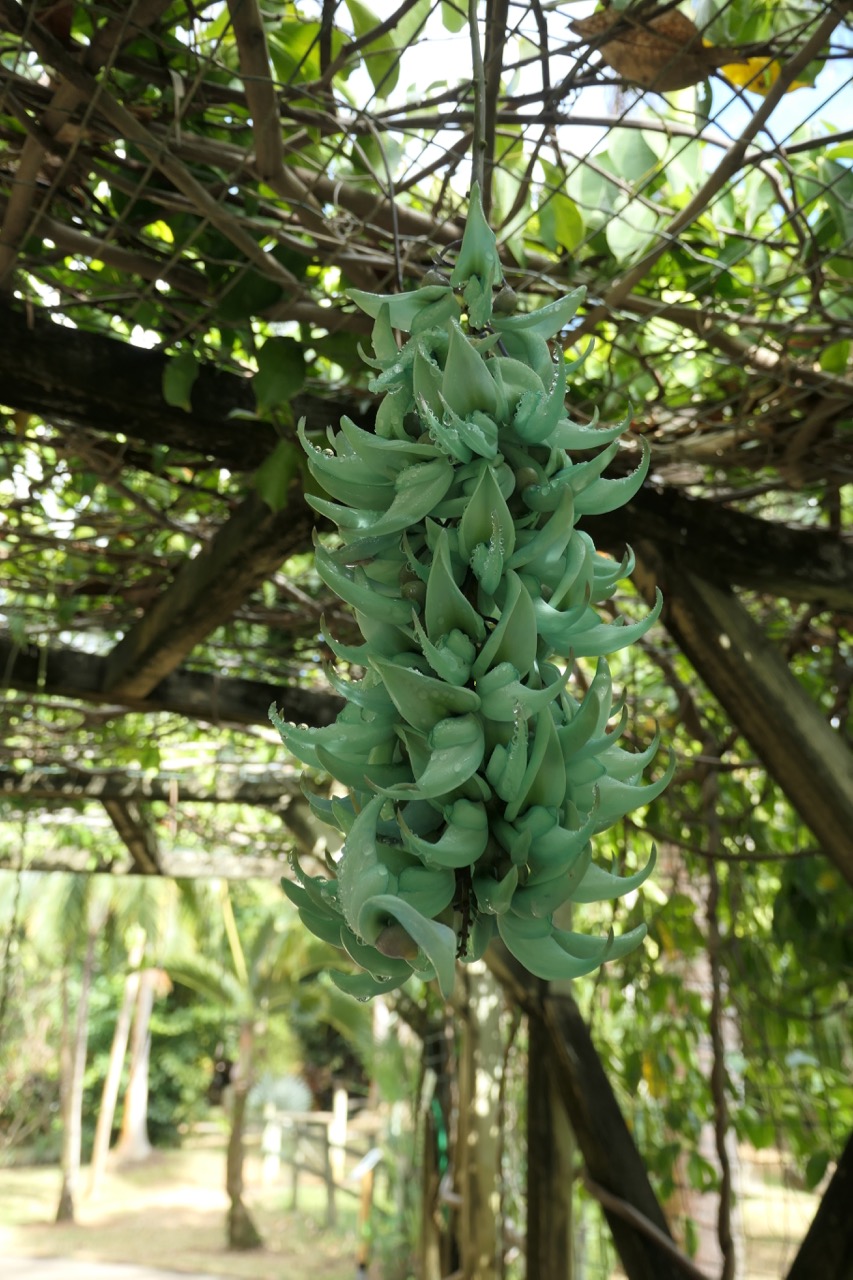
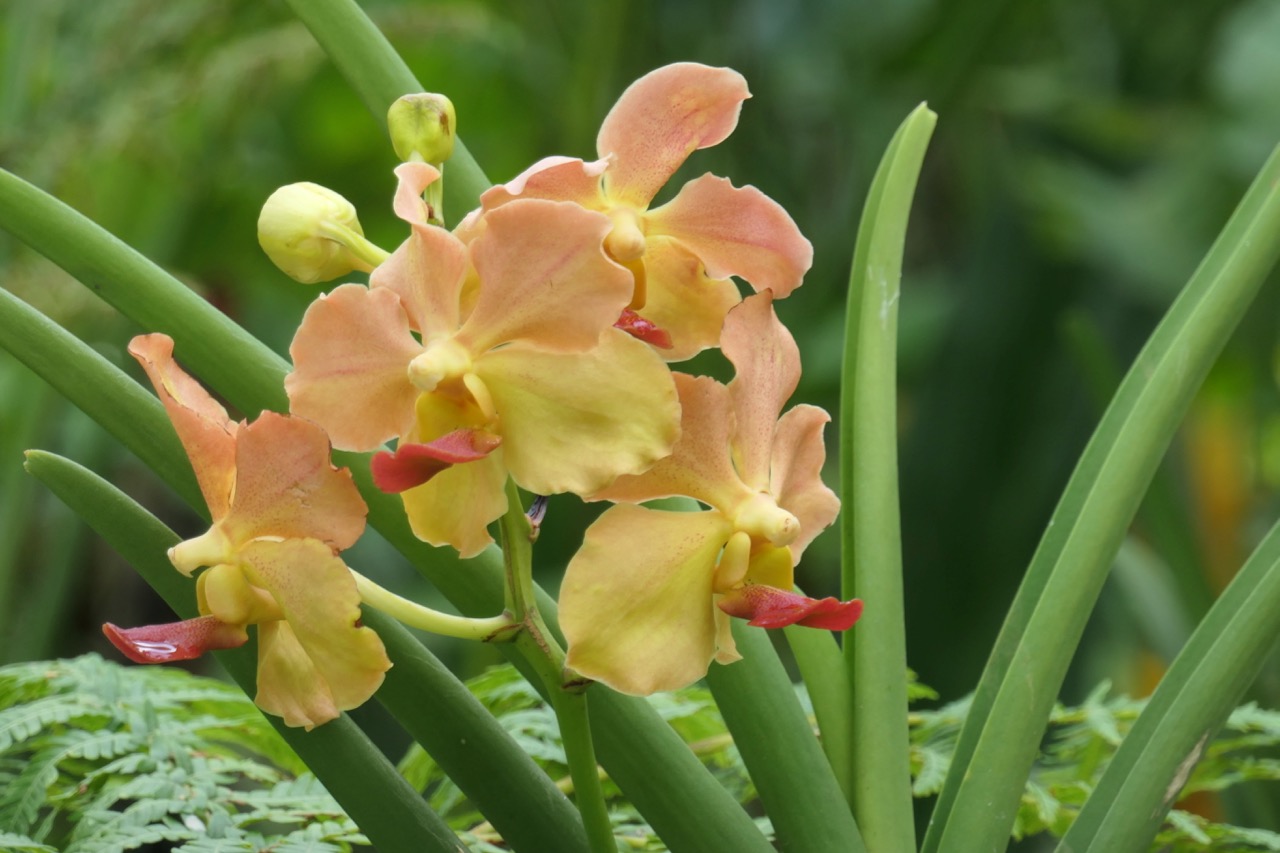
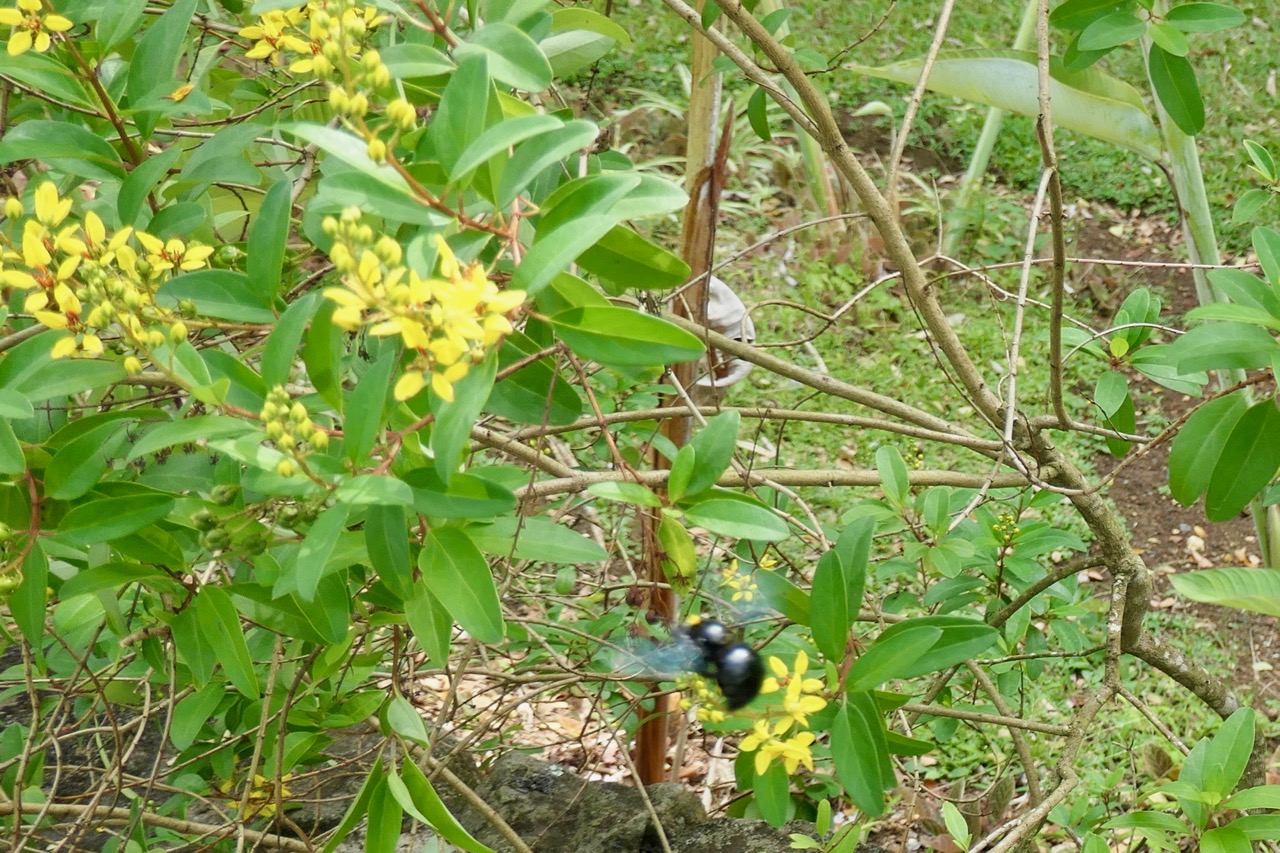
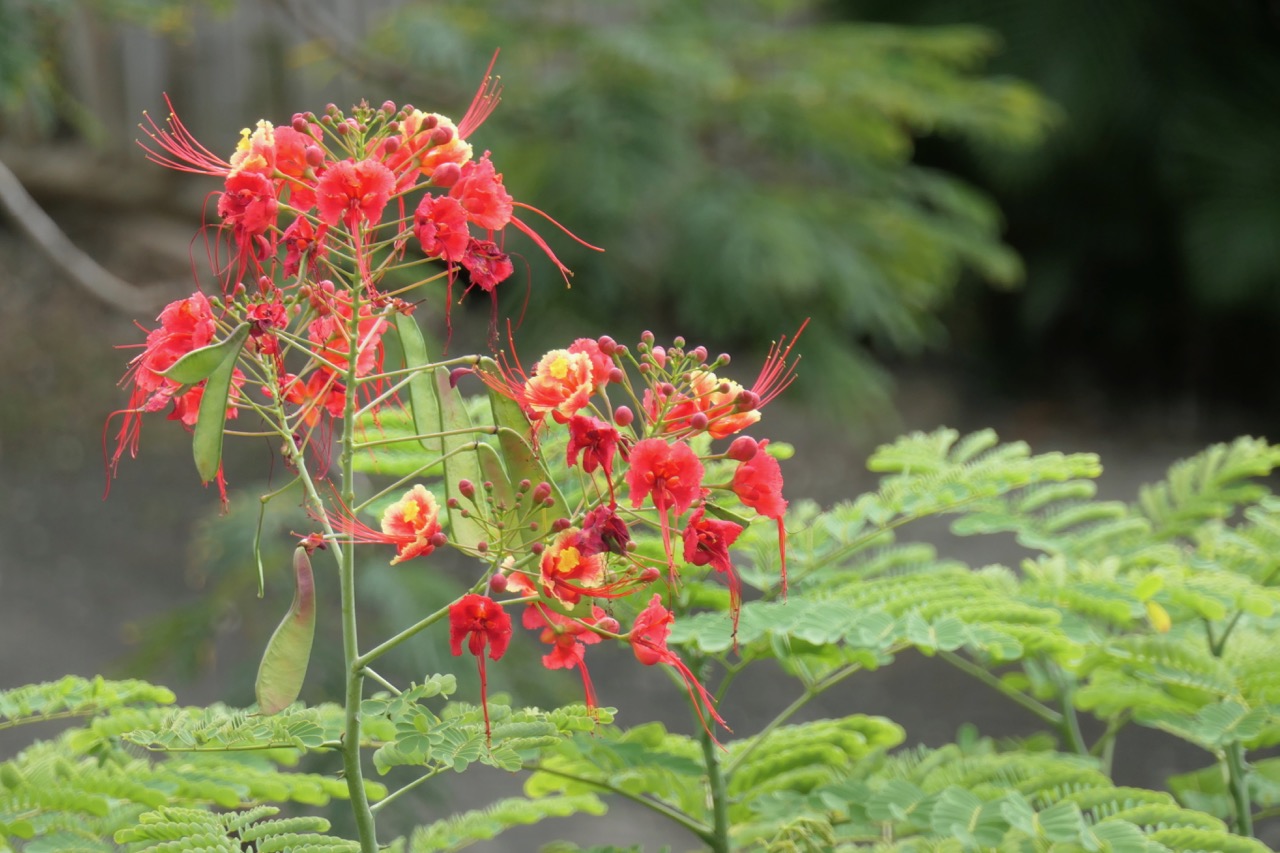
The gardens include winding paths of beautiful flower beds, water gardens, tropical birds, trees, frogs, lizards and bees….  Ending this post with pictures worth many, many, thousands of words.
Manmade waterfall above pond full of pink flamingos

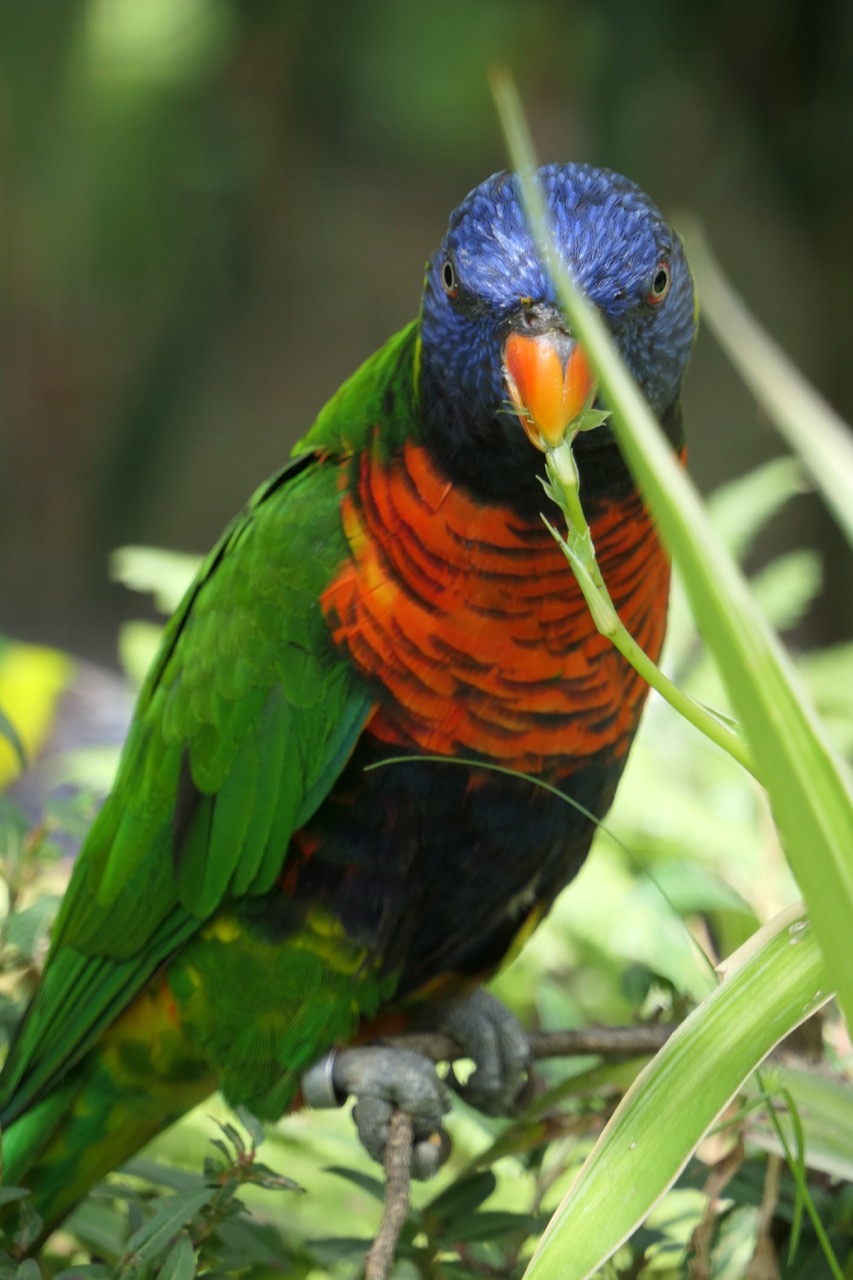
Loriquet a Tête Bleue
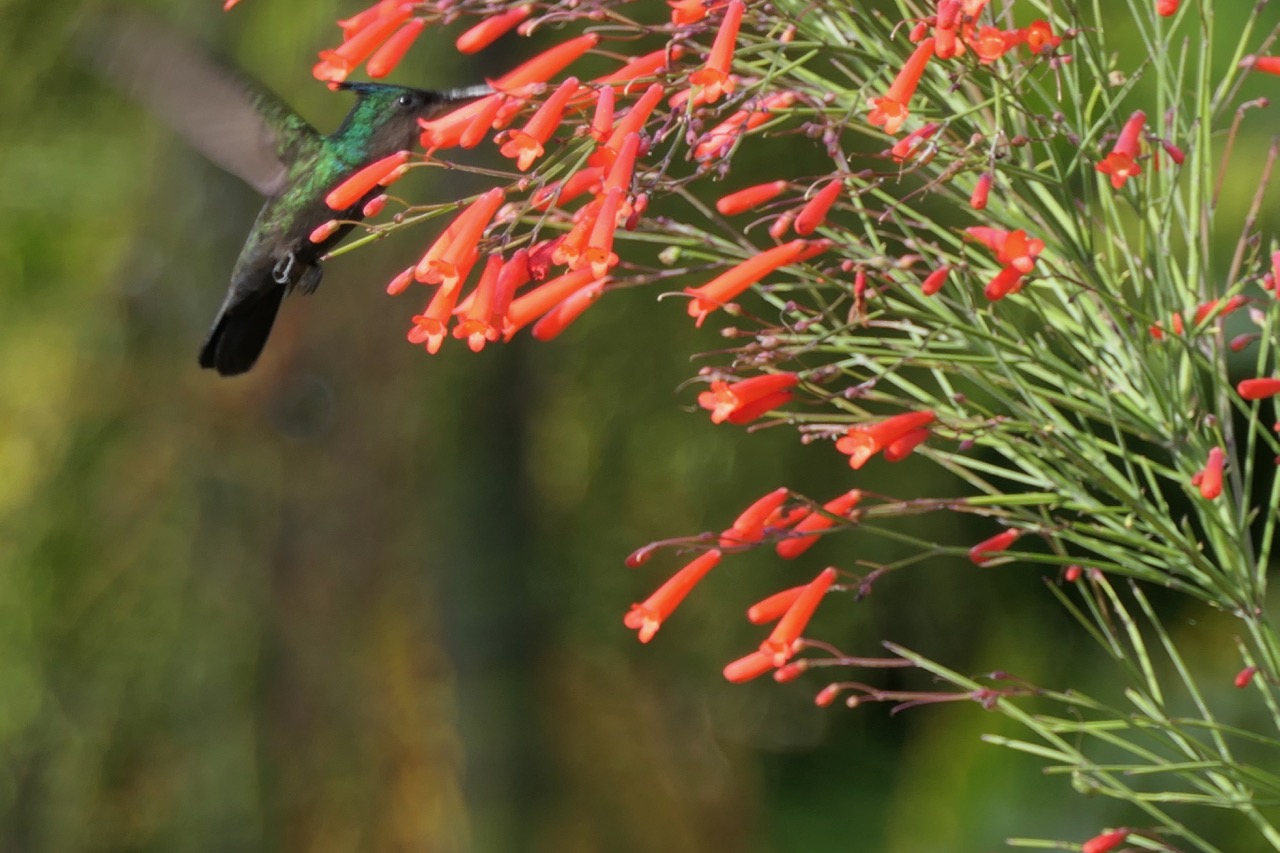
Hummingbird of unknown species

A Hike up the Deshaies River in Guadaloupe

A bit of fun on the Deshaies River in Guadeloupe

The Deshaies River hike is described in Doyle’s Cruising Guide as a “one to two hour”…, “cool and shady scramble”… ”  The trail was said to end about 20 minutes after a road intersects the trail on the left at “a giant cave-like gully, with a waterfall at the back of it”.  It is noteworthy that he acknowledges that “Several readers have complained that this hike is difficult” although at the same time he challenges this assessment with a comment “on the other hand, a five year old hiked here for two hours without any problem”.

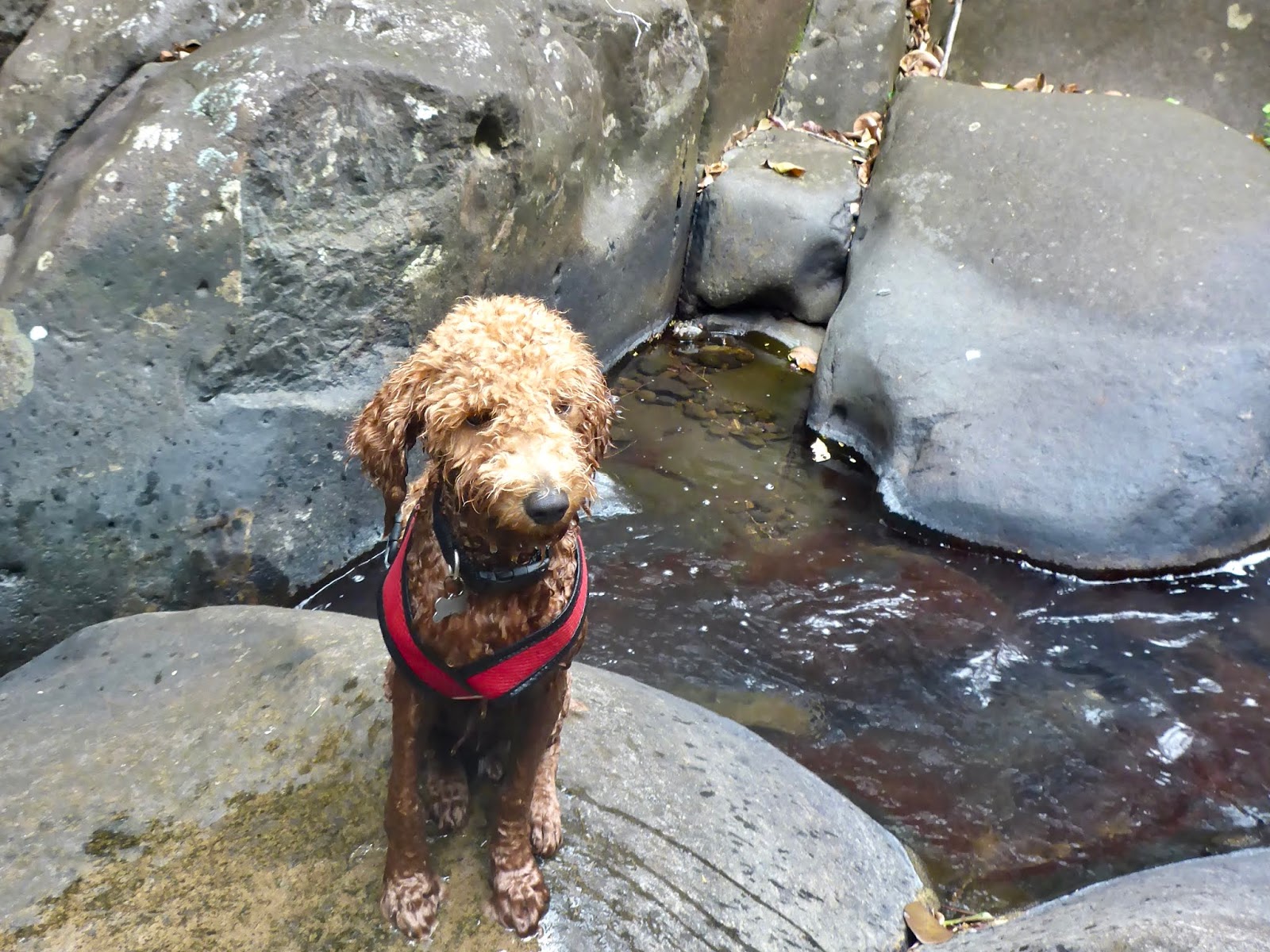
Let me start by concluding that we enjoyed the hike very much.  It was indeed shady, and we scrambled up and down many, many, many boulders, but we were decidedly not “cool”.  I venture we sweat a half gallon each.  There is considerable overall elevation to the hike as the river flows from the top of a small mountain (large hill just doesn’t quite describe it).  We found it to be a very strenuous hike and Duhkxy agreed!!!

Bring lots of water, shoes that can get wet, strong legs, and some degree of balance (I am decidedly not strong in that regard and managed the trail without falling – YAY!).

The trees and plants were beautiful and often distinctly adapted to their environment. 

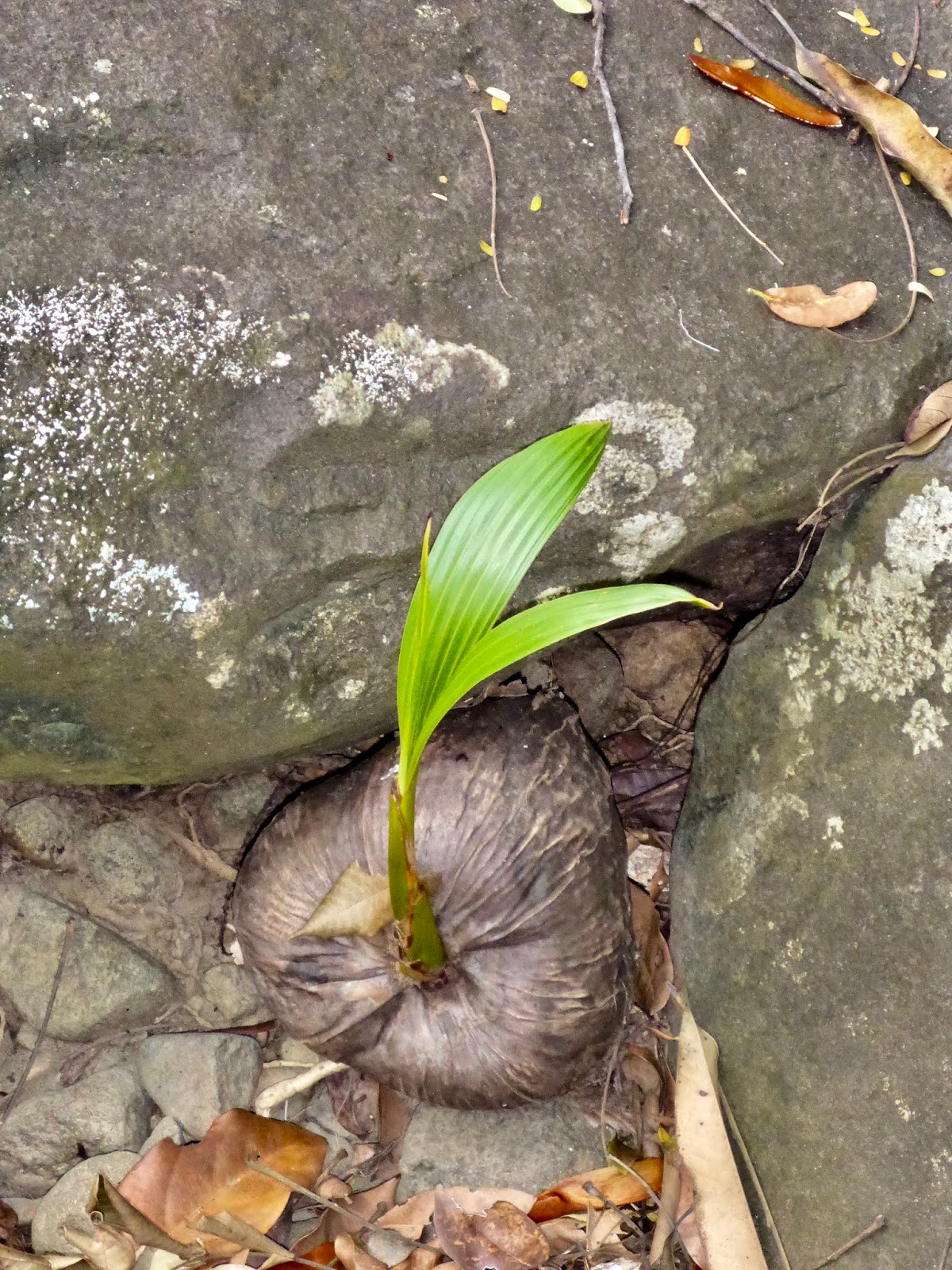
We were surprised to see palm trees growing in this dense forest – having associated them in our minds as the lovely trees lining beautiful salt water beaches.

Coconut palms getting their starts in unlikely places
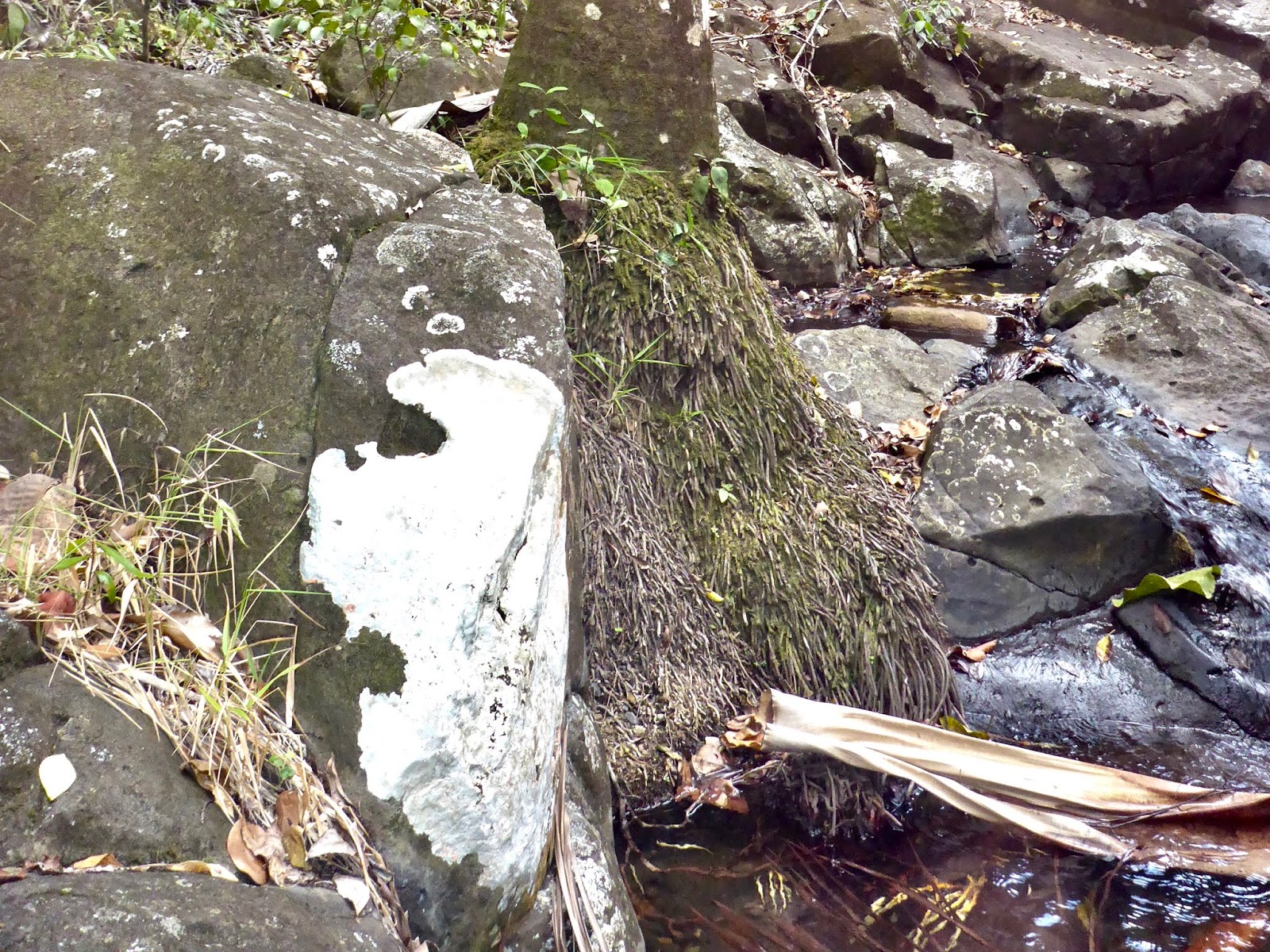
Massive exposed root base of palm forging its way through the rocks to the water and nutrients it requires.  On left, a massive white lichen.
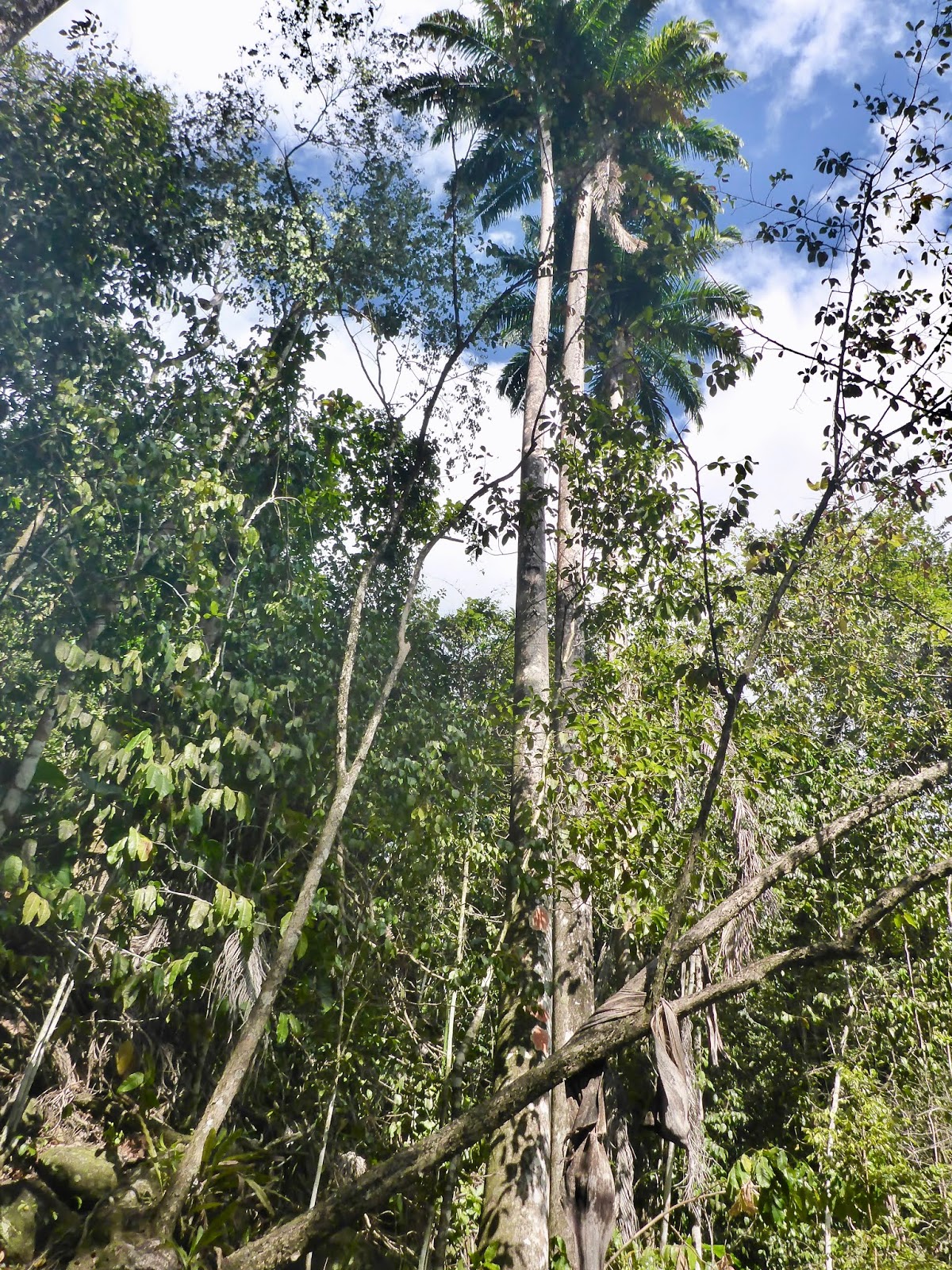
Reaching heights we have rarely seen

We were three hours into the hike and we saw no sign of any road connecting with the trail on the left or right side.  This was cause for dismay as our plan had been to take the road back.  It would be long past dark if we needed to follow the trail back.  We forged on for a considerable while.

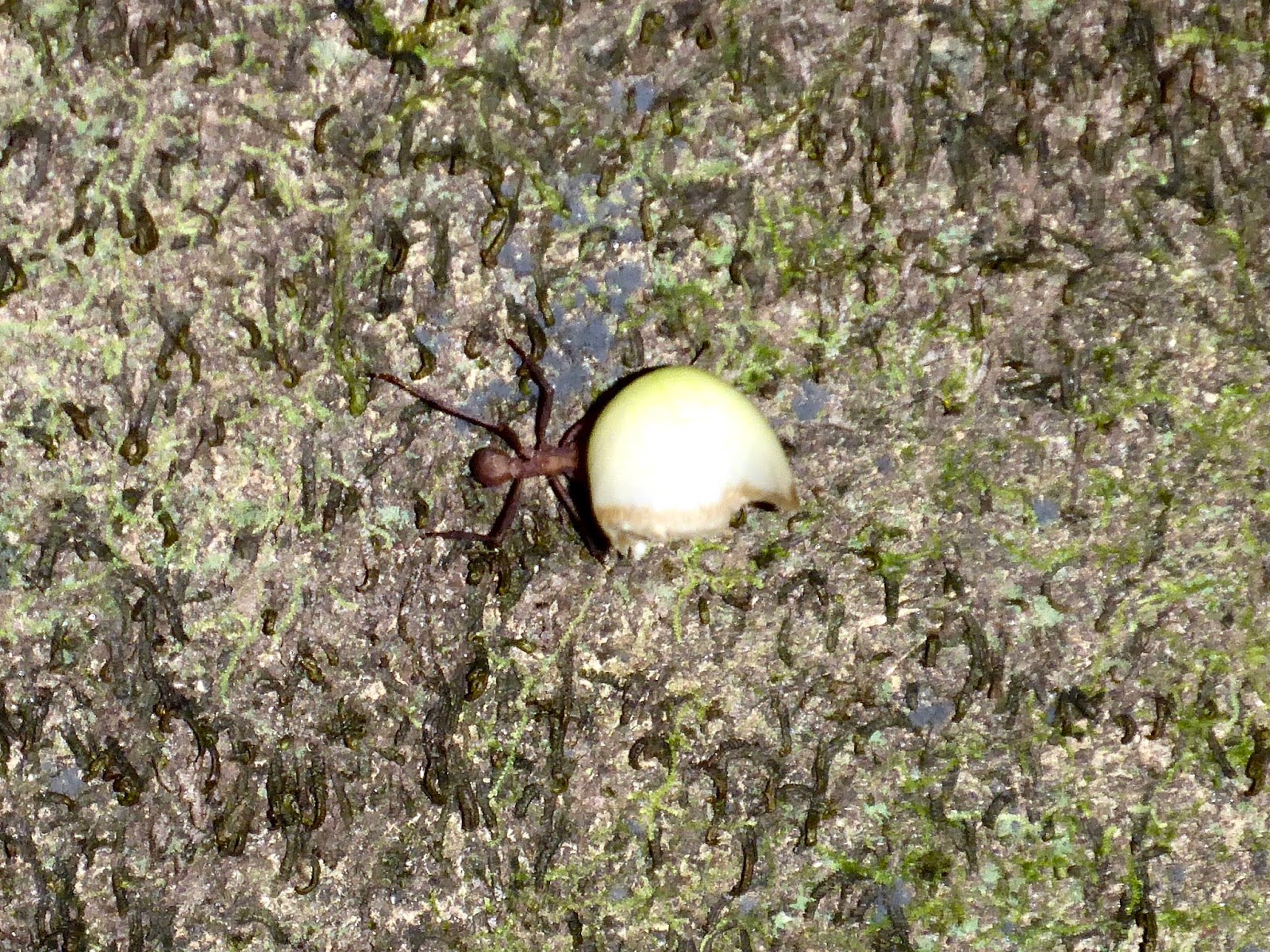
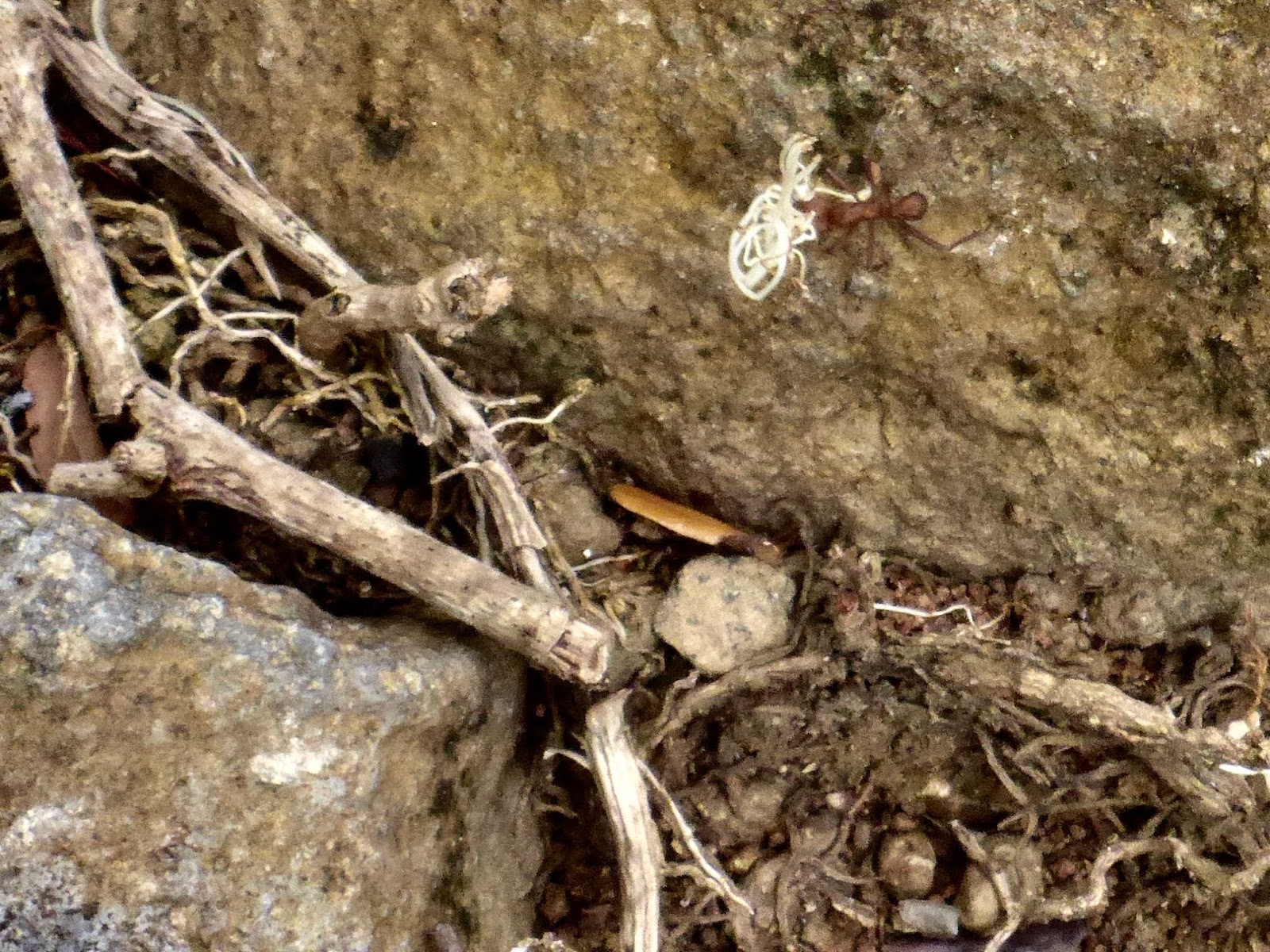
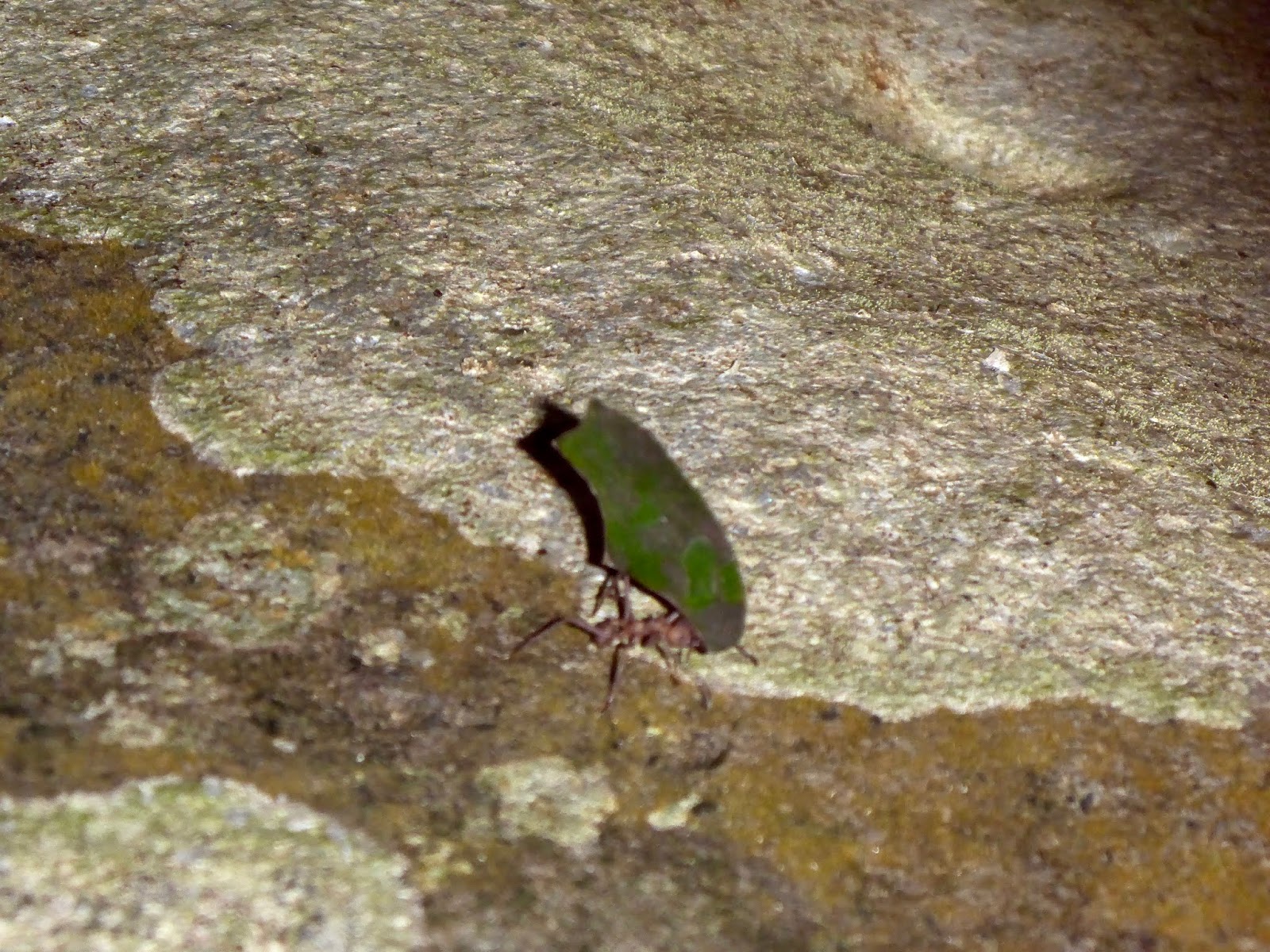
We encountered some very large ants industriously carrying loads much larger than themselves.

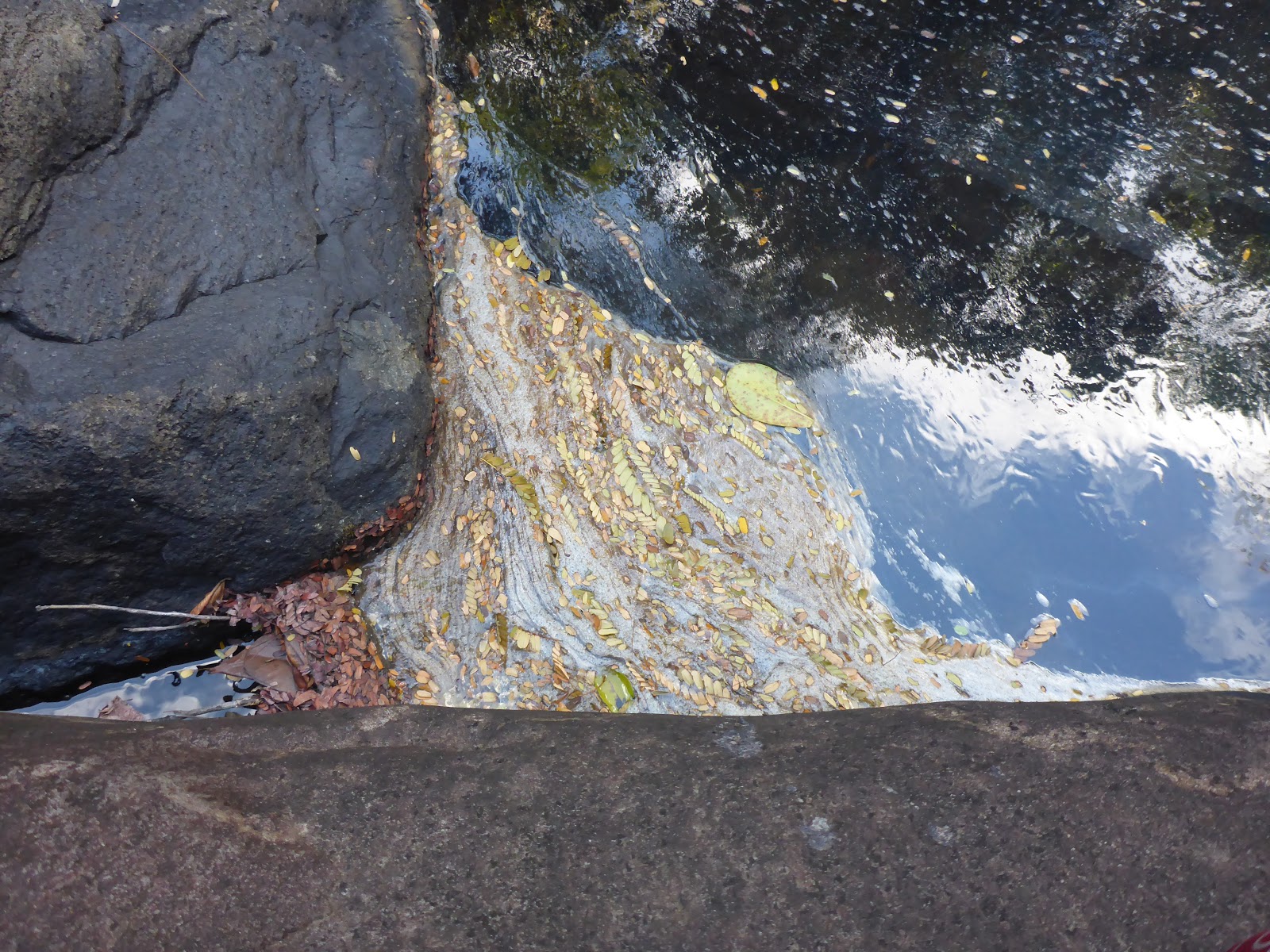
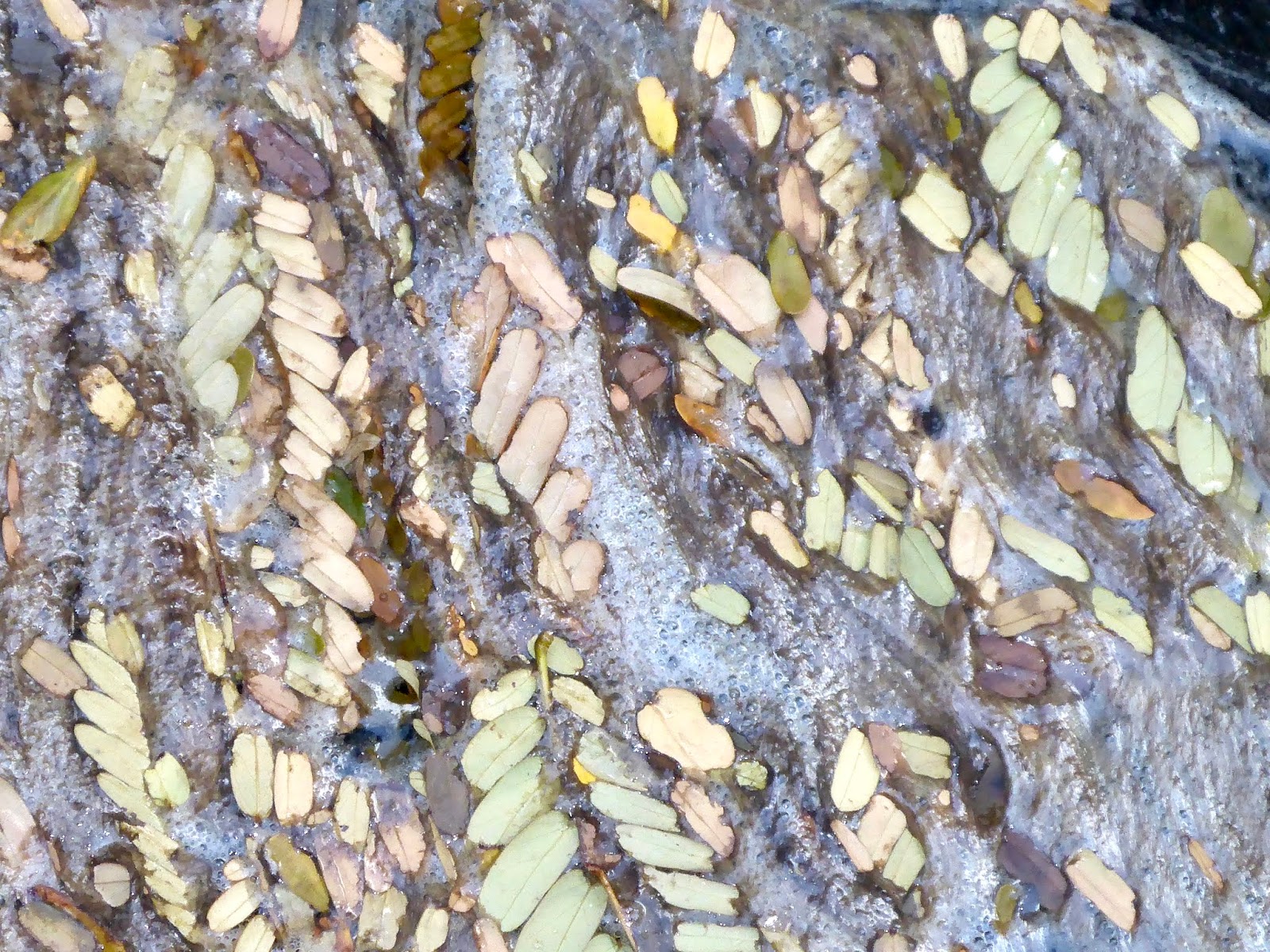
But, we did not find an intersecting road.  The following two pics are of the most beautiful river scum I have ever seen.

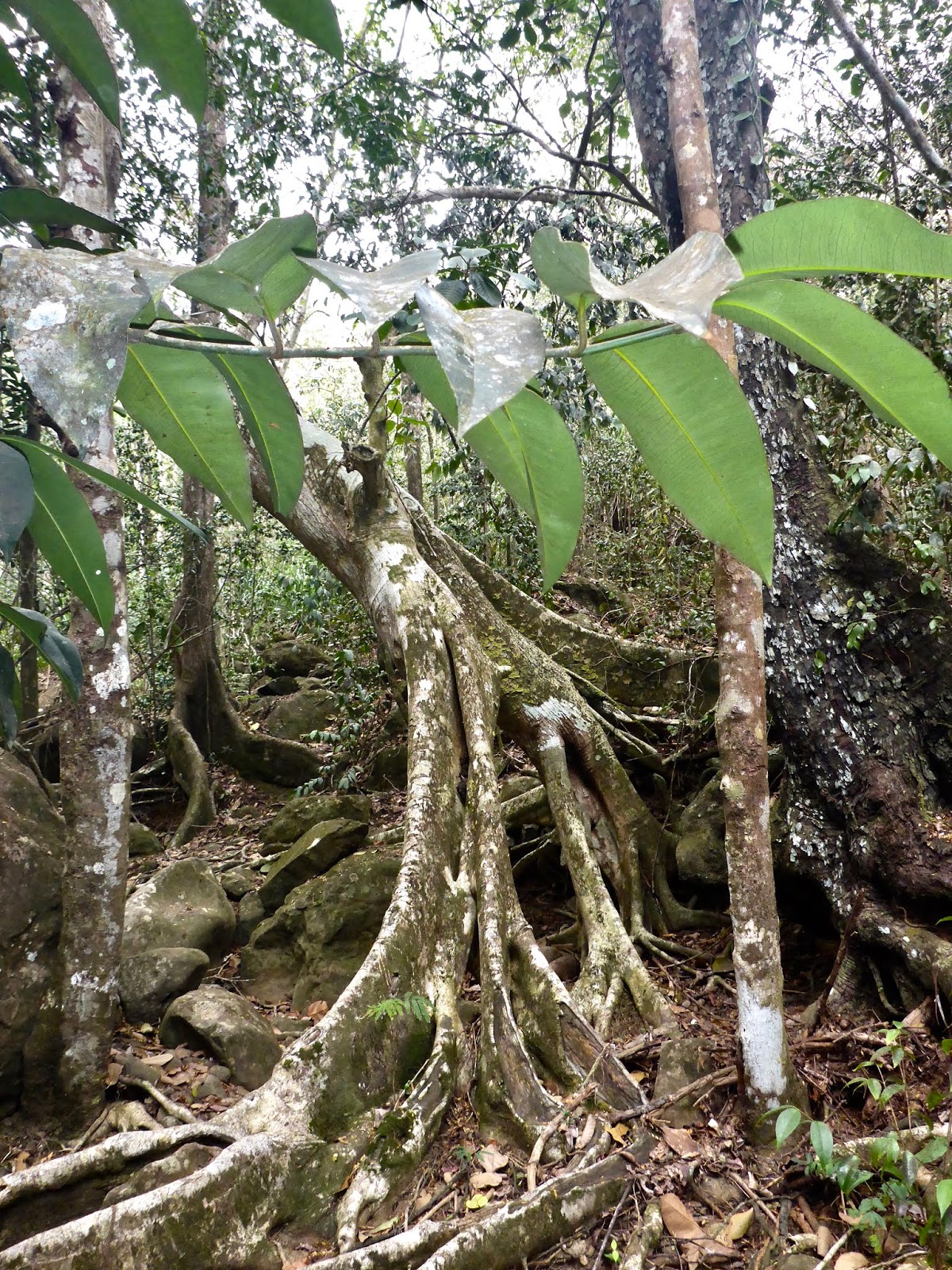
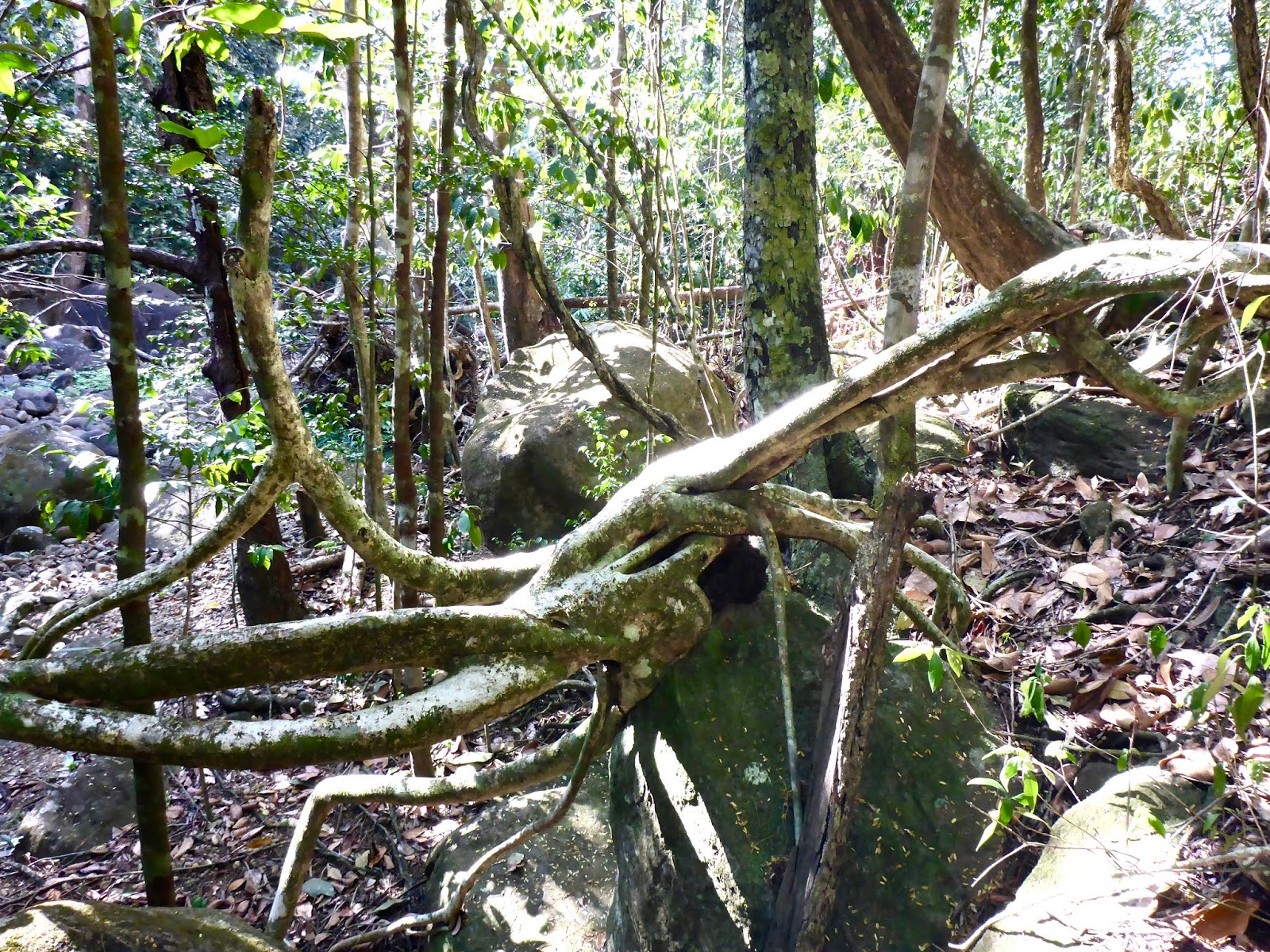
We marveled at the unusual way some trees grow in the tropics.  We hypothesized their growth habits evolved in a world that never saw a freeze or snow.  When encountering an obstacle, a limb may snake around it.  It is sometimes hard to distinguish a limb from a root.  Trees thrive growing on top of rocks or with three quarters of their roots undermined.

This tree above, and the one below, are part of the same living tree.

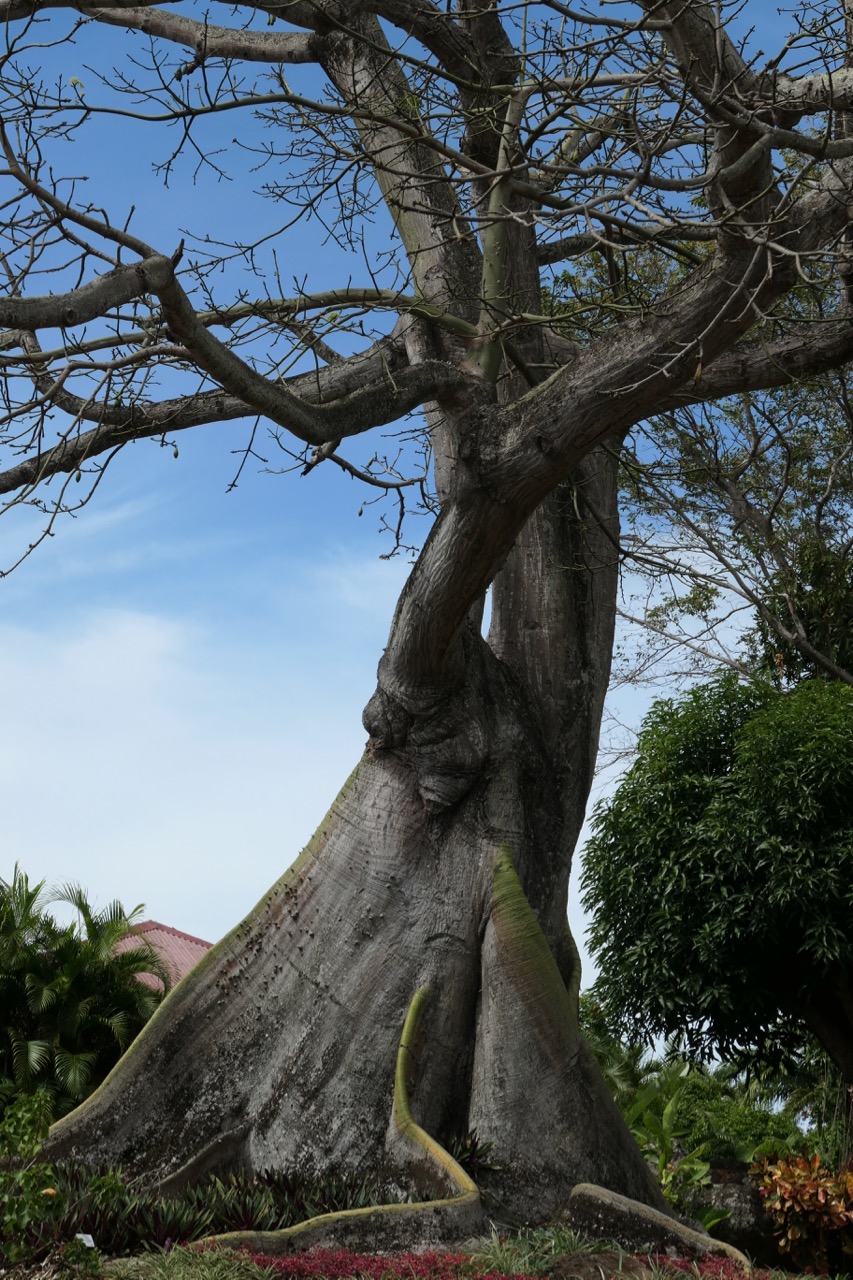
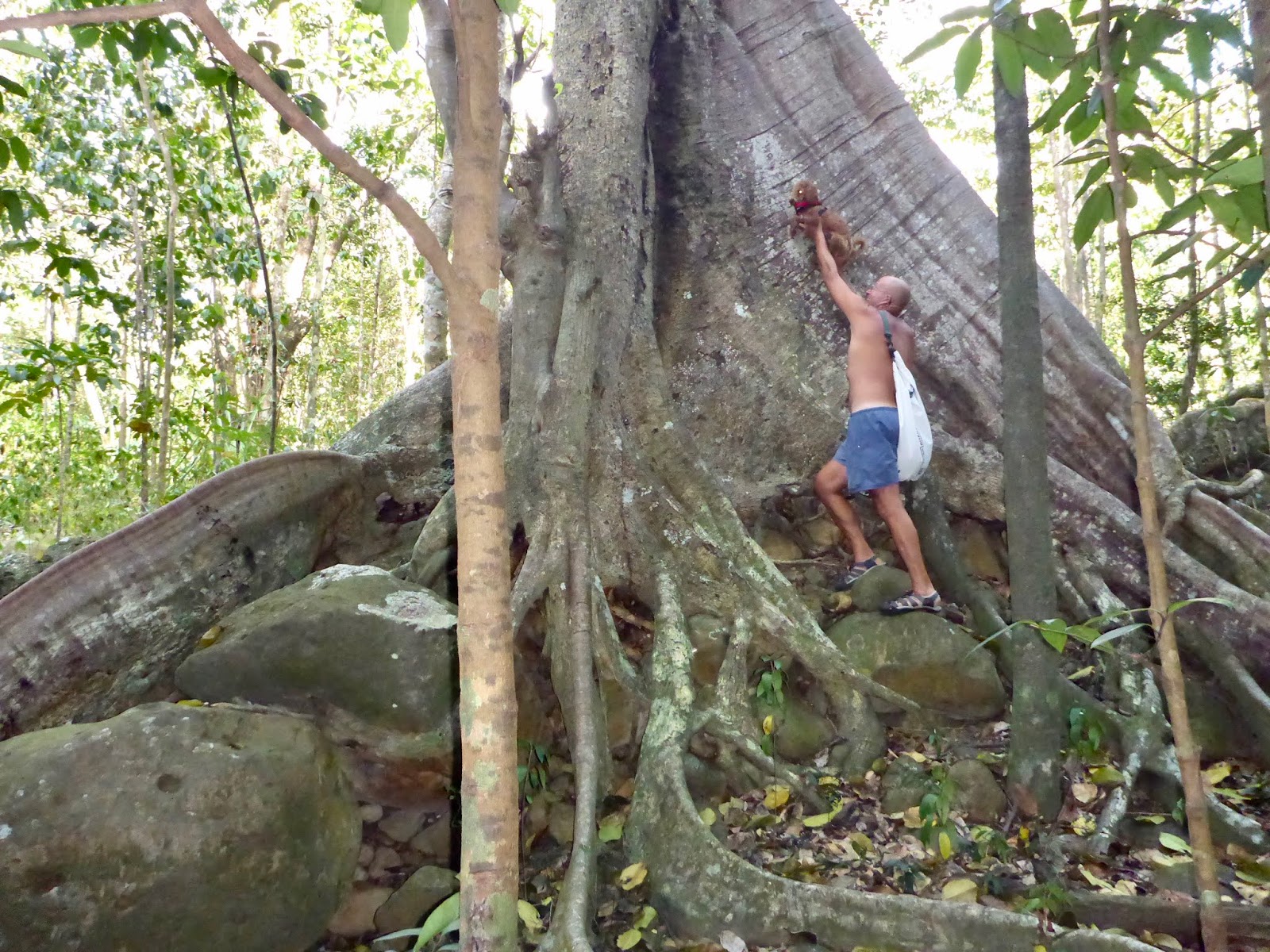
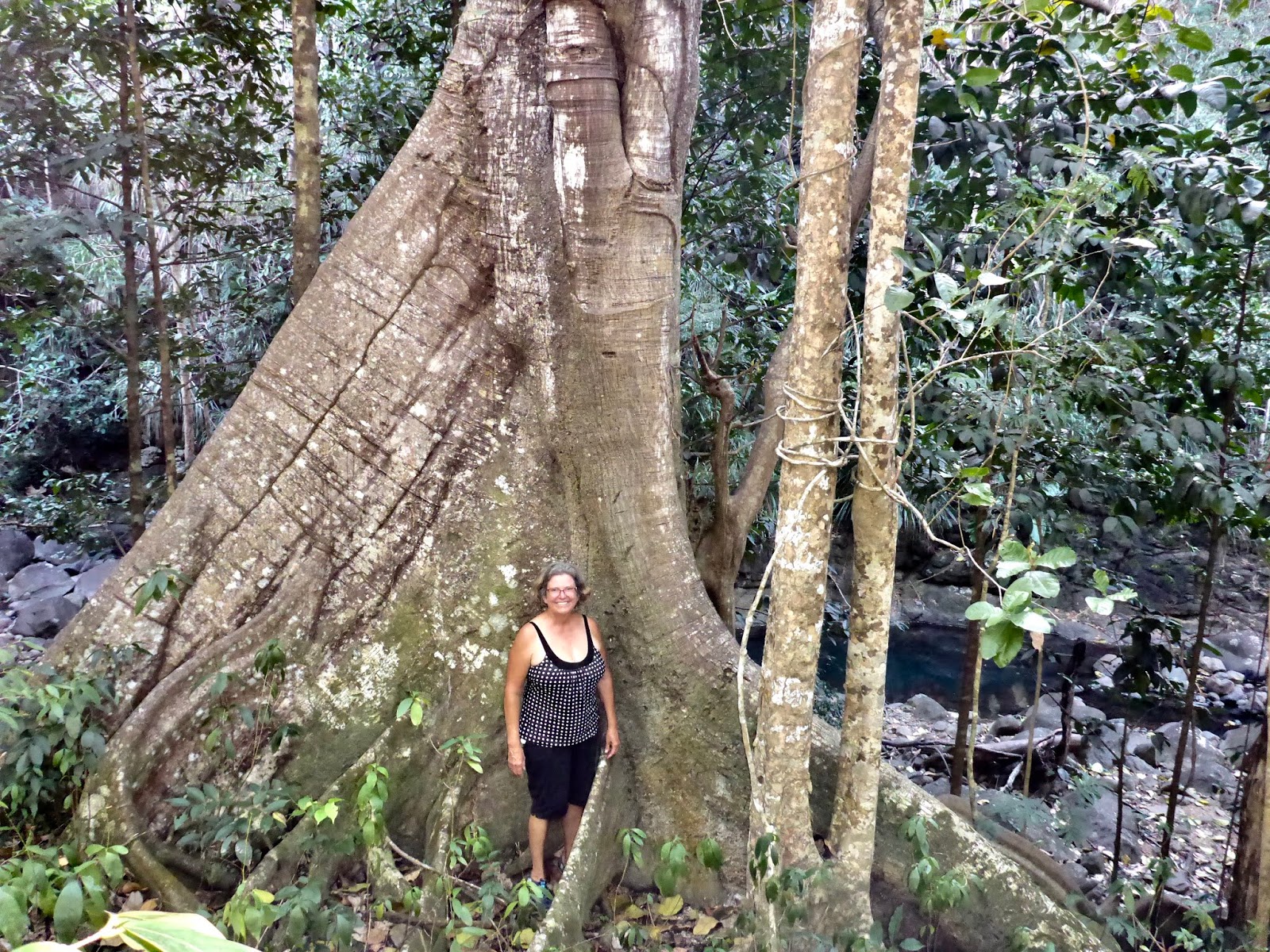
We found a large ceiba tree a little way into the forest on the left side of the river.  These trees grow to enormous sizes and have the most amazing roots that extend 10 or more feet beyond the tree.

George holds up Duhkxy so you have a reference for how big this ceiba tree is
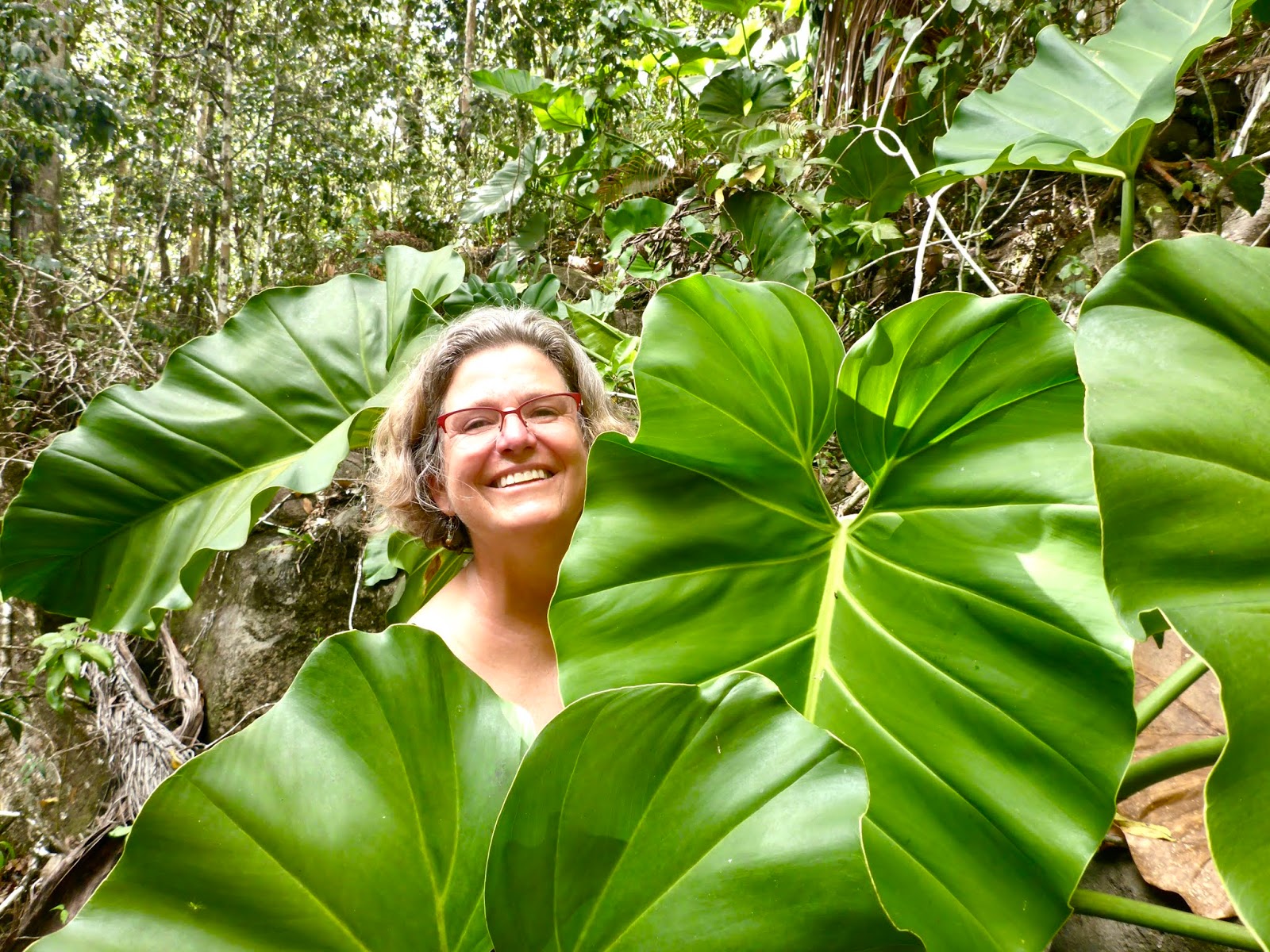
George takes a rare photo of me in which you can actually see my smile
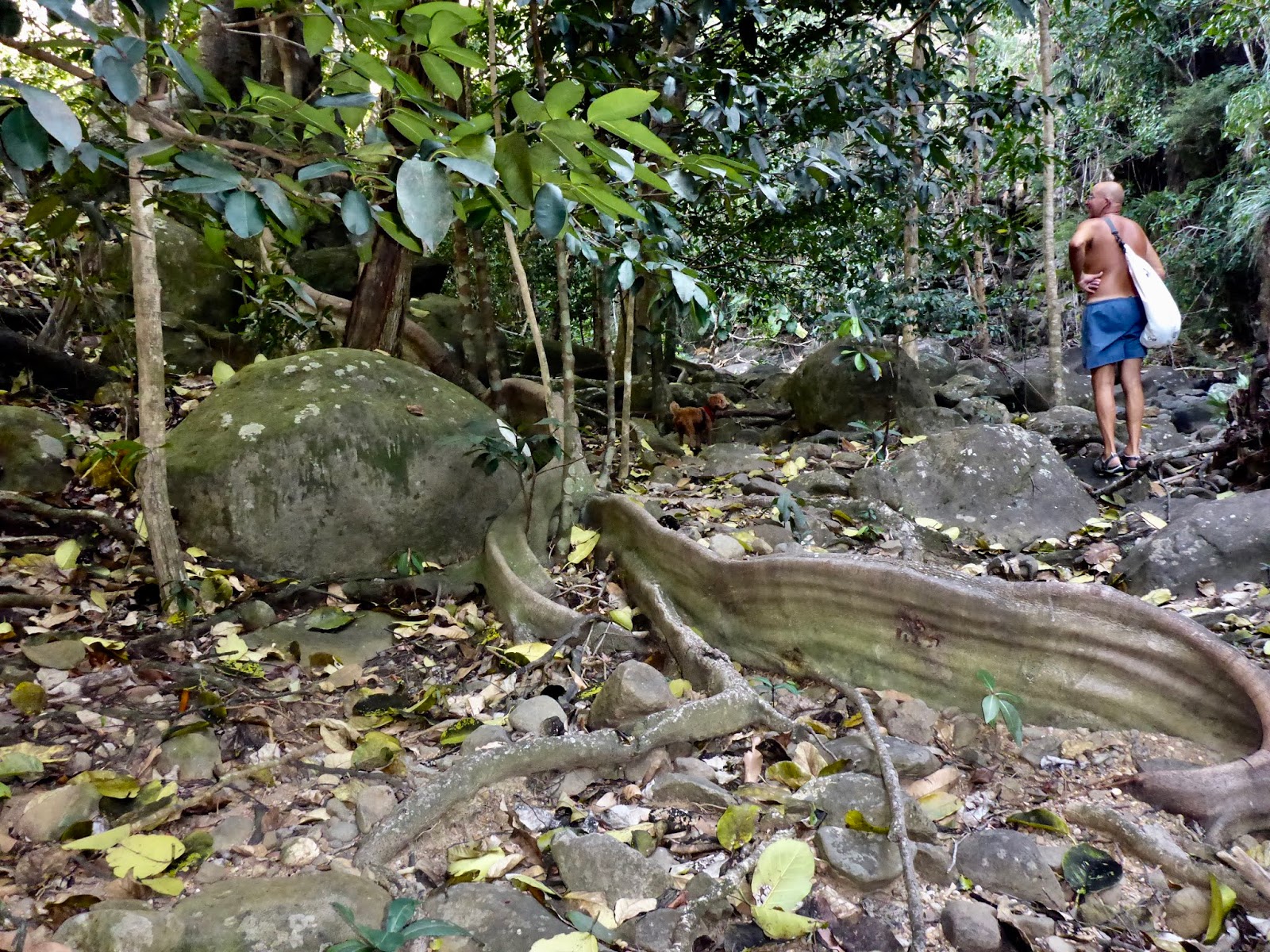
Well beyond the sight of the ceiba tree, its root continues to scrawl

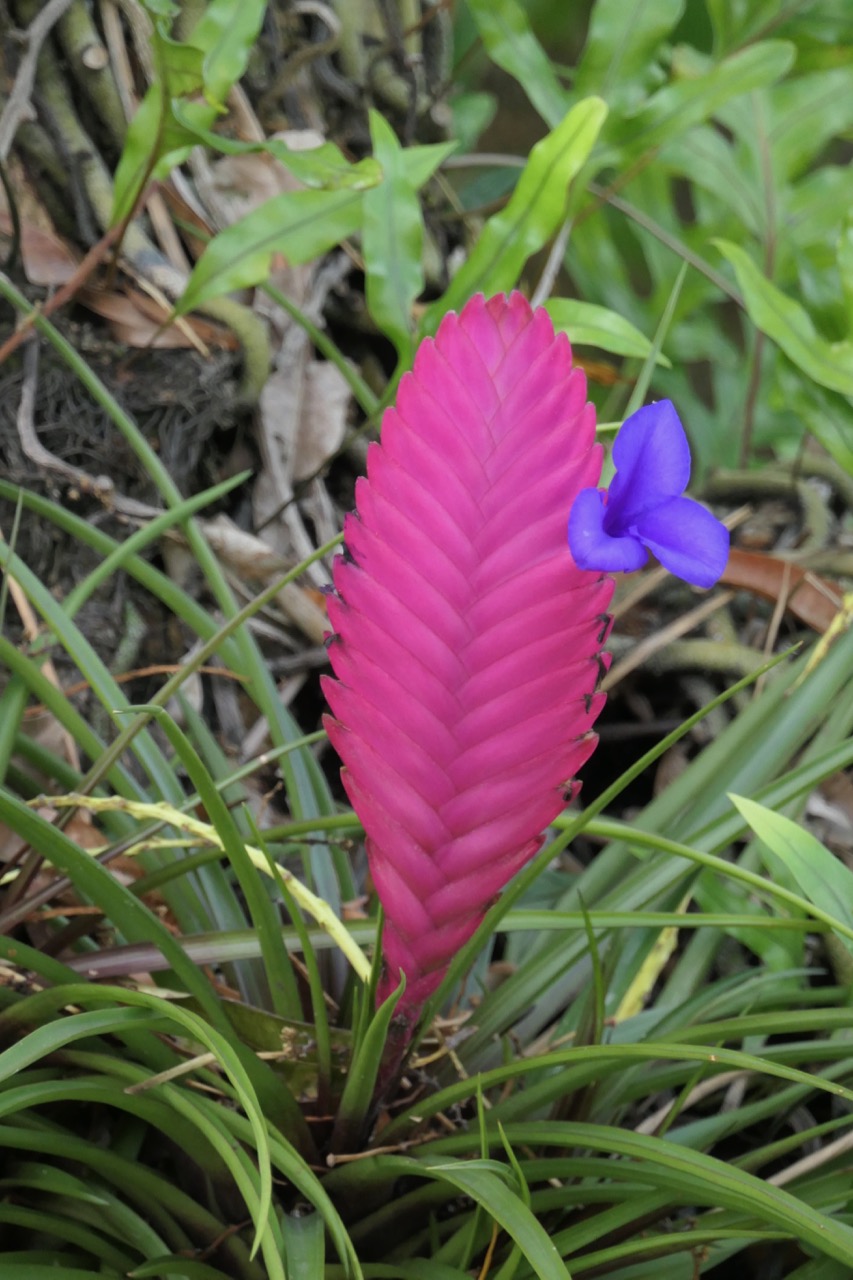
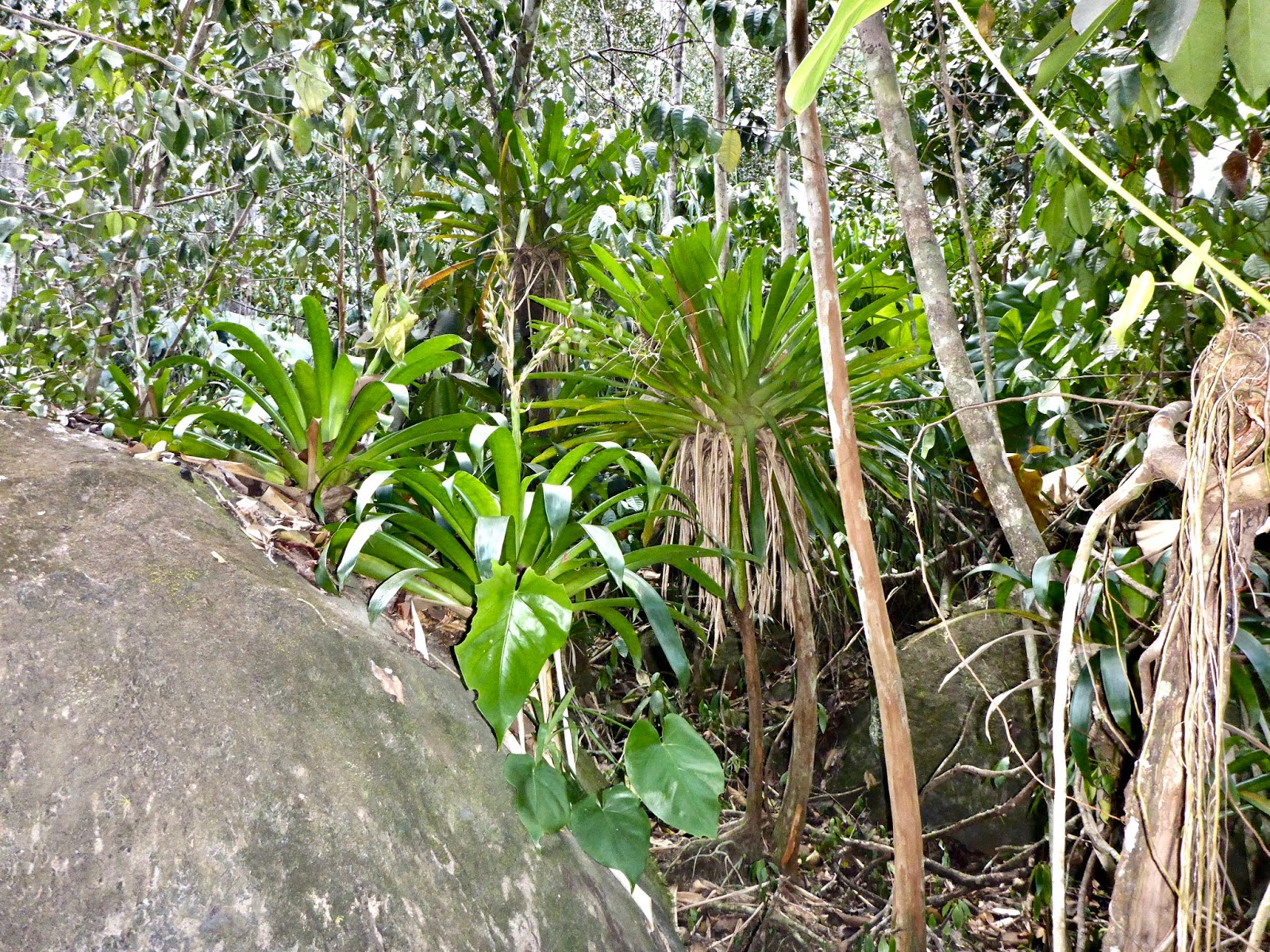
Moist forests in the Caribbean have many “air” plants that grow on other plants and rocks.  The one below was common on the trail.

Plants grow attached to trees and atop rocks
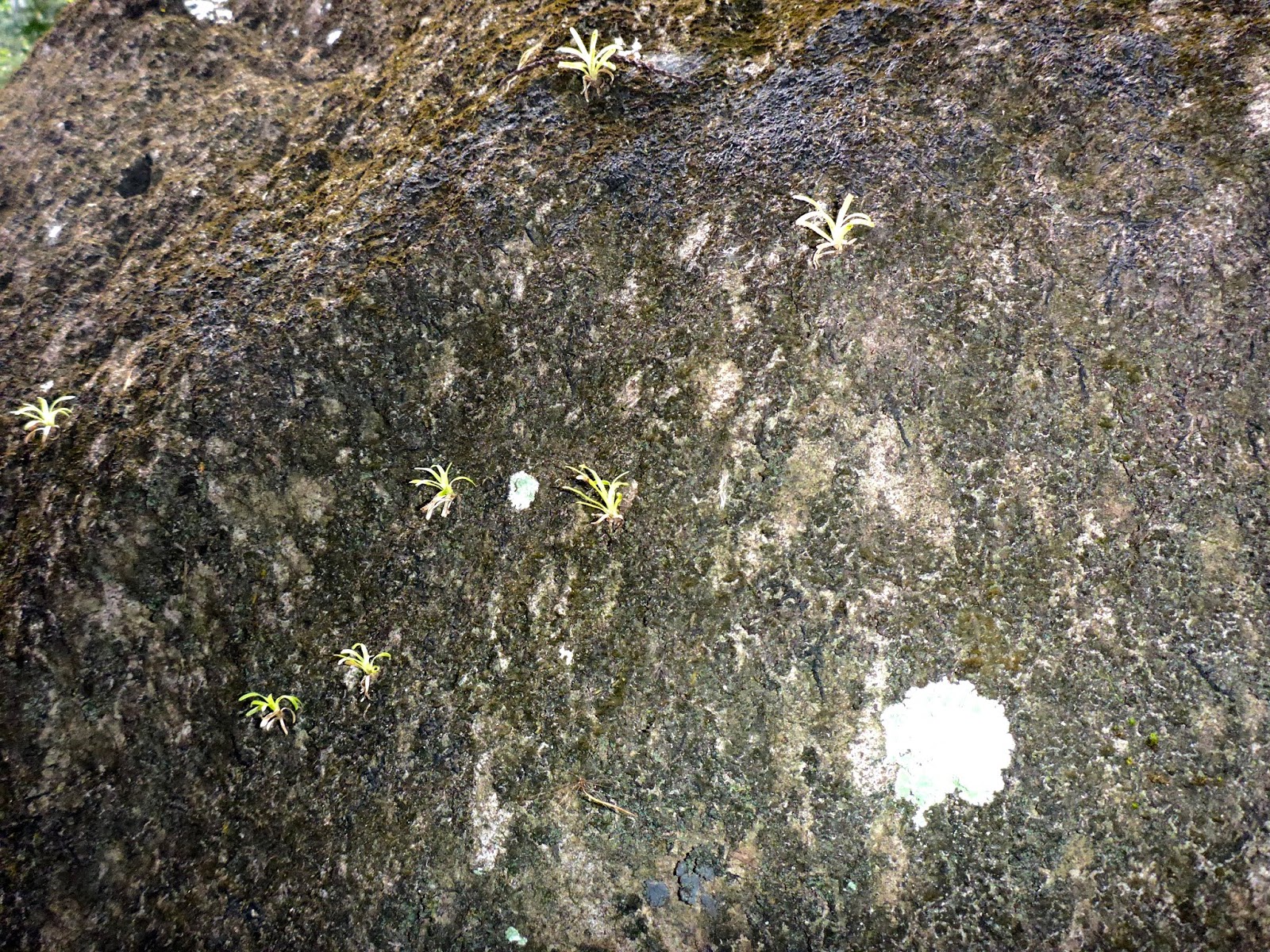
Seedlings of “air” plants just getting a start

Exhausted, going on four hours, with no sight of road or waterfall, we turn back.  We look for two concrete blocks that may be steps leading to something George remembered seeing that might have been a house in the woods.  Beside the steps was an old sign with “Interdict” barely discernible (equivalent to no trespassing).  Upon finding it, we clawed our way up a steep bank hearing what sounded to us like religious chanting.  The grounds and buildings appeared to belong to a religious group.  There were several areas with stations of the cross represented and there was evidence of vegetable gardens and animal pens.  A woman who had just driven up kindly showed us how to get to the road and we wearily headed for a beer in town.

This fun story cannot end without my sharing information we found on this trail (after we survived it).  Accounts from a number of sailing bloggers indicate that, indeed, there is a road and a lovely waterfall at the end of the trail.  I think Duhkxy was just slowing us down.

Our favorite was from http://www.gowitheflow.co.uk/2017-2/guadeloupe-nov-17/deshaies-river-walk/

Michael (Uncle and brother) is joining us in two days!

St. Bart’s to Guadaloupe

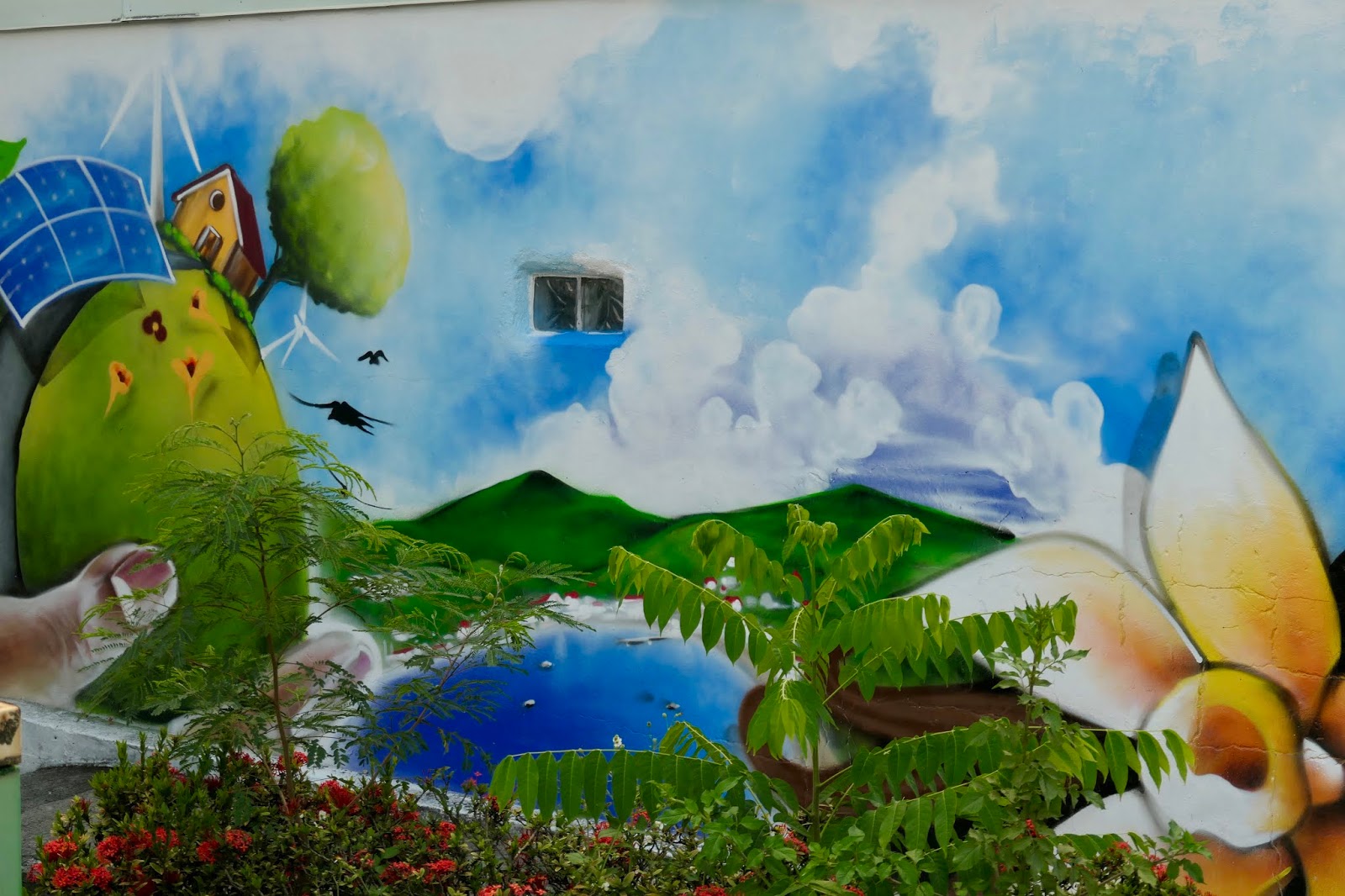
Beautiful mural on concrete wall in Deshaies, Guadeloupe

From Ile Fourchue we returned to the St Barts mainland to provision up.  The following morning, March 27, we began our sail to Guadeloupe at 6:30am.  The trip would take three days with lay over in Nevis and Monserrat.  We would not go ashore on either of these islands as Duhkxy did not meet requirements and we were not cleared to do so.

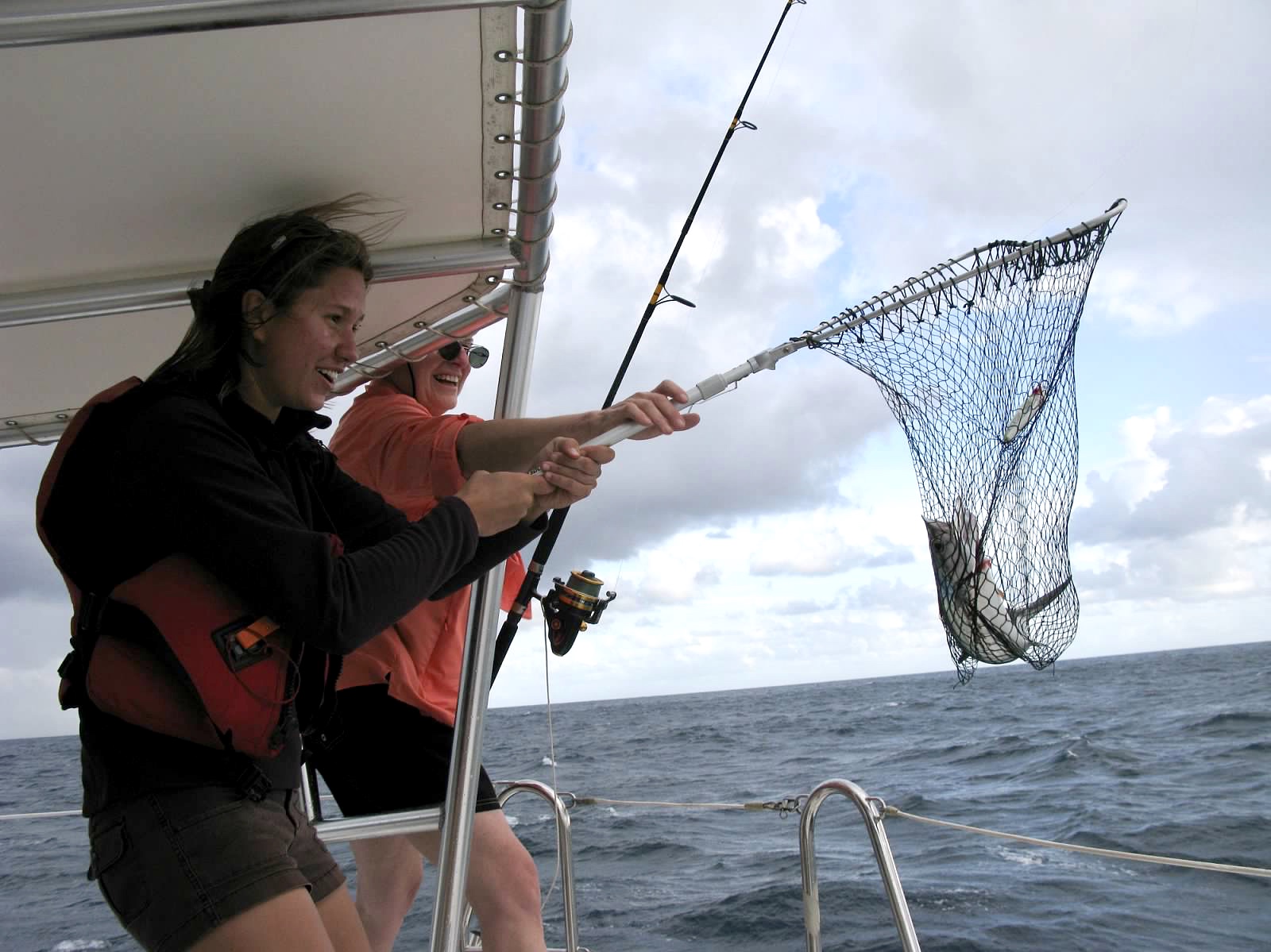
The first two days we sailed as close to the wind as Ice Floe can sail and endured 5-6 foot swells.  Wind was around 12-15 knots interspersed with squalls into the low to mid-20s.  This was pretty rough sailing and adding to the challenge, we fished most of the time.  Sadly, I only caught one very large and one pretty small barracuda!!  Are there any fish left in the sea?

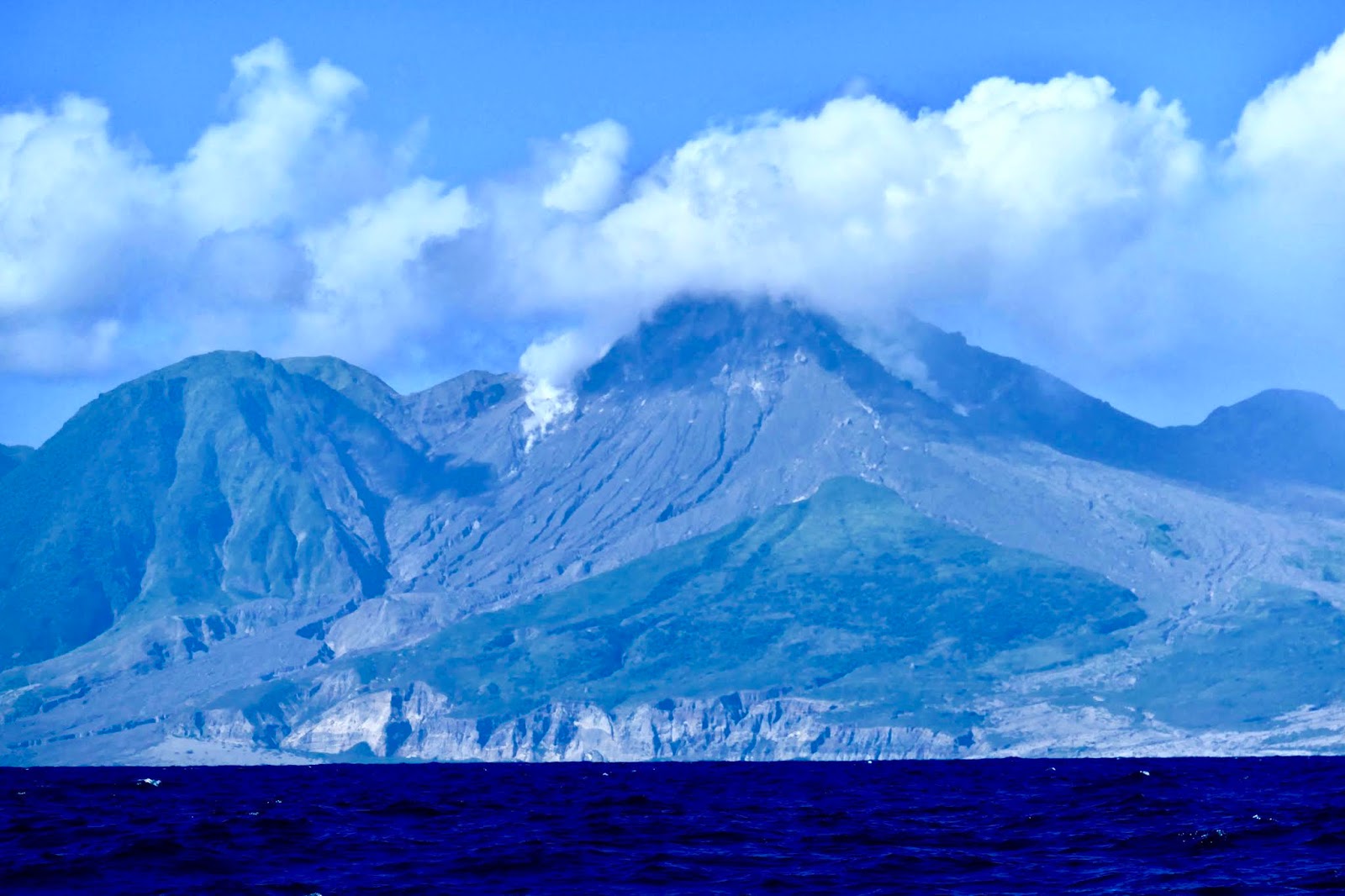
The Soufrière Hills Volcano on Monserrat

We passed by Monserrat and viewed the Soufrière Hills Volcano blowing smoke from several places.this previously dormant volcano erupted violently in 1995 and 1996, burying the islands capital, Plymouth, and requiring the relocation of half the island’s inhabitants.  Fortunately, the town was evacuated prior to the major eruptions, but 19 lives were lost.  The southern two thirds of the island remain uninhabitable and the volcano remains active.

Our third day required us to motor sail as the wind was down to 5 knots.  The squalls were, however, the most severe we have encountered – with a top speed of 35 knots.  The sails were set for the squalls, with a reef in the mainsail, and no jib.  Nonetheless, a sudden 35 knot wind with substantial swells is a mighty force.

We arrived in Guadeloupe on March 29th around 5:00pm. We were bone-tired and ready for an early night when we anchored in Anse Deshaies, Guadeloupe.

The information we reviewed concerning the anchorage in Anse Deshaies had prepared us for it to be crowded.  Free moorings were all occupied by local boaters.  The depth of the anchorage drops off quickly.  We anchored out a bit, repositioning ourselves twice and settling in about 30 feet of water.  It was a comfortable anchorage with plenty of breeze, little swell, and a short dinghy ride to restaurants and a small grocery store.  Our only concern was Ice Floe, along with all the boats in the cove, continually shifted direction.  Of greater concern was that it was not unusual for one boat to swing in one direction and the boat beside it another.  With a great deal of anchor chain out, we regretted not having set a float to mark the anchor’s position.  This would give other boaters an idea of the substantial area Ice Floe might occupy depending on how she swung.

The following photos and comments are from our first day in Deshaies, Guadeloupe.

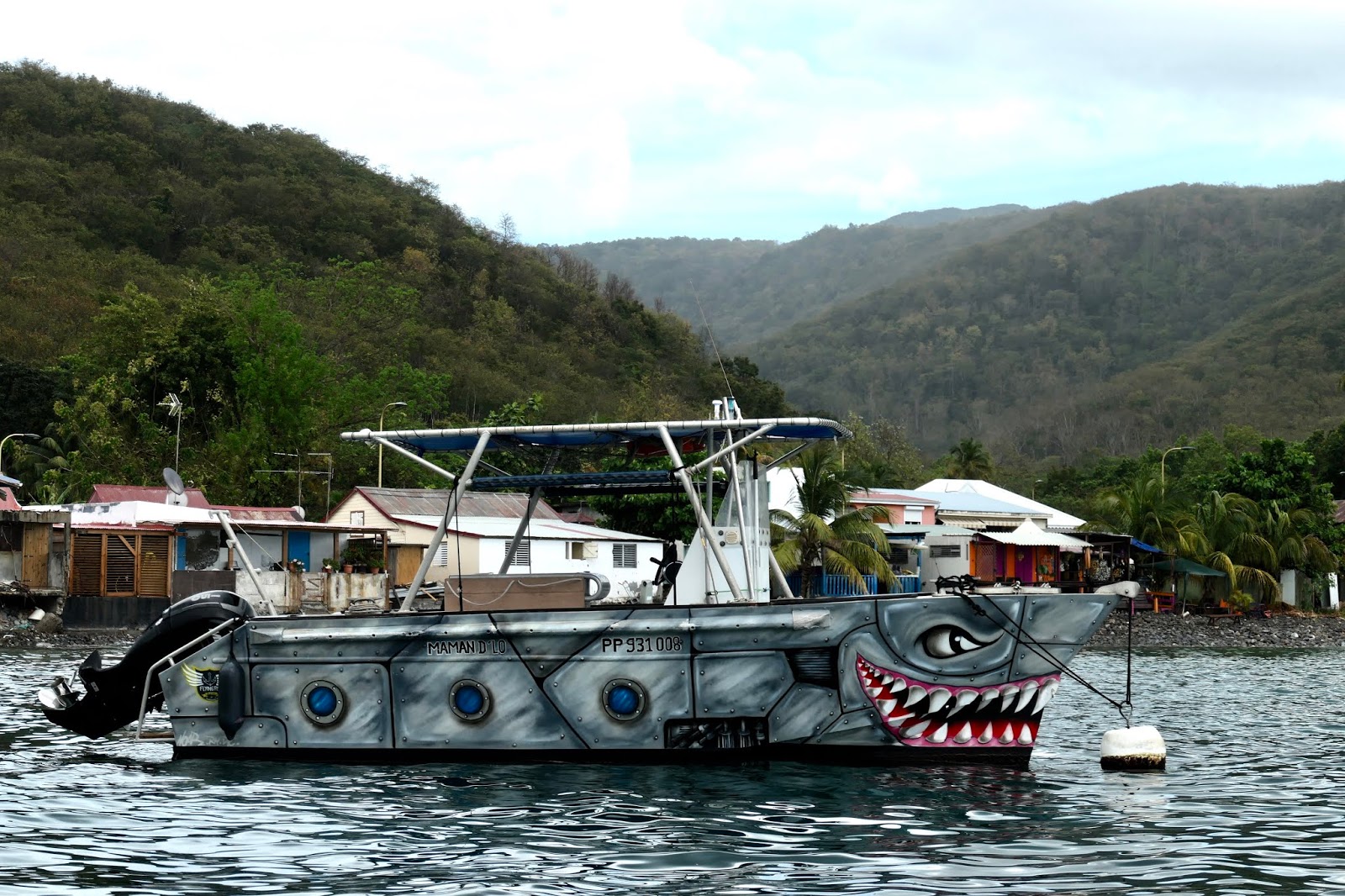
Local fishing boat in Anse Deshaies
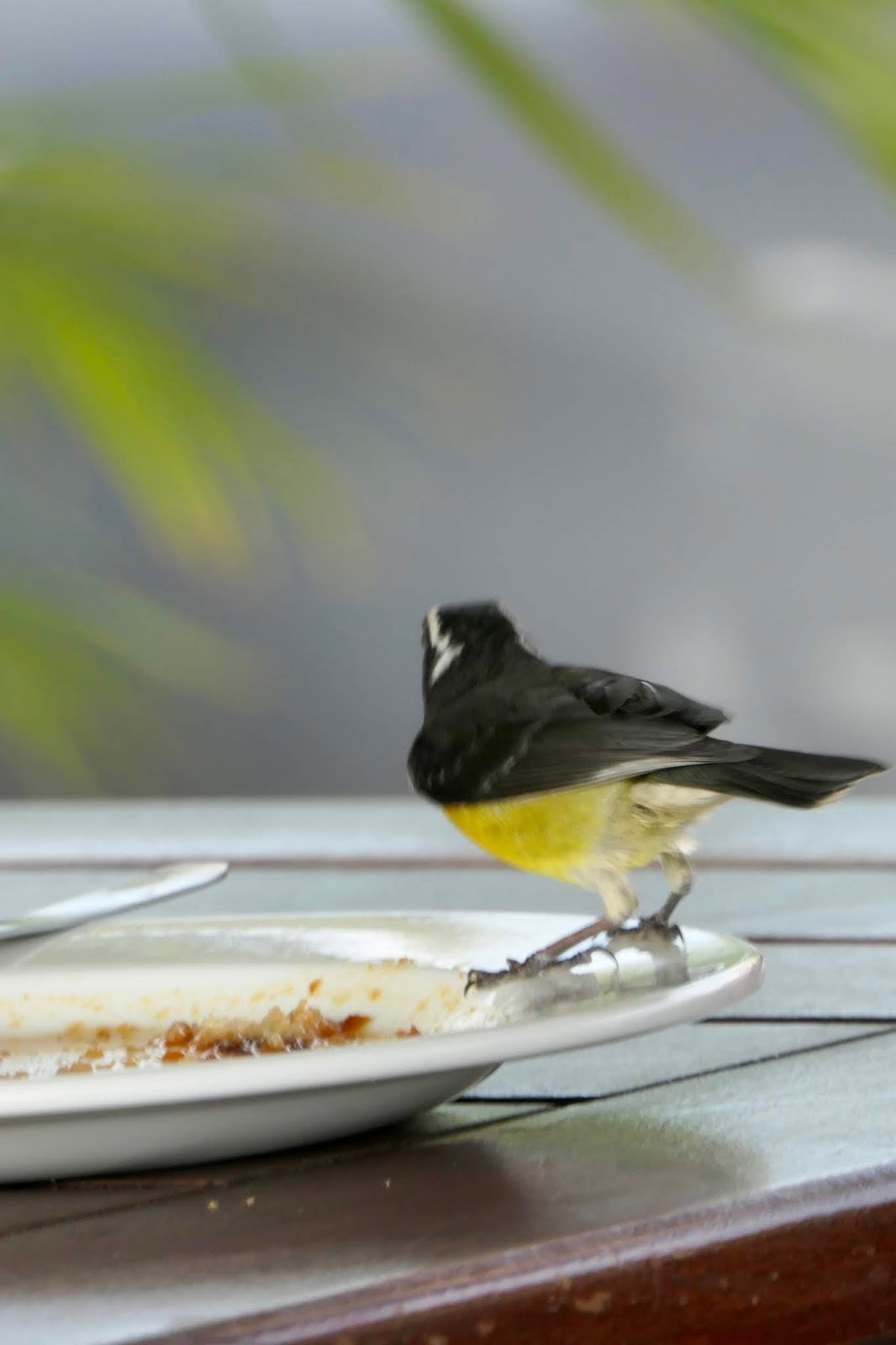
We had a fabulous lunch of local fish and pork while entertained by bananaquits
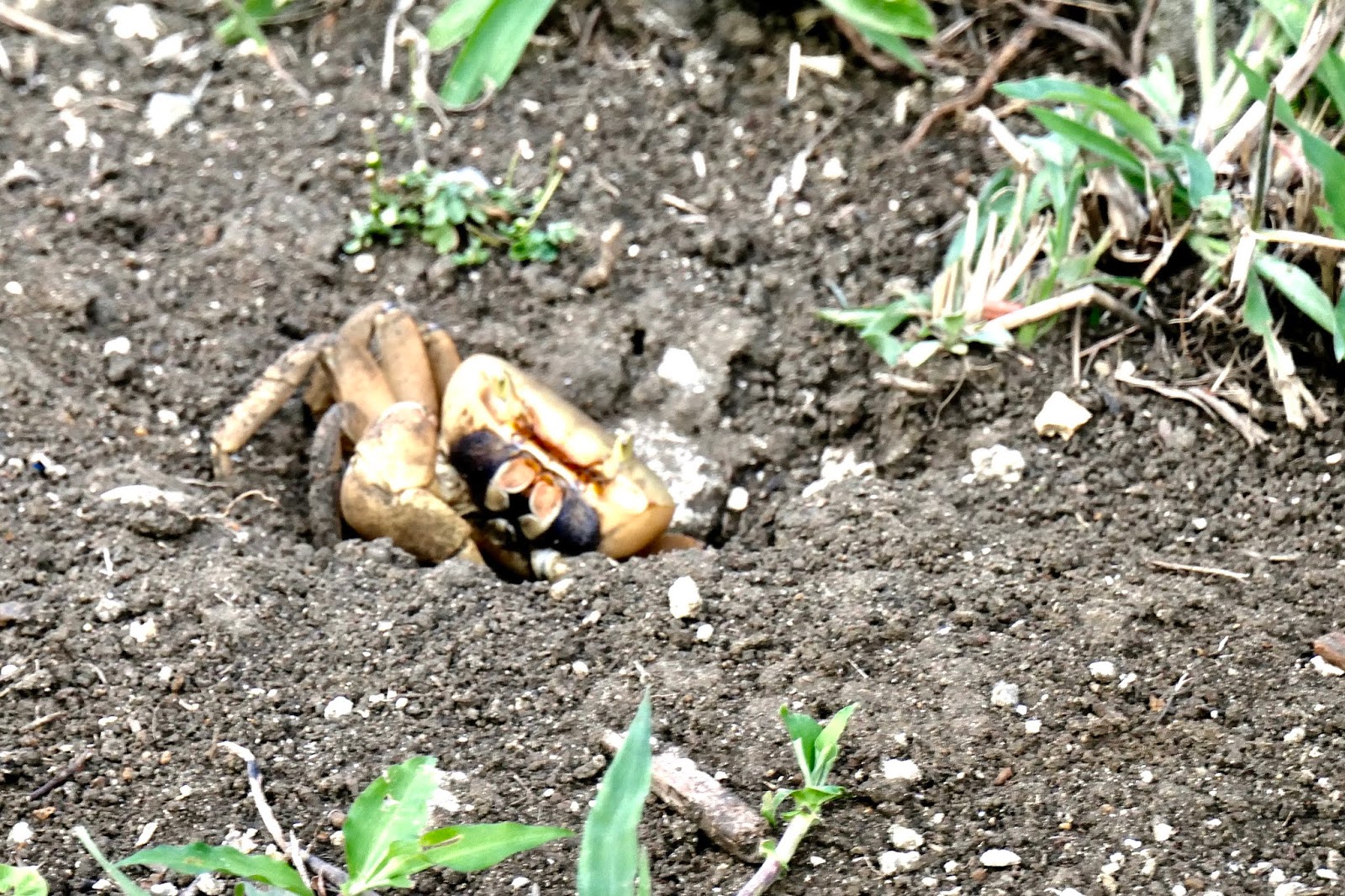
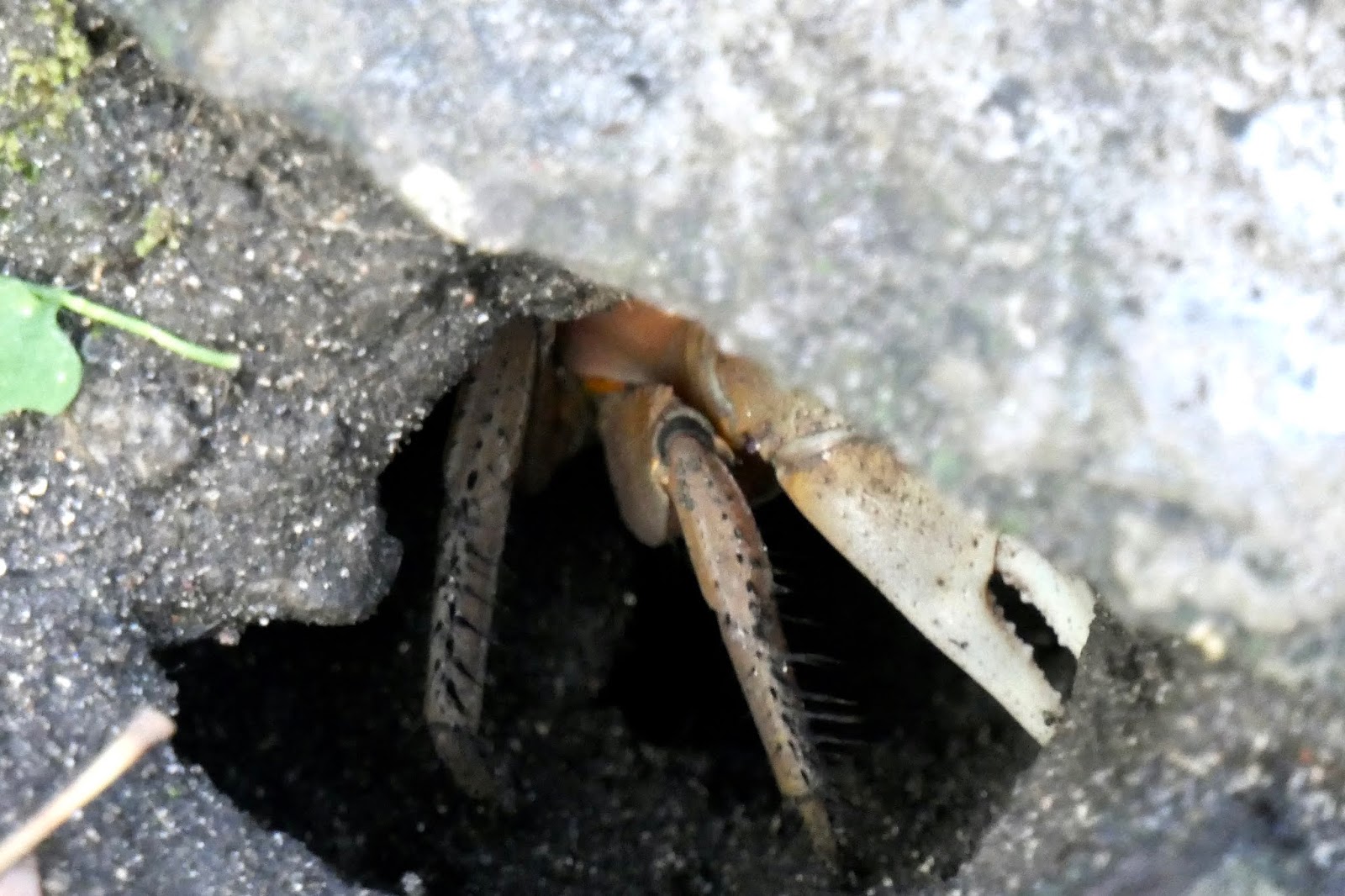
Land crab ready to duck into its substantial underground home
Land crab half hiding in its underground home
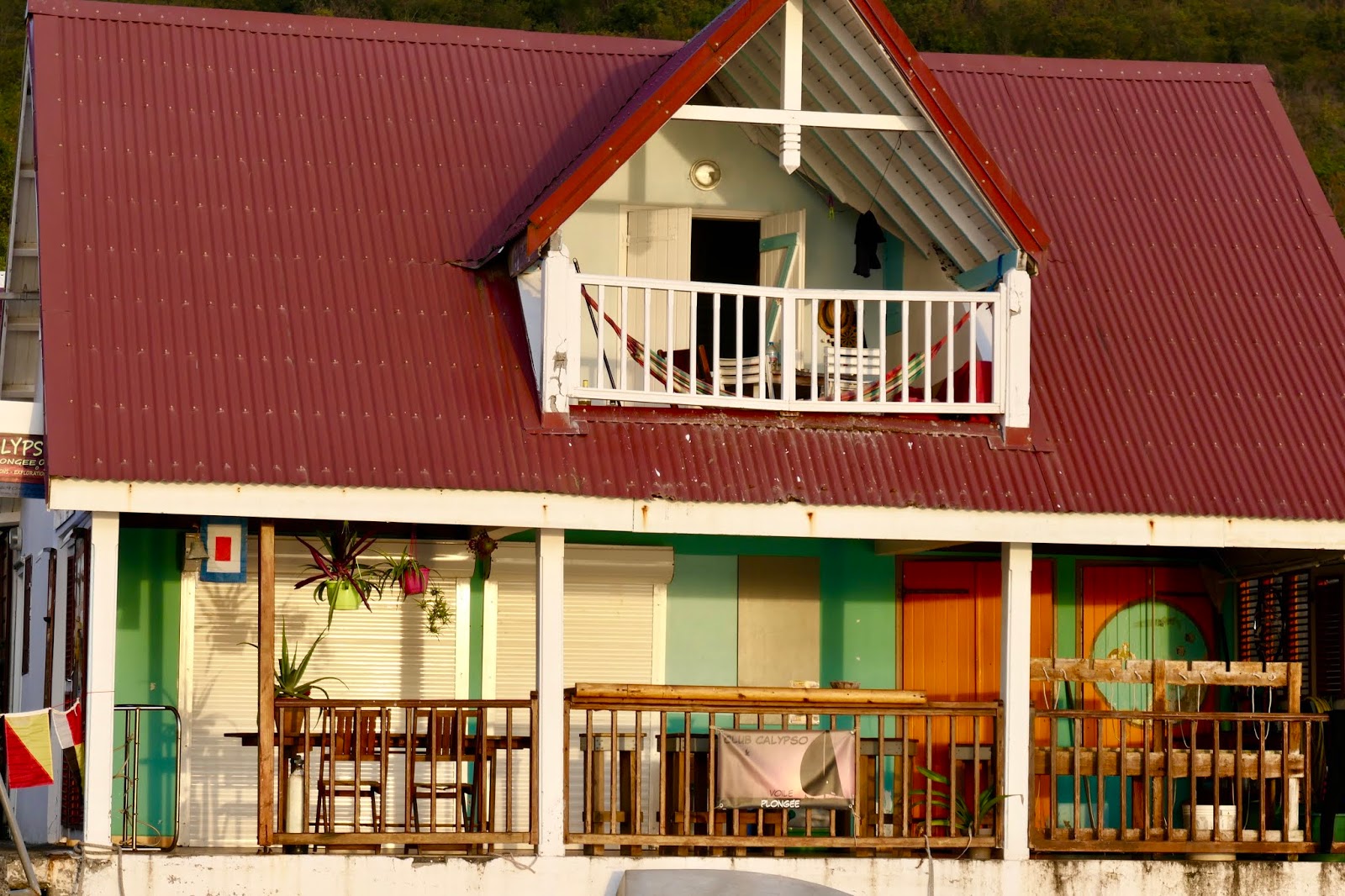
Picture-perfect home on the waterfront of Anse Deshaies
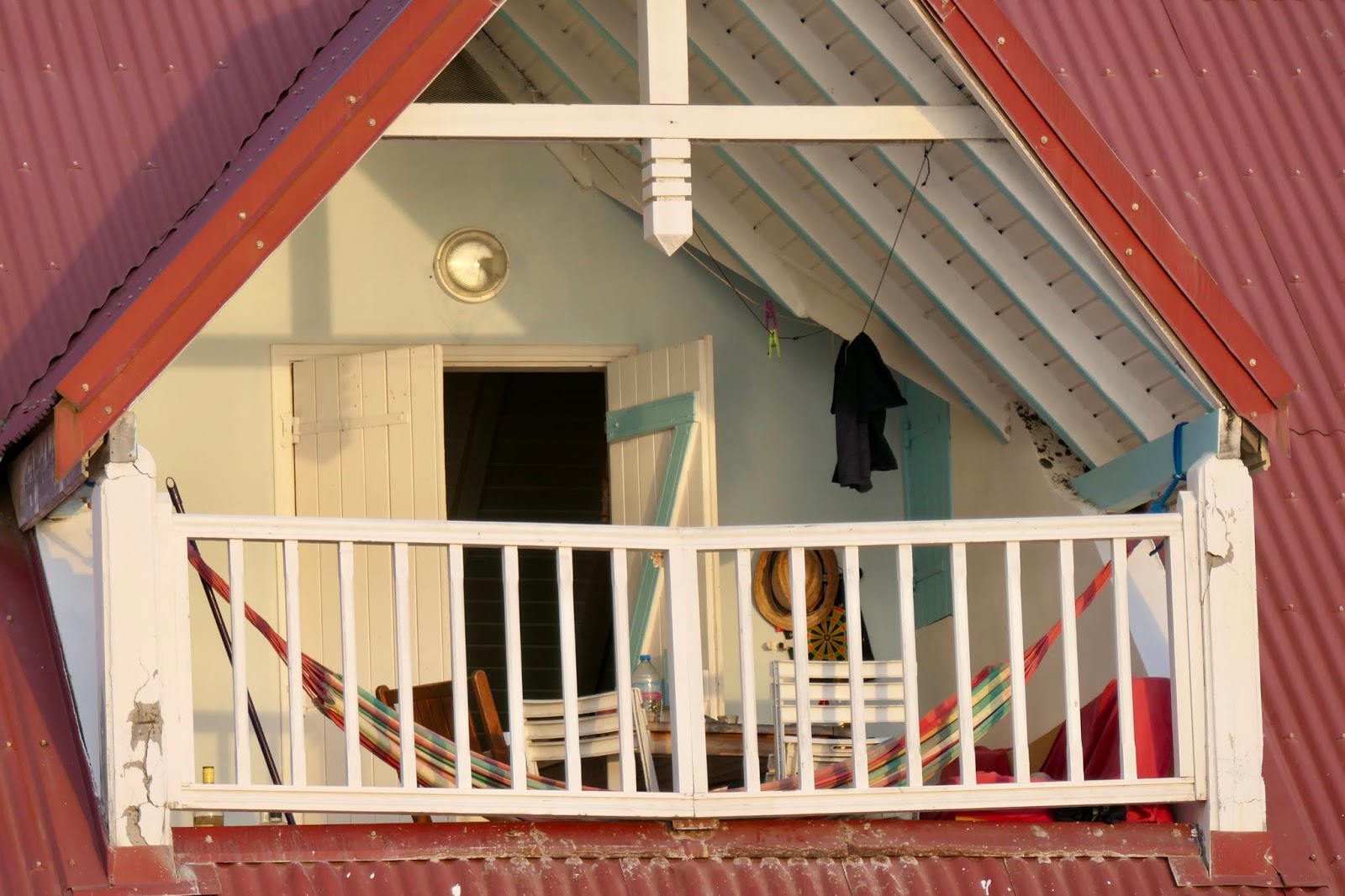
The dormer of this lovely home with a balcony set up with children’s size chairs

Visiting St. Barthélemy

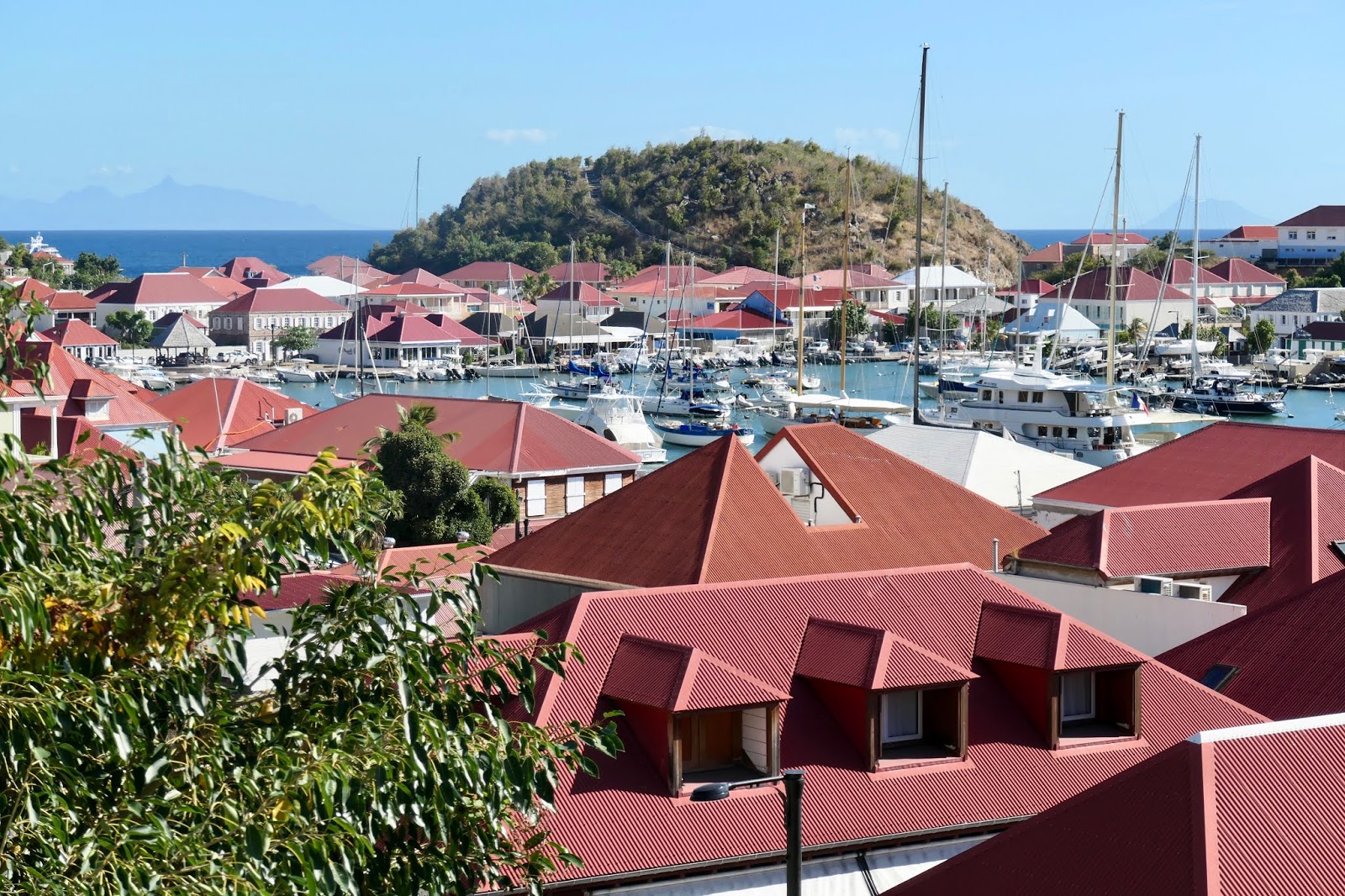
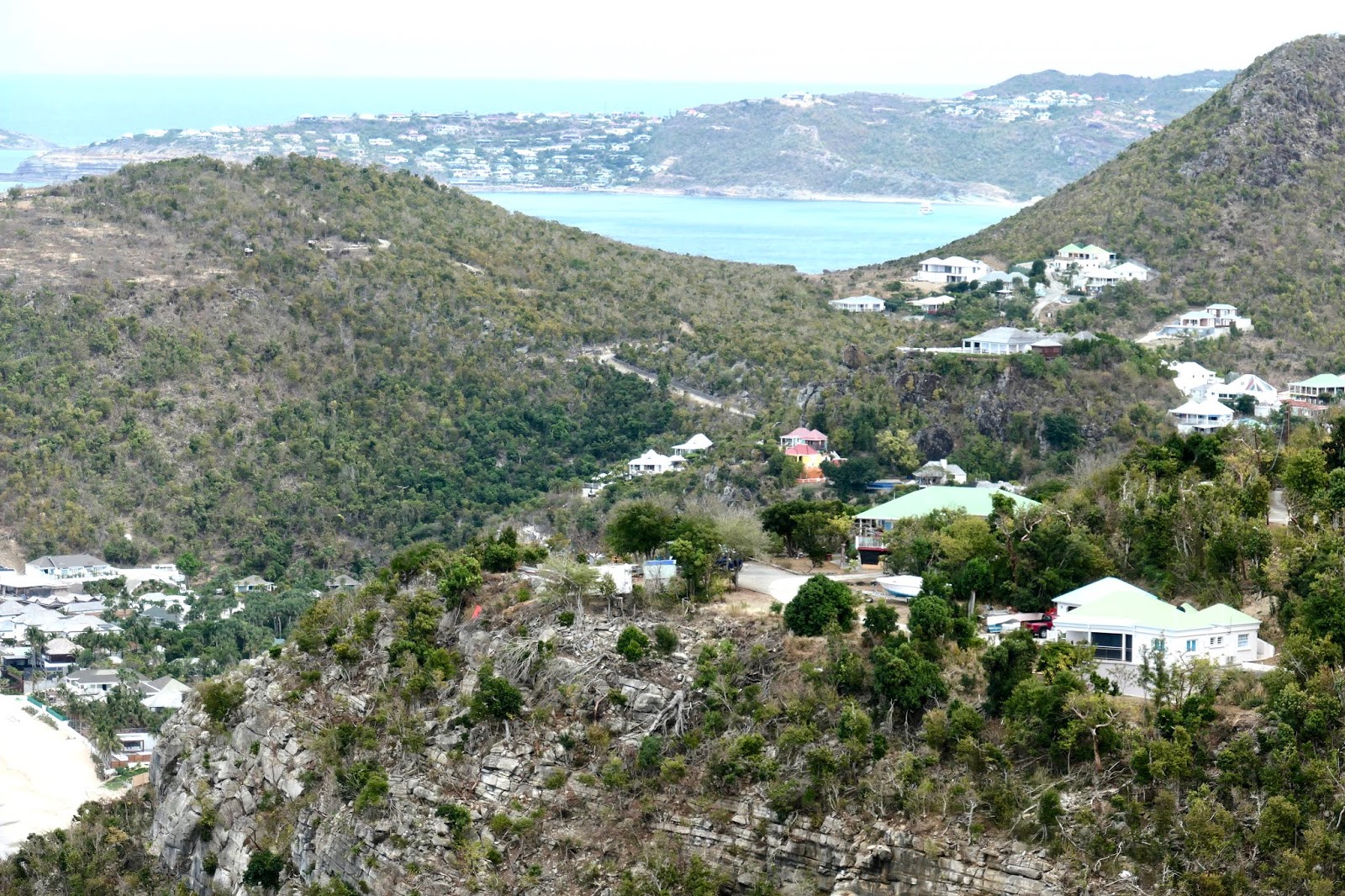
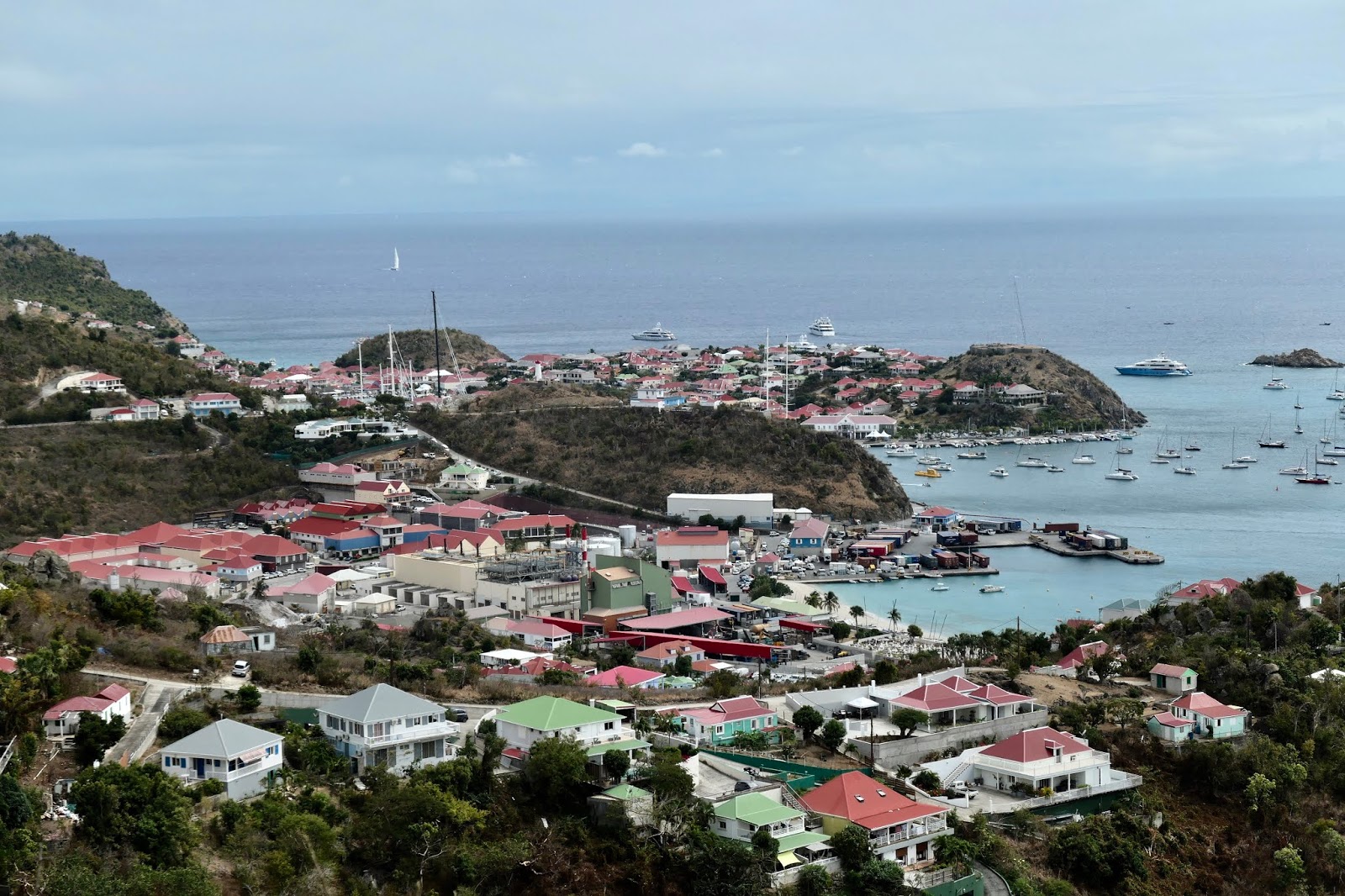
Hilltop view overlooking Gustavia Marina

St. Barthélemy, also known as St. Barth (French) and St. Barts (English), has approximately 10,000 inhabitants.  The language is French and many inhabitants speak little to no English. It was fun when I found myself in situations where I knew as much, or more French than the person I was speaking with knew English.

St. Barts is a wealthy island – sort of the Caribbean version of the Riviera’s St. Tropez.  It is said to be frequented by the rich and famous, although we met no celebrities that we were aware of.  We were told because many island inhabitants are well off, the recovery from the 2017 hurricanes was very fast.  Any able-bodied person could earn 50 euros / hour (~ 55 US dollars) just on a cleanup detail.

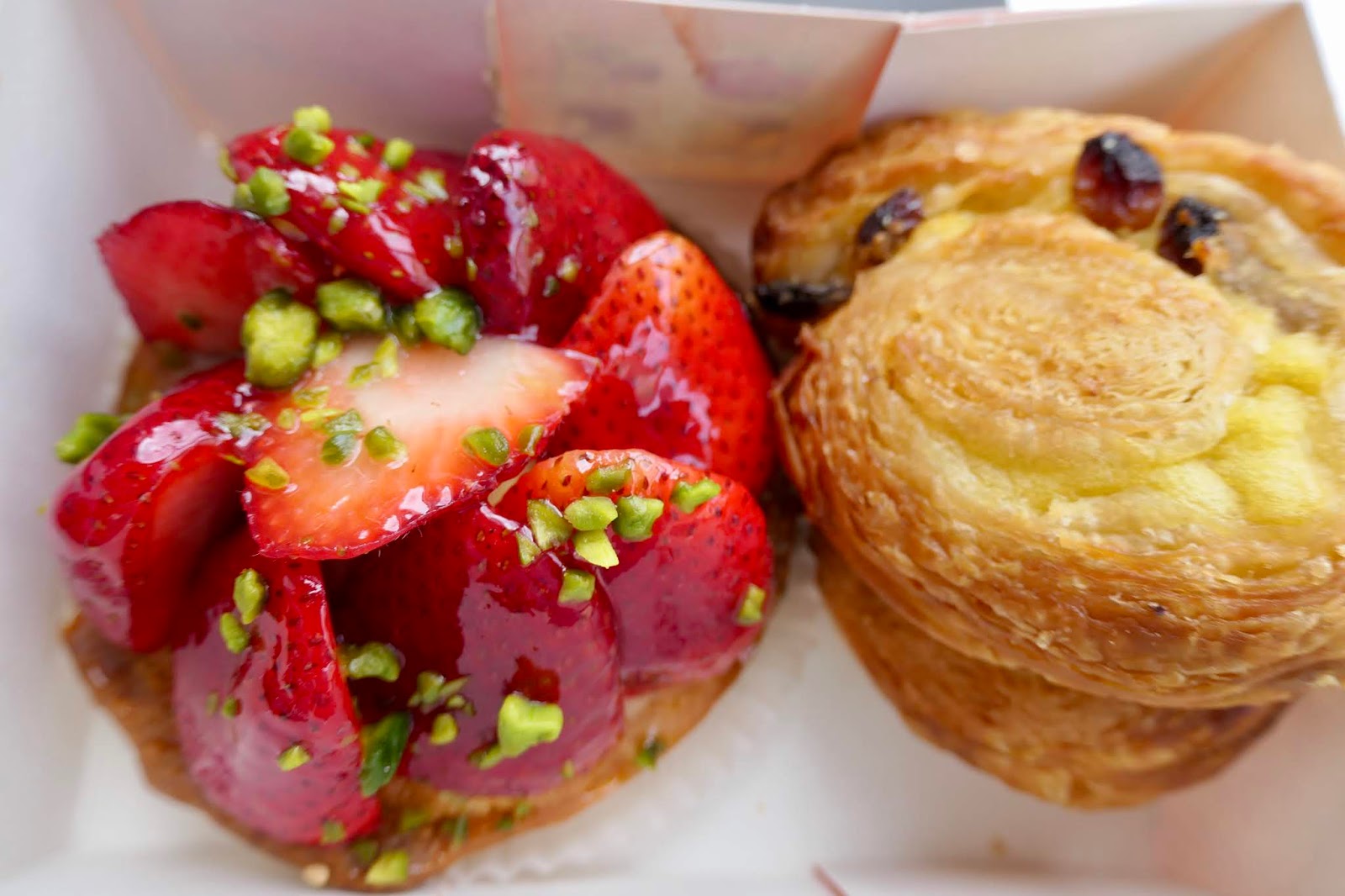
The culture is decidedly French.  We enjoyed our first pain au raison and strawberry tart since we returned from Europe and fresh(ish) baguettes became a staple once again.  I do not mean to imply that a store would sell a day old baguette; only that they were not baked fresh every hour and purchased warm.

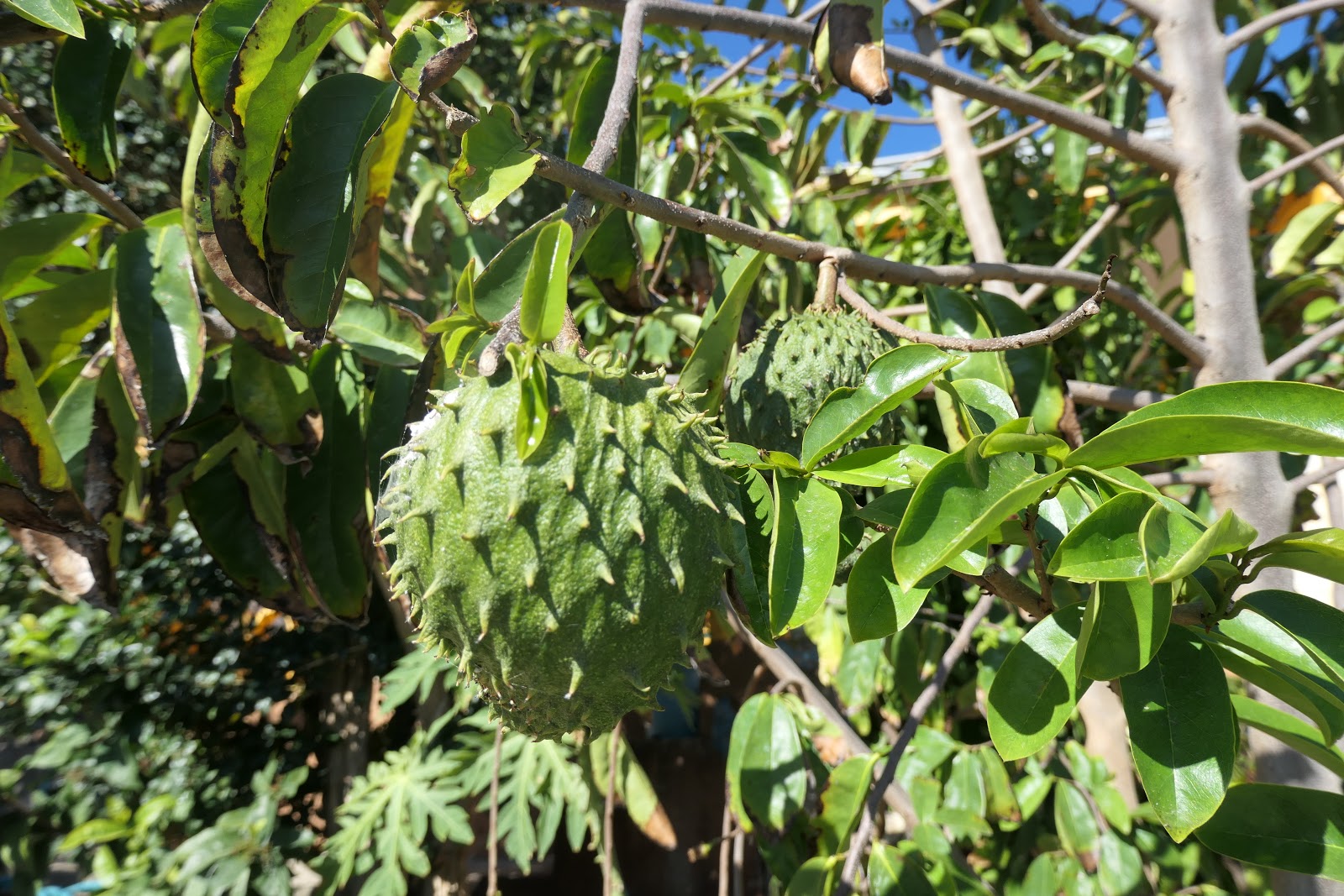
Most food must be imported as the soil is dry and rocky.  However, much like in France, most properties have a collection of well-maintained fruit trees native to the Caribbean (mango, papaya, breadfruit, sour sop, bananas, coconuts…)

Sour sop – Wikipedia describes sour sop (aka custard apple) as having an aroma similar to pineapple with a flavor described as a combination of strawberries and apple and sour citrus flavor and an underlying creamy texture reminiscent of coconut or banana.  We have yet to have the opportunity to try it, but who could resist with that description.

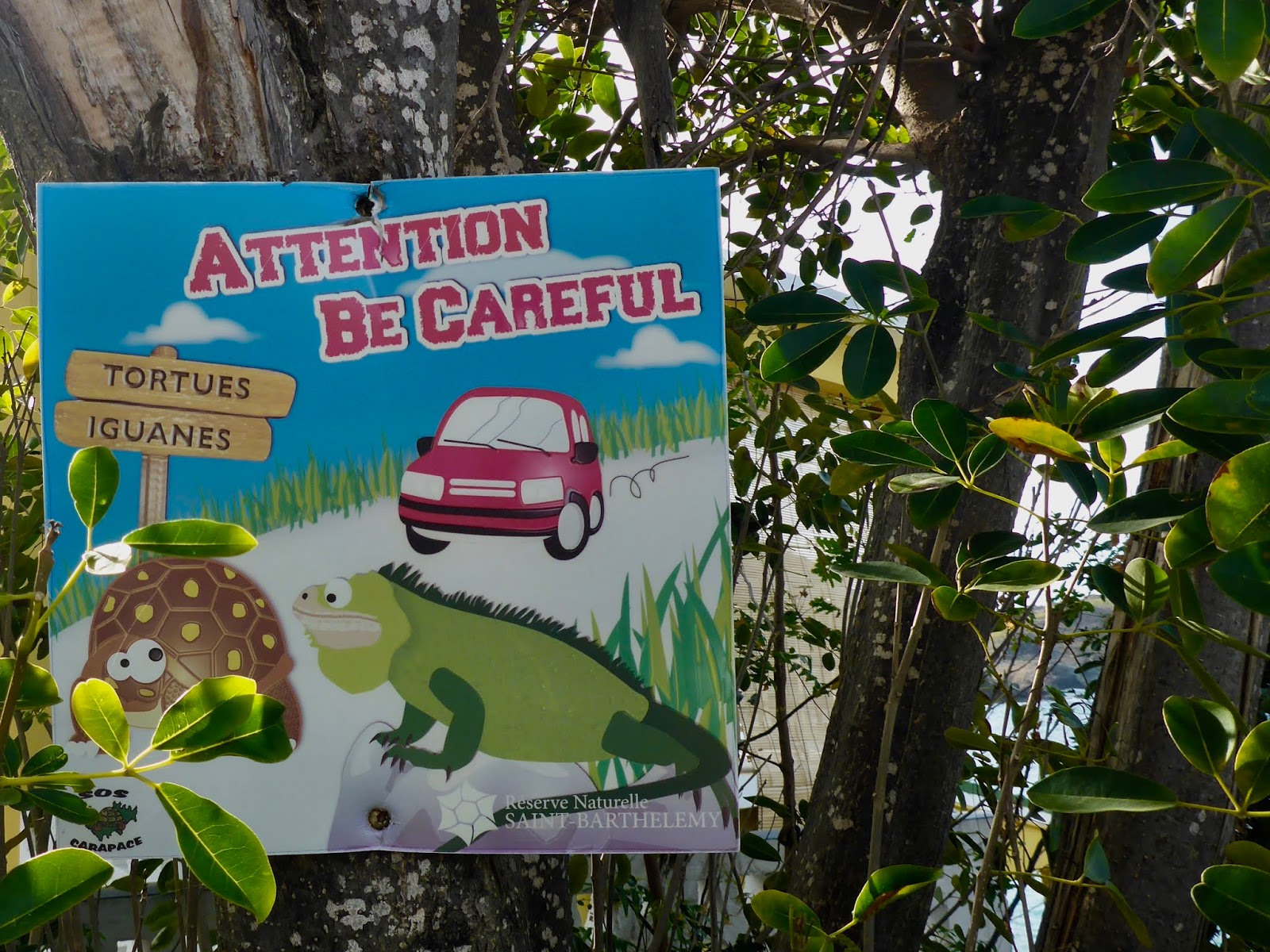
Most natives are indifferent to other people’s dogs.  Duhkxy is learning not to expect pats and praise from everyone he meets (which is a good thing).  He now rarely runs to jump on people unless they encourage him to do so.  He also finds that he is not welcome in supermarkets and many stores.  Restaurants are about 50:50 as to whether they will permit a dog to enter and many beaches are off limits.  The beach restriction is primarily to ensure dogs do not disturb turtle nests, but it sure has been hard on Duhkxy, who loves nothing more than to run and play in the sand.

EVEN IF IT TAKES A WHILE TO DOWNLOAD THIS SHORT VIDEO, PLEASE BE PATIENT.  YOU WON’T WANT TO MISS DUHKXY SHOWING HIS GREAT LOVE FOR SAND AND BEACH.

The capital of St. Barts is Gustavia, a very beautiful town with a busy marina and crowded anchorage.  As such, we anchored Ice Floe in a cove, Anse de Colombier, a short distance away and visited St Barts by dinghy and by car.

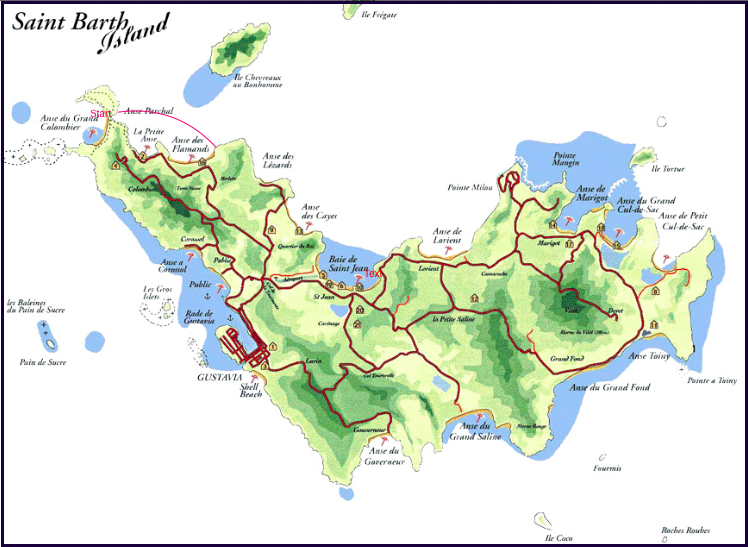
The island , just 9.7 square miles, is very small, even when compared to most of the small Caribbean Islands.

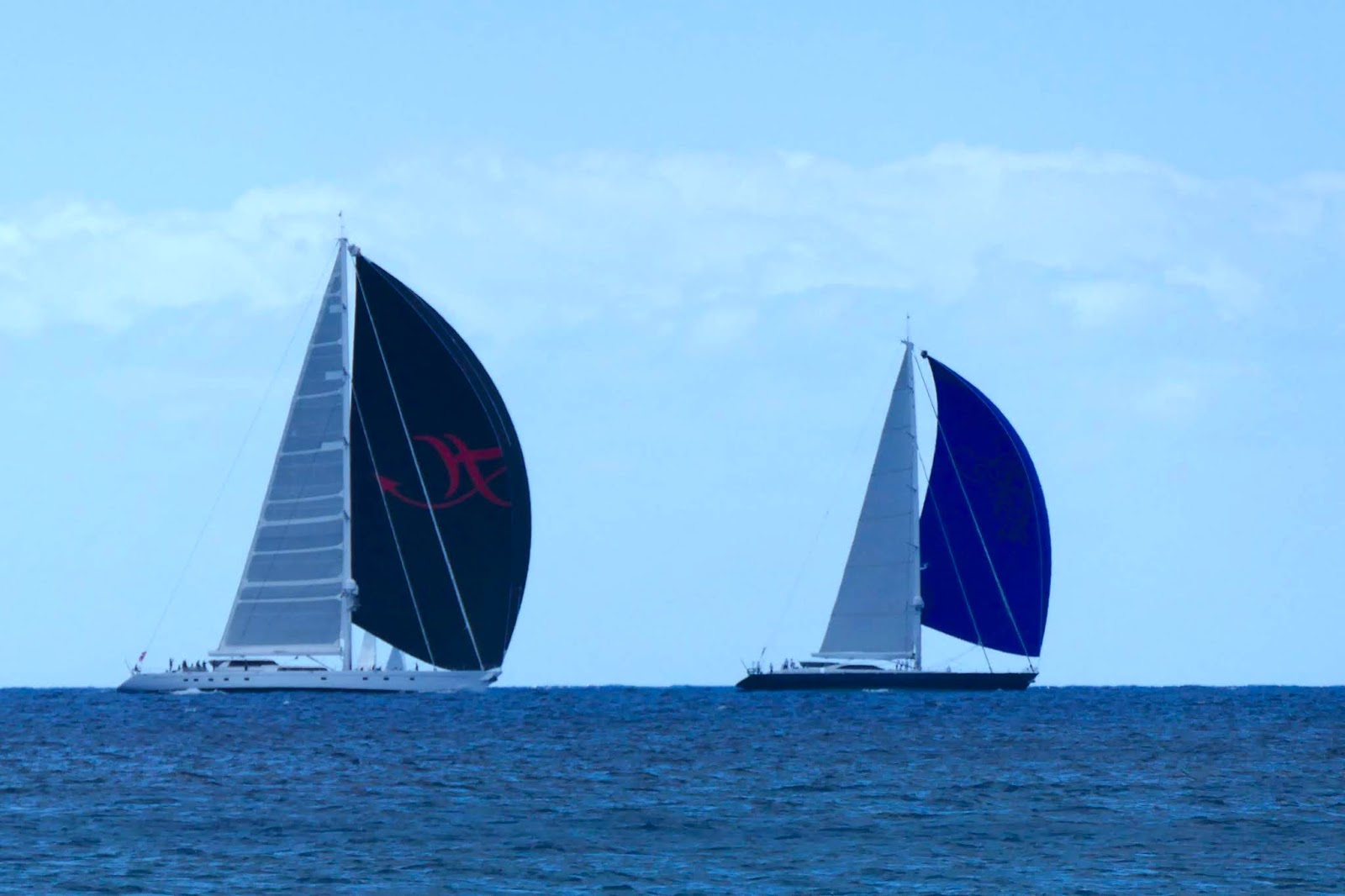
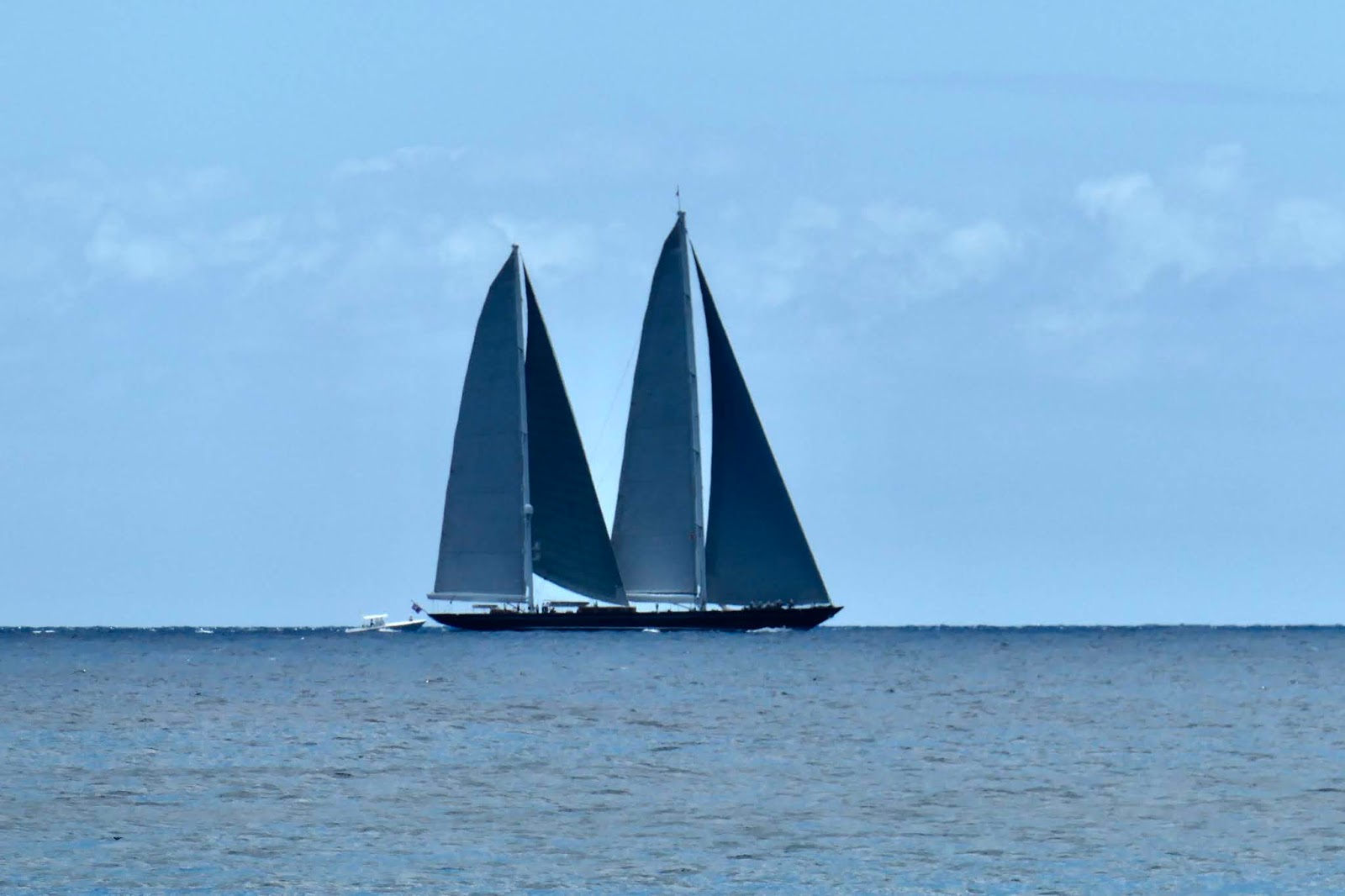
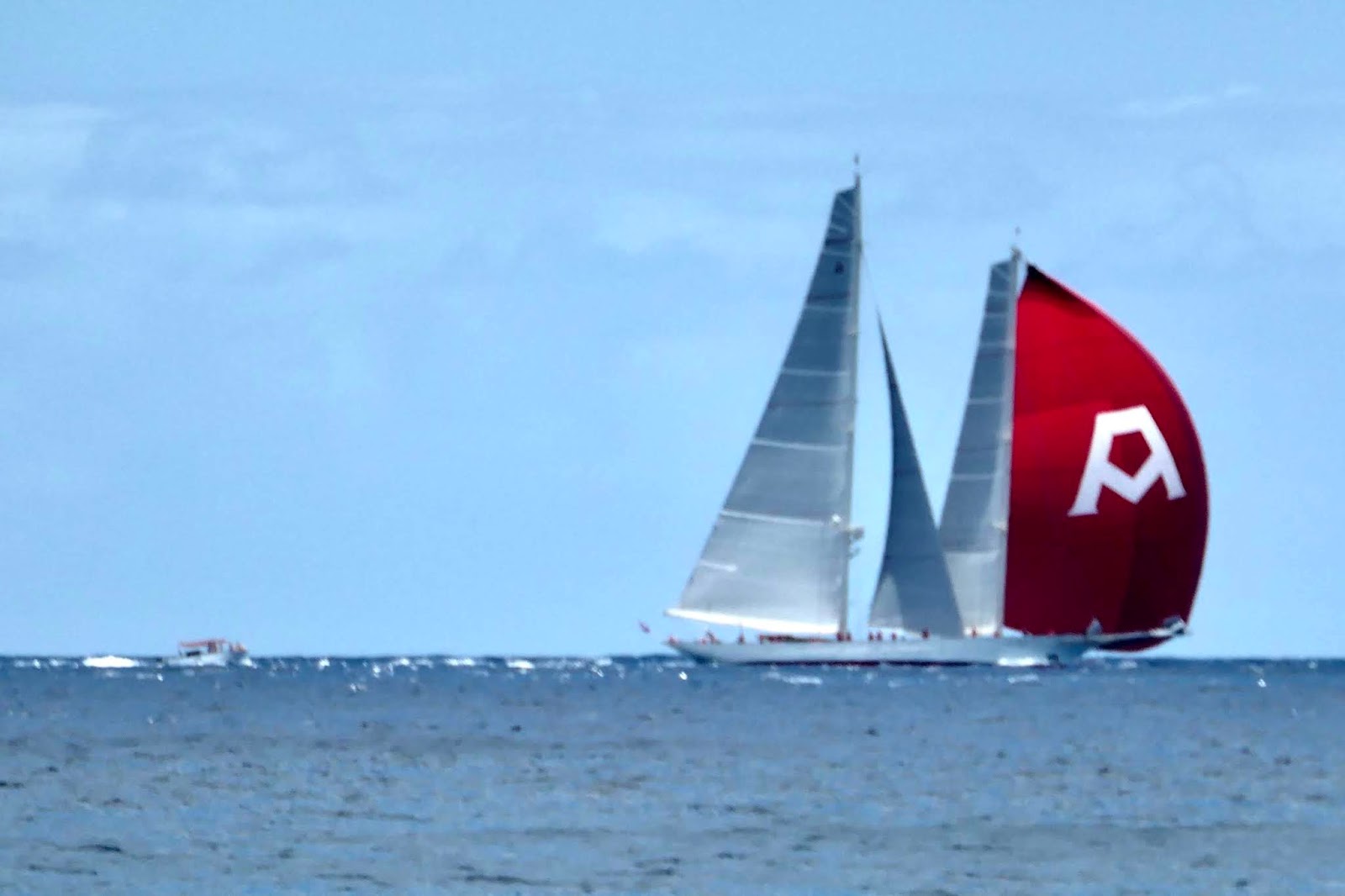
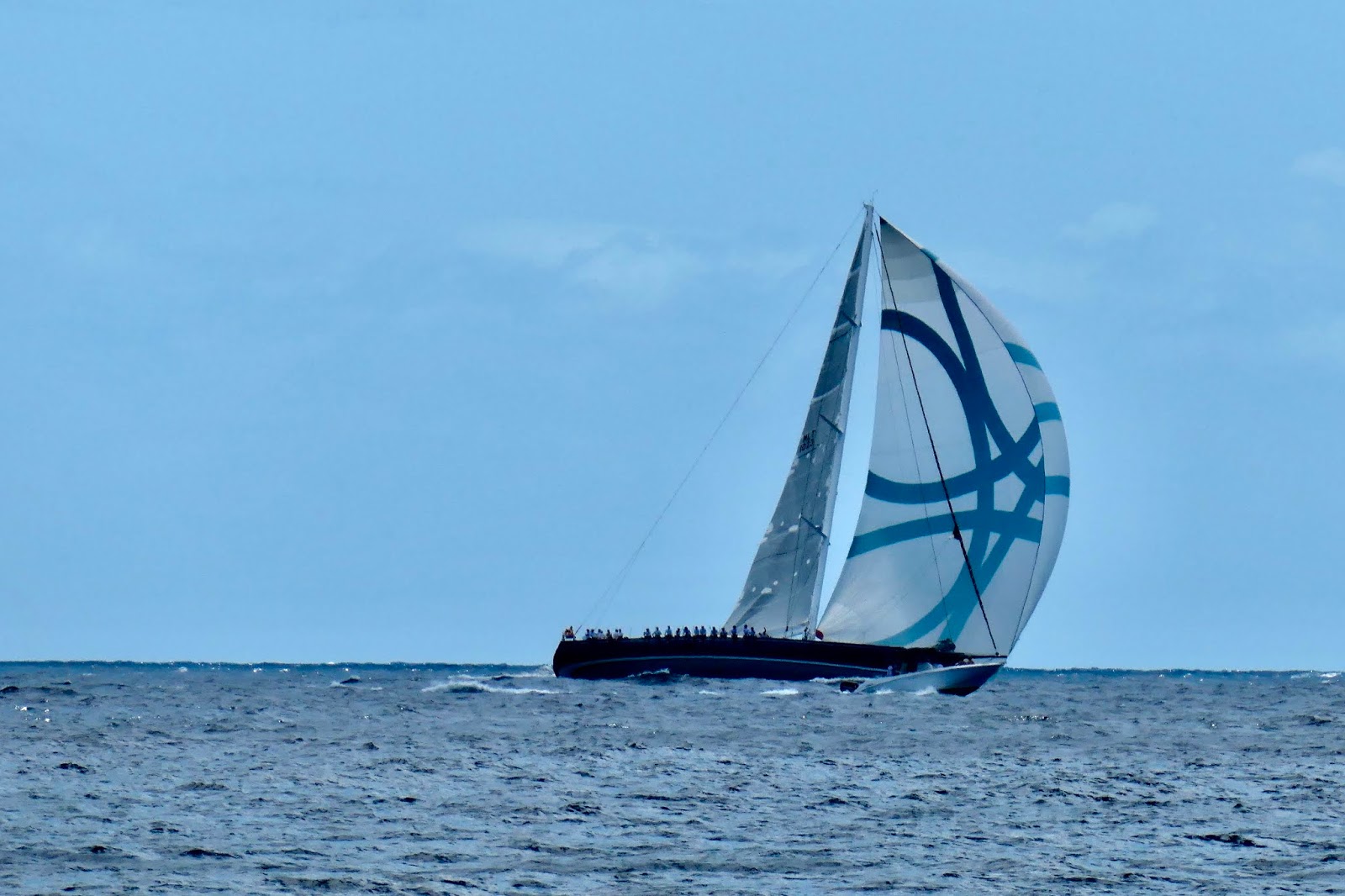
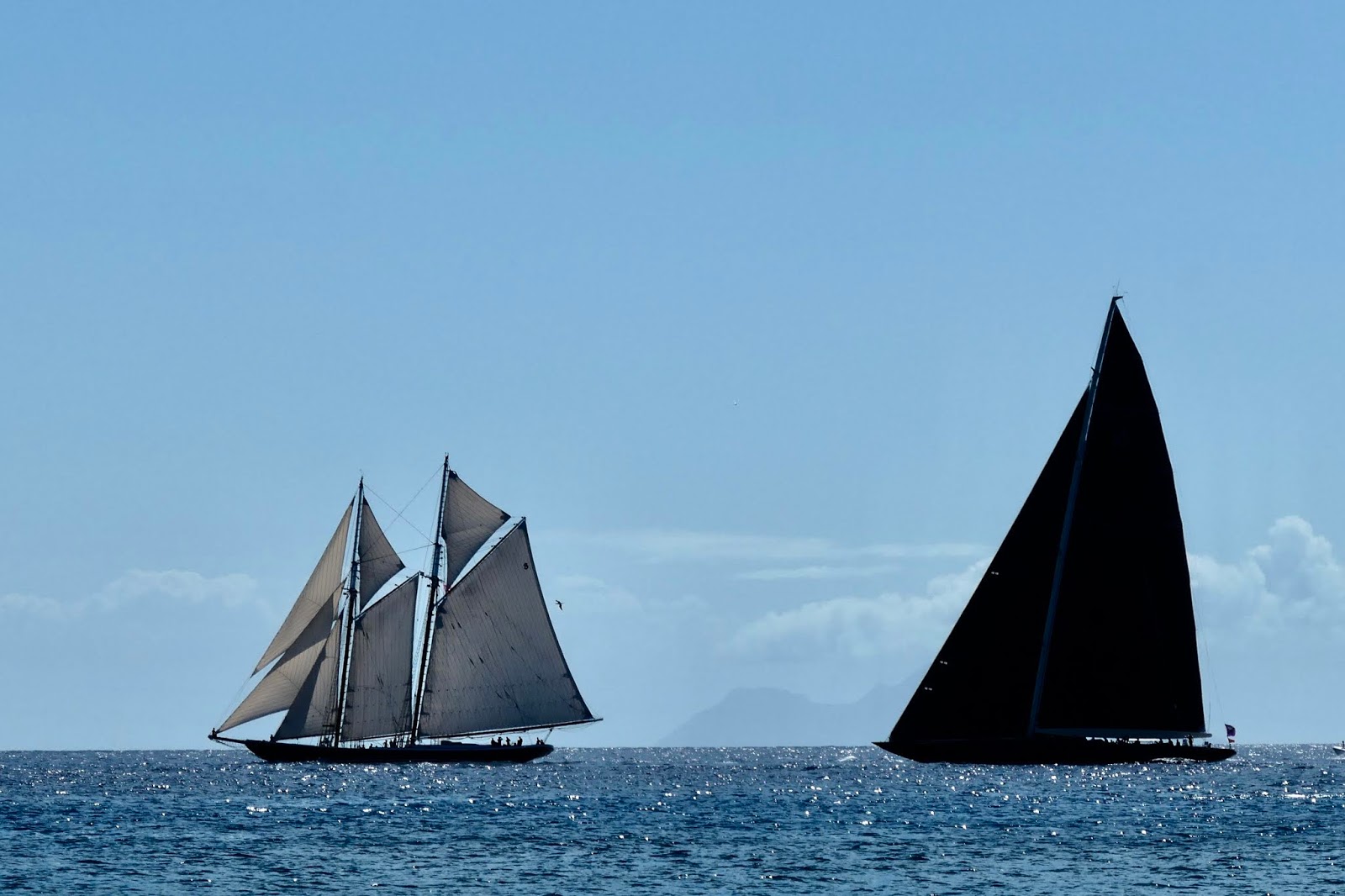
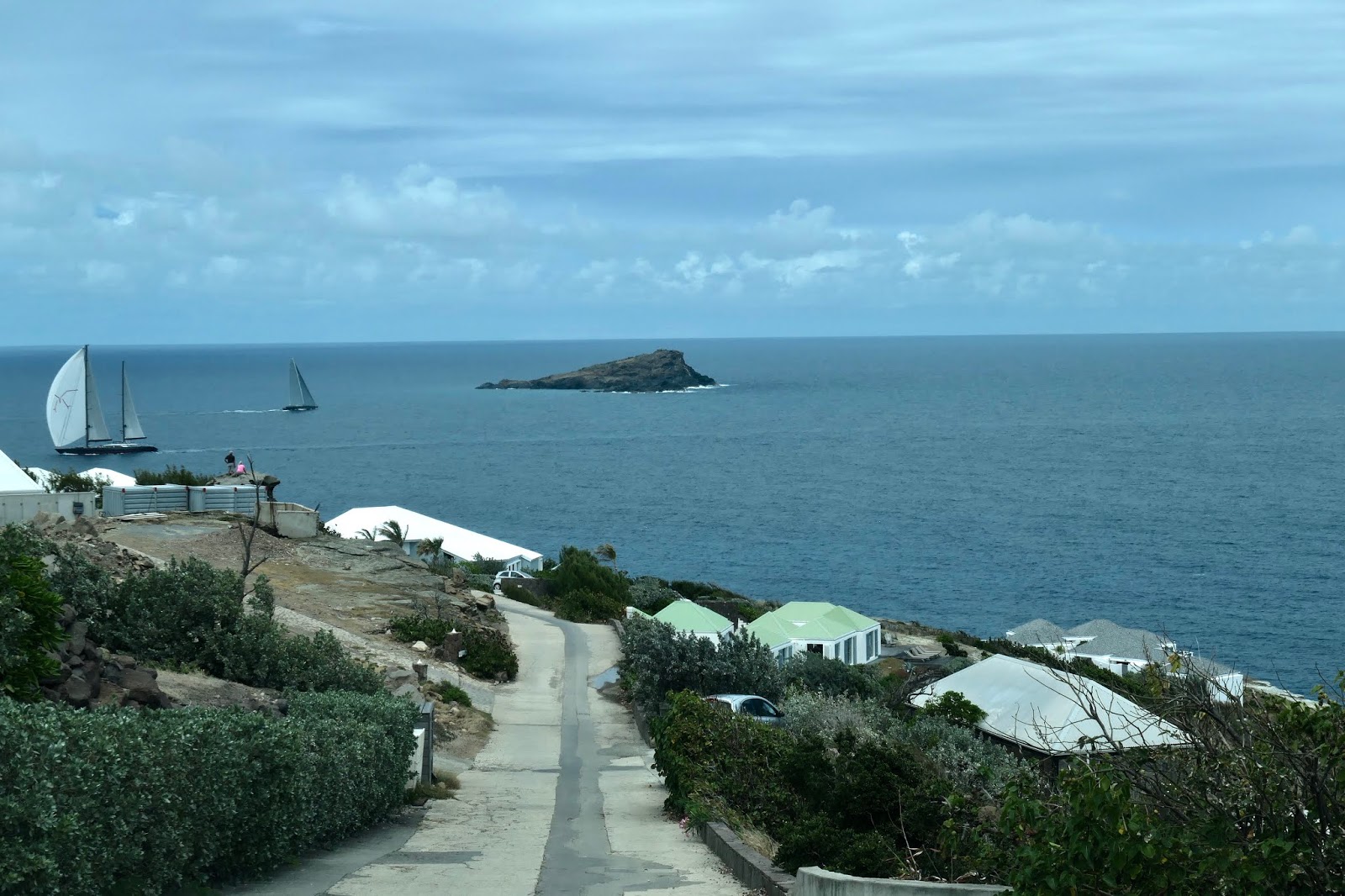
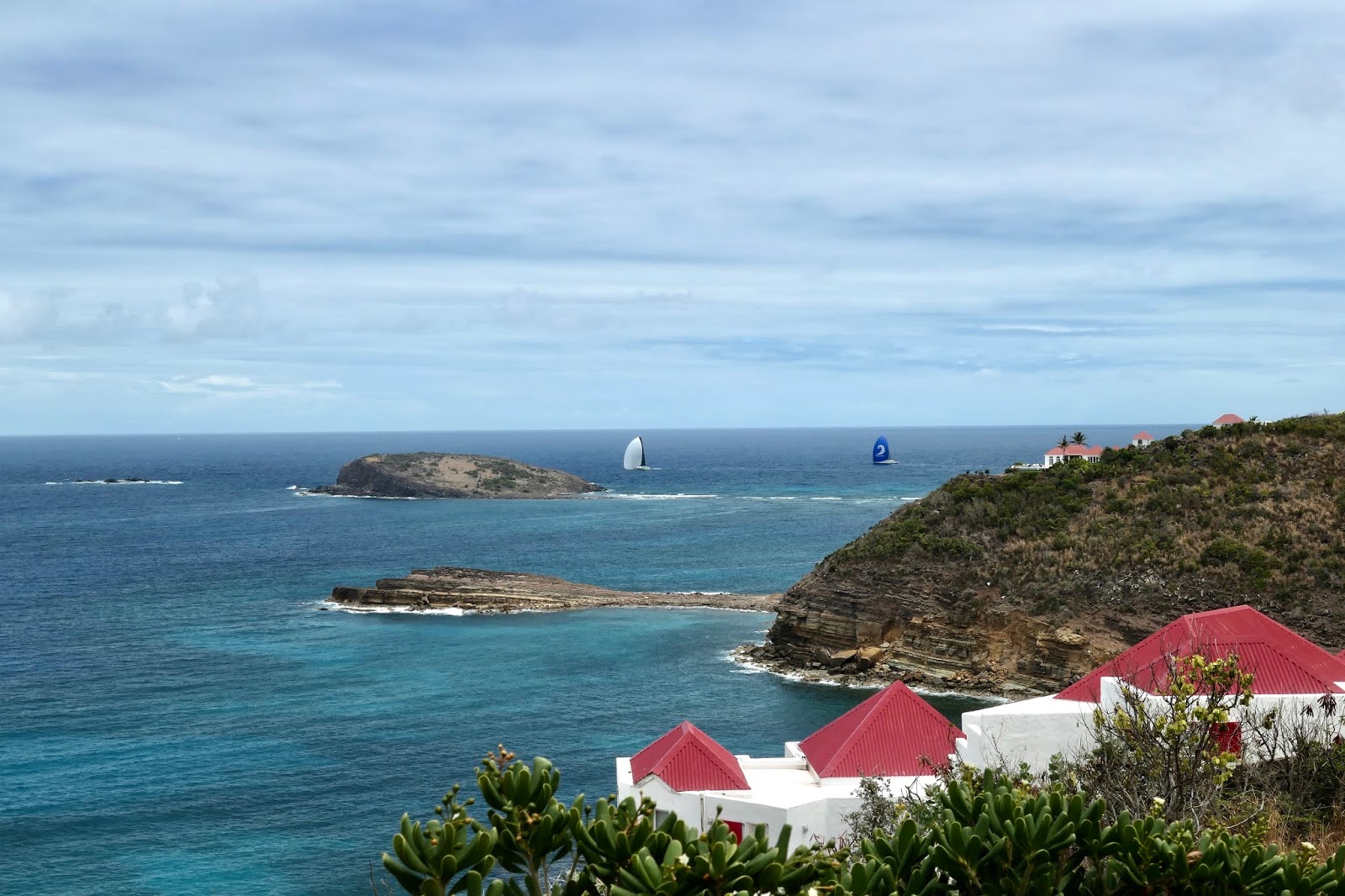
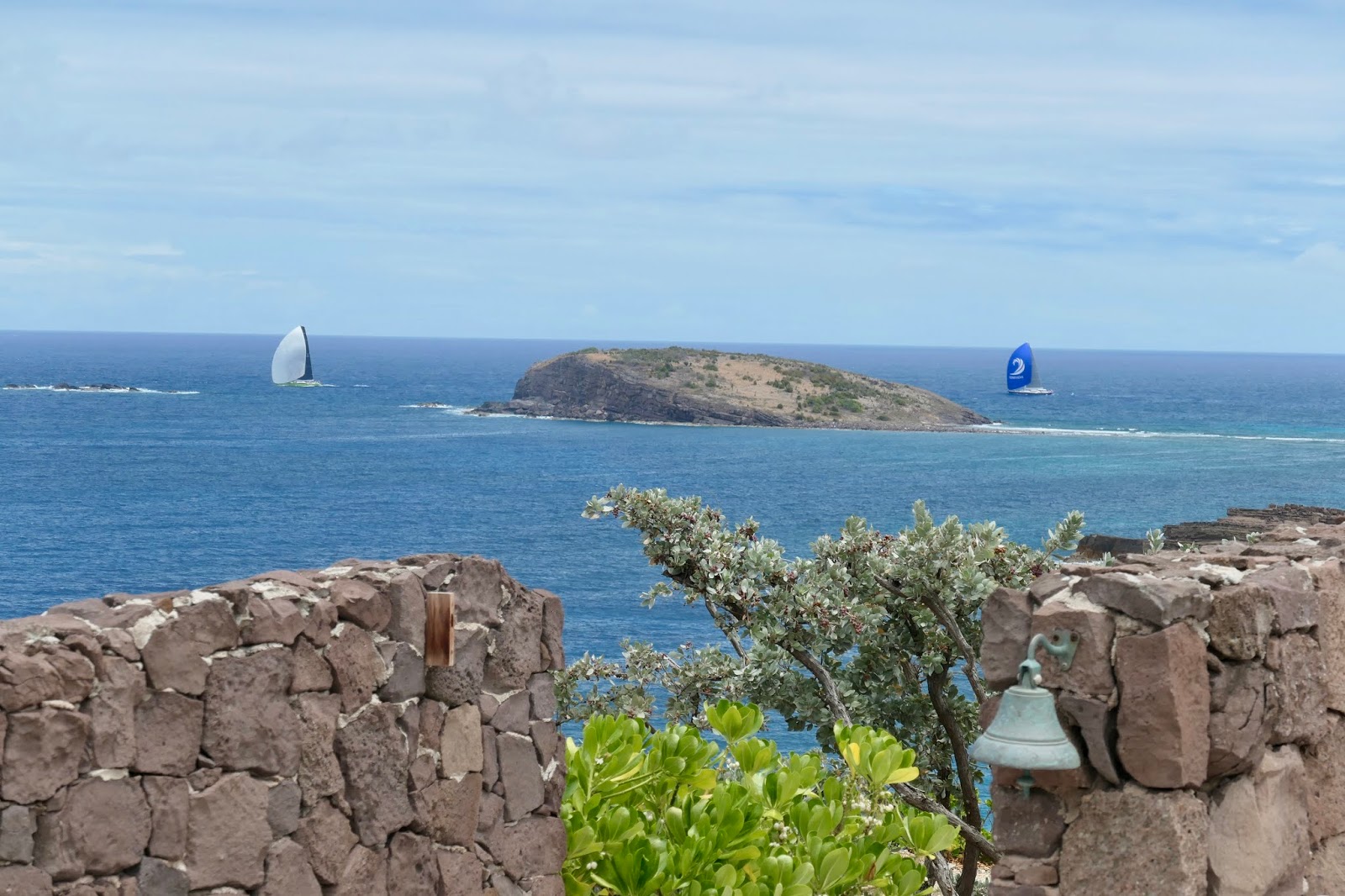
On the evening we arrived, the Gustavia marina and harbor were full of enormous sailing yachts.  We learned shortly afterward that a series of sailboat races was planned for the weekend.  The contestants were by invitation only and qualifying sailboats had to be a minimum of 30 meters in length.  What a sight!!

These boats sailed neck and neck in relatively light wind
These two goliaths sailed so close to each other they sometimes looked like a single vessel with a bizarre attire of sails.  The one created a wind shadow for the other, perpetually keeping it a bit behind.
An unusual instance in which competing boats chose vastly different sails
All the ships carried dozens of people to serve as ballast to minimize healing
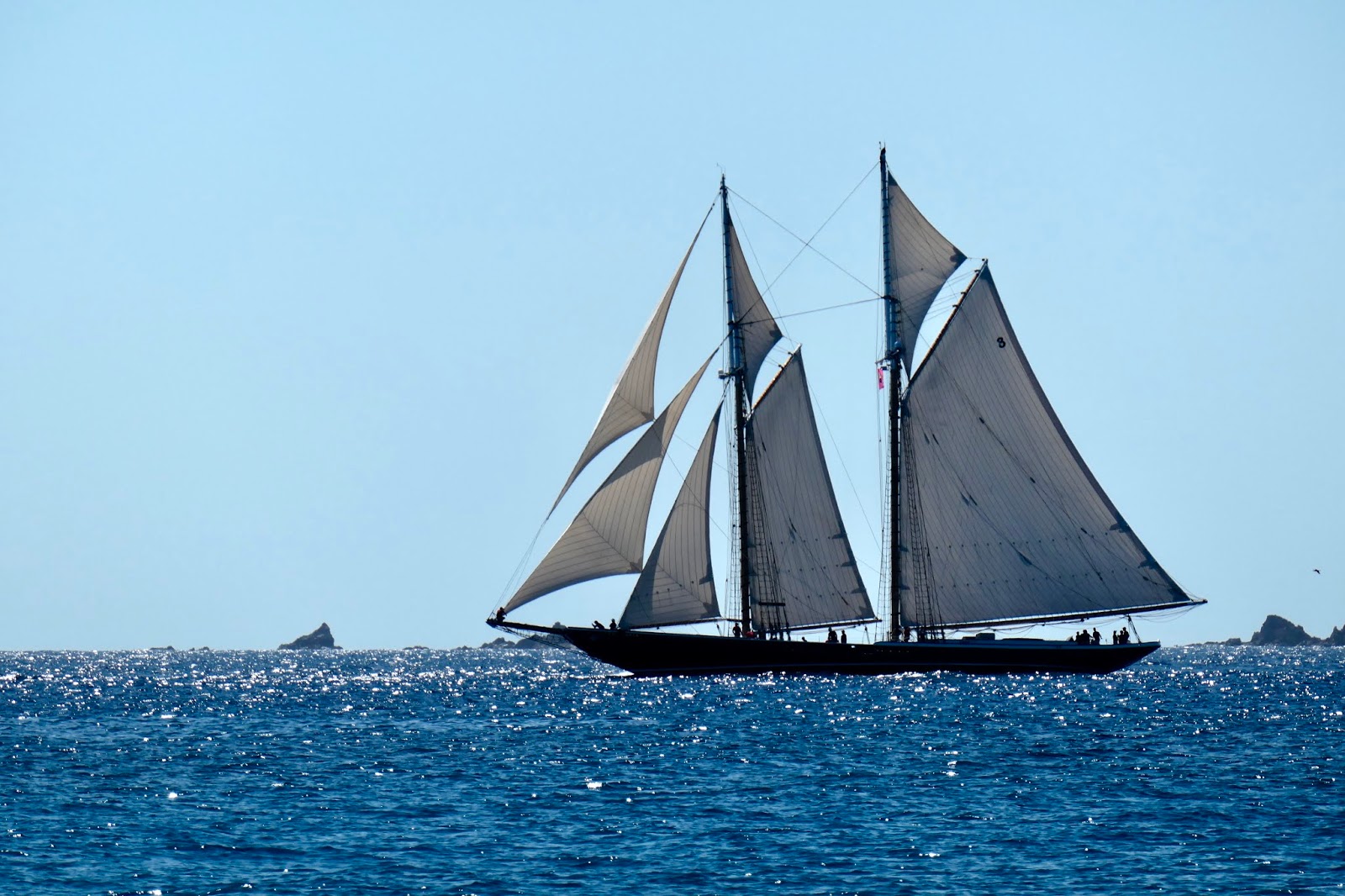
Some beautiful classic sailboat types participated
The lovely schooner was so swiftly overtaken by this sleek, black sloop, it looked like it was standing still

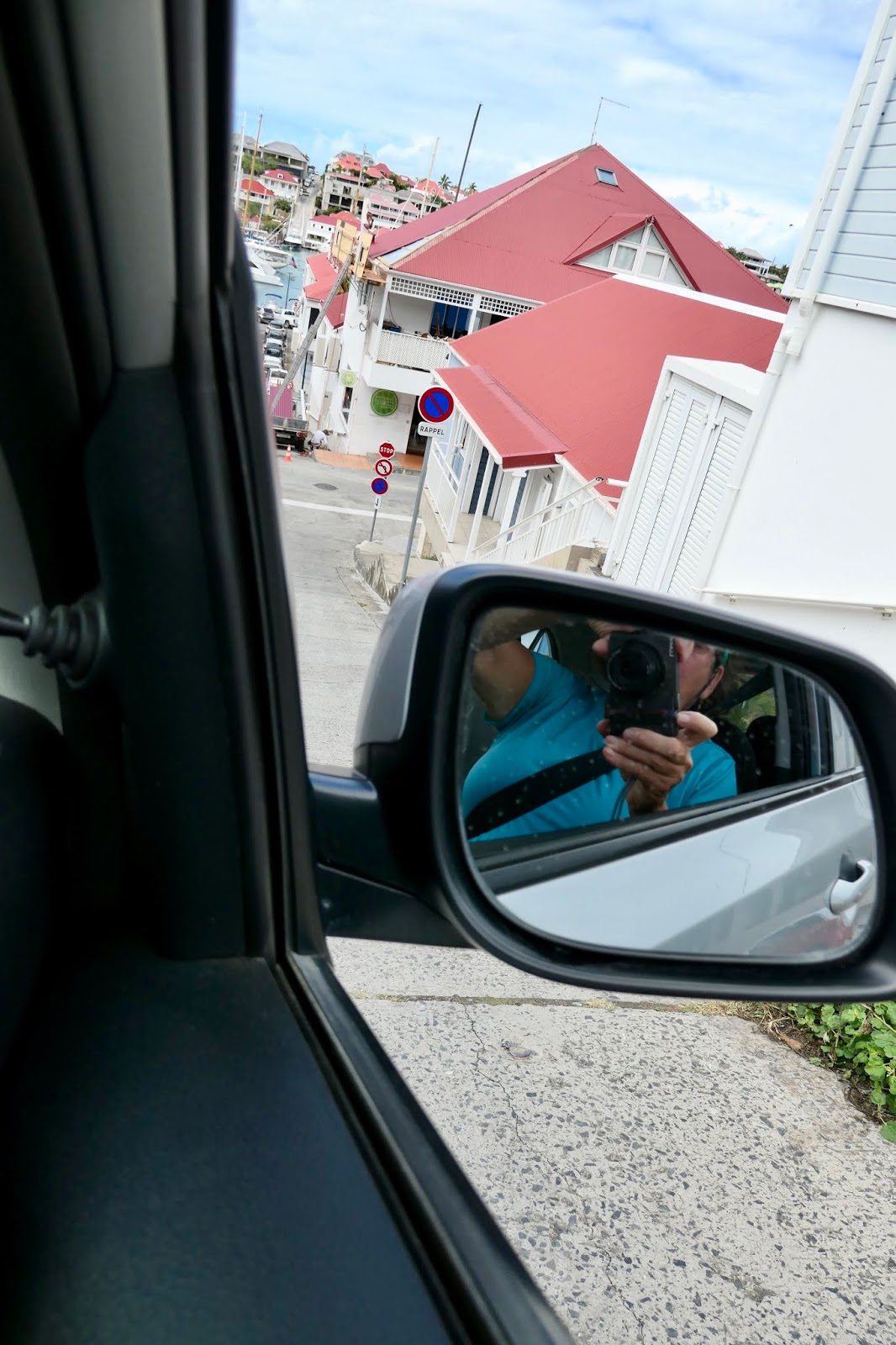
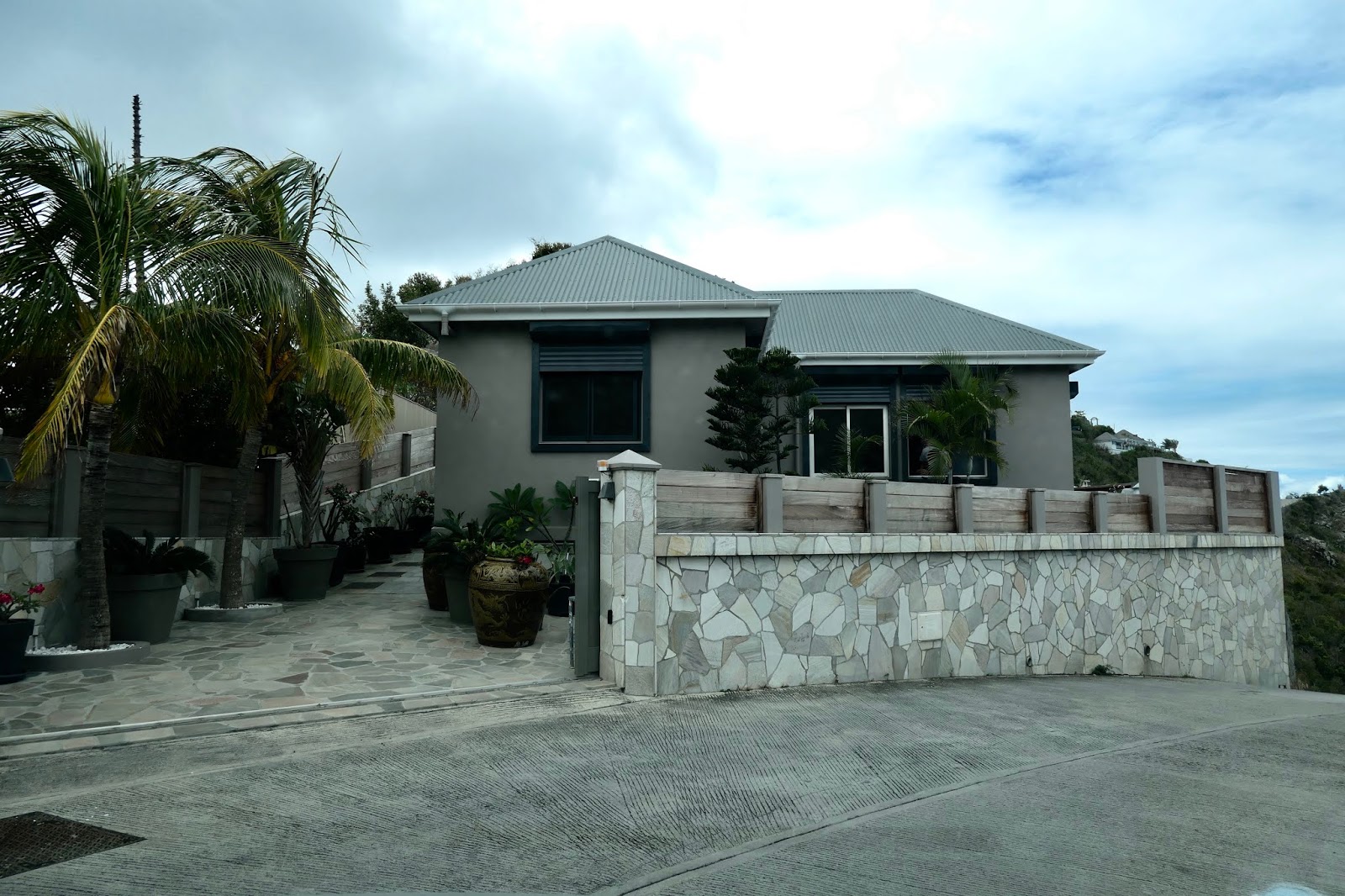
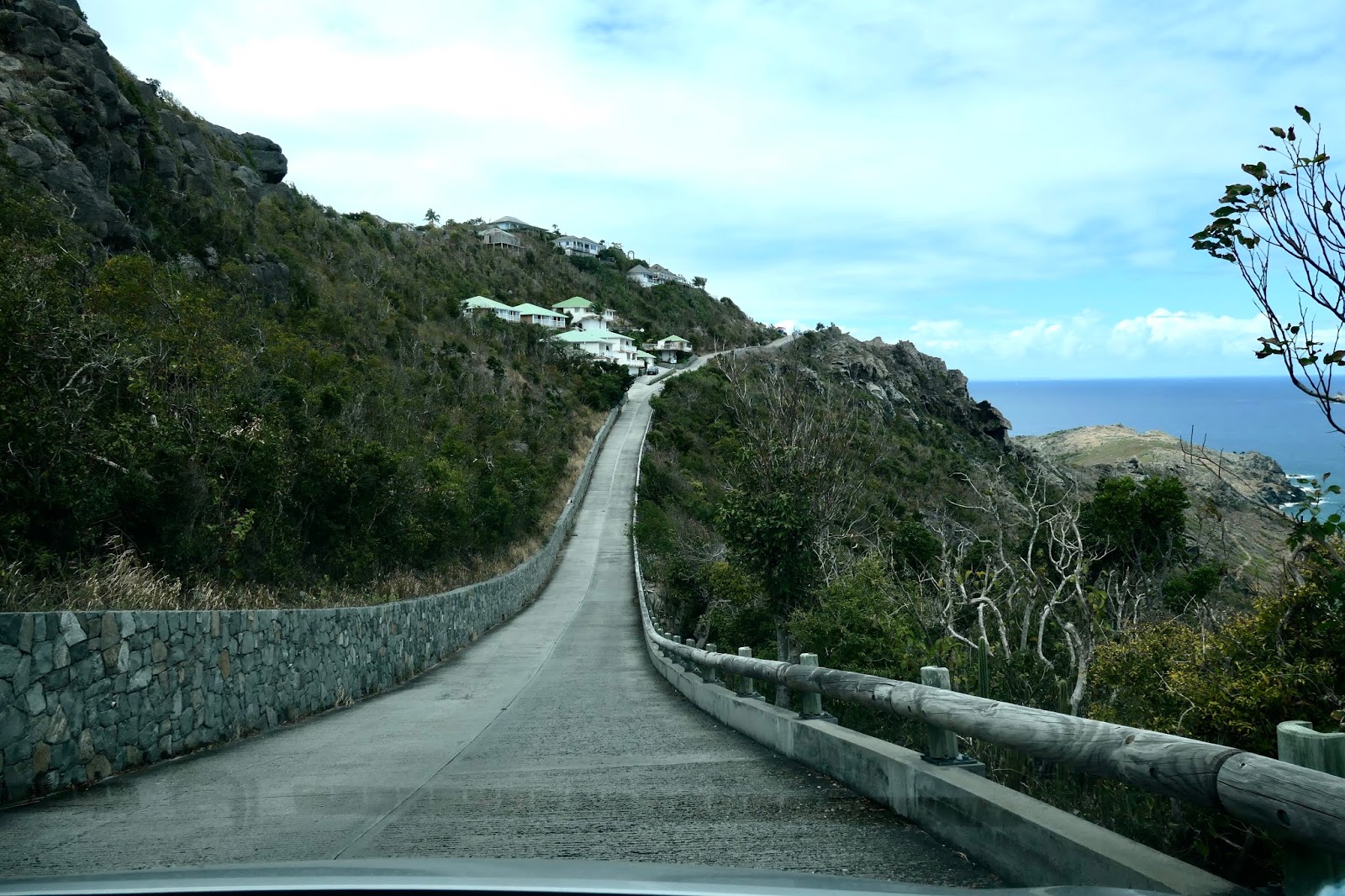
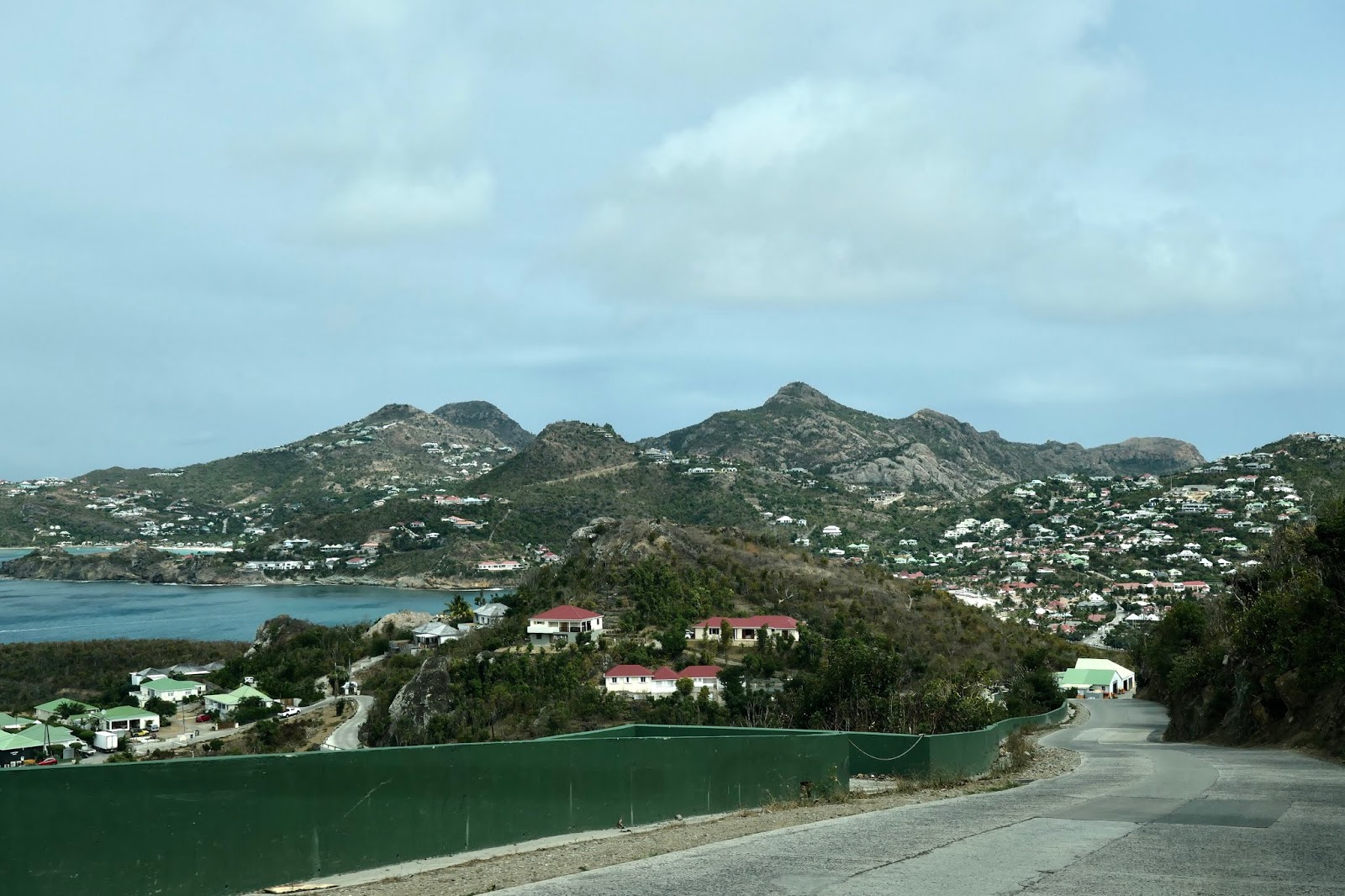
To see more of St. Barts, we rented a car and traveled every public road on the island.  Our first road rivaled the steepness of anything you have seen or driven on in San Francisco.

Photo absolutely fails to show how steep this road was.

We finished our week’s visit St Barts on one of its small, unihabited, islands, Isle Fourchue.

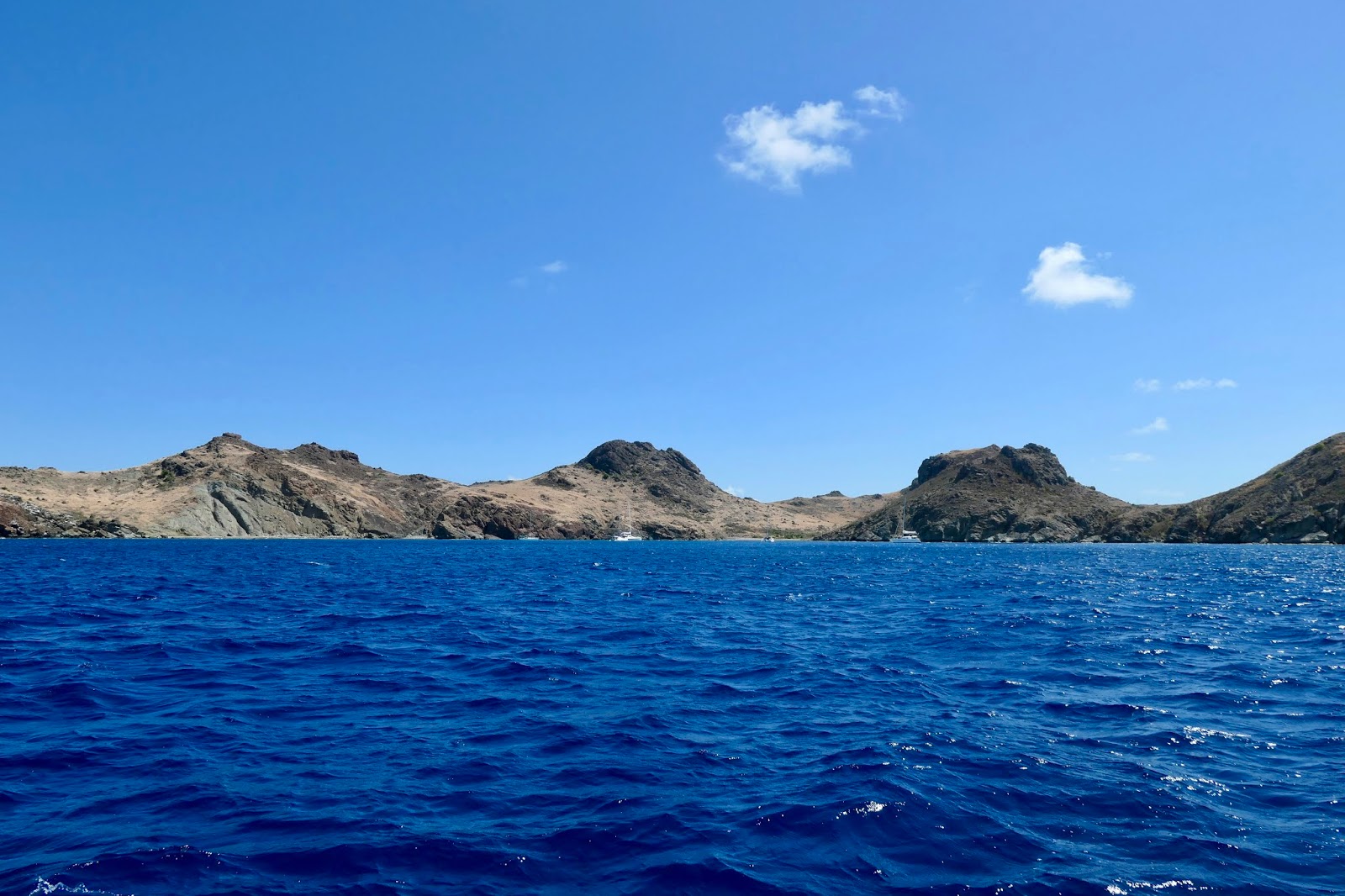
We anchored in the cove where you see a couple of other boats in this photo and spent two days exploring and watching the sailboat races.

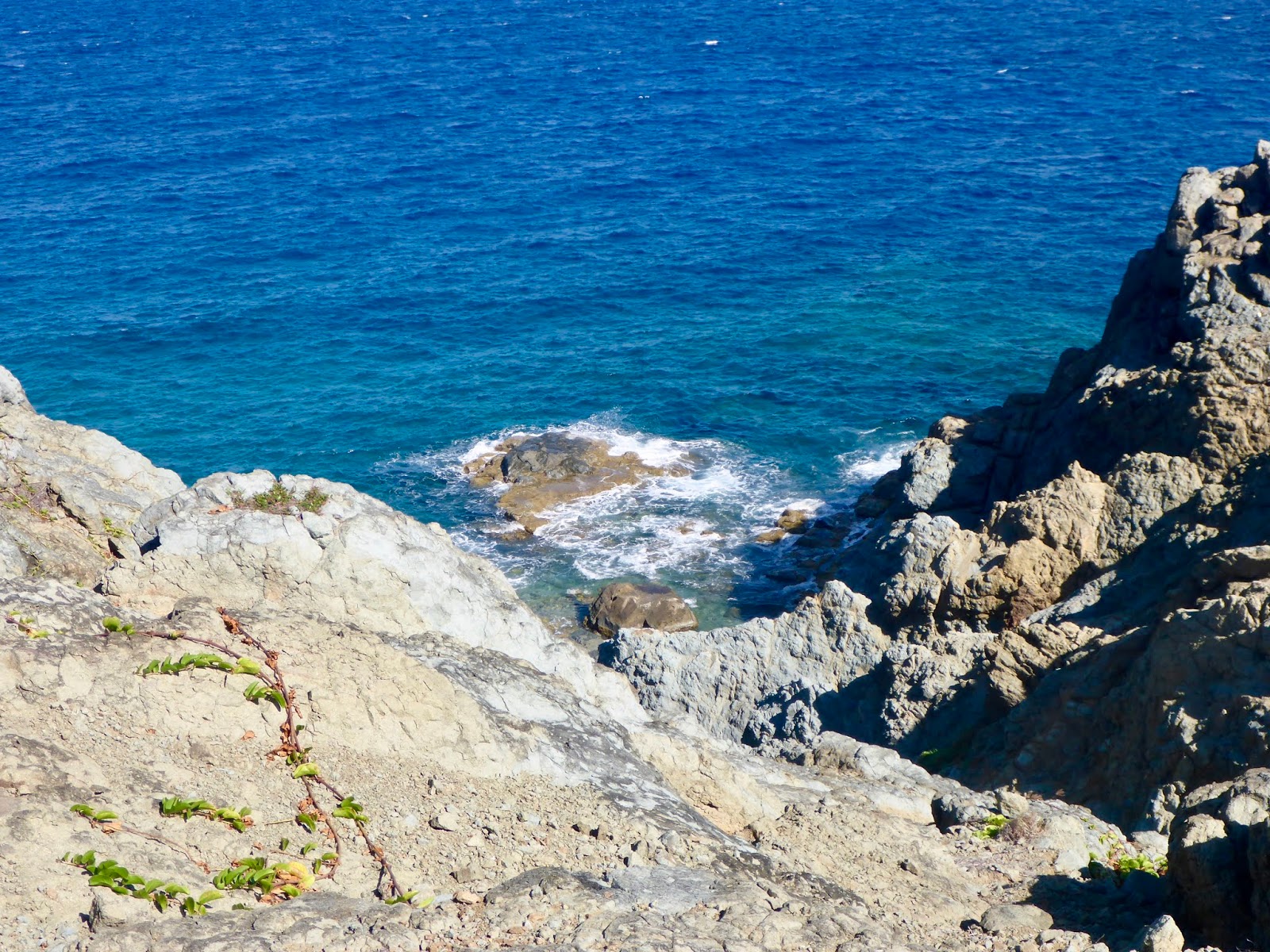
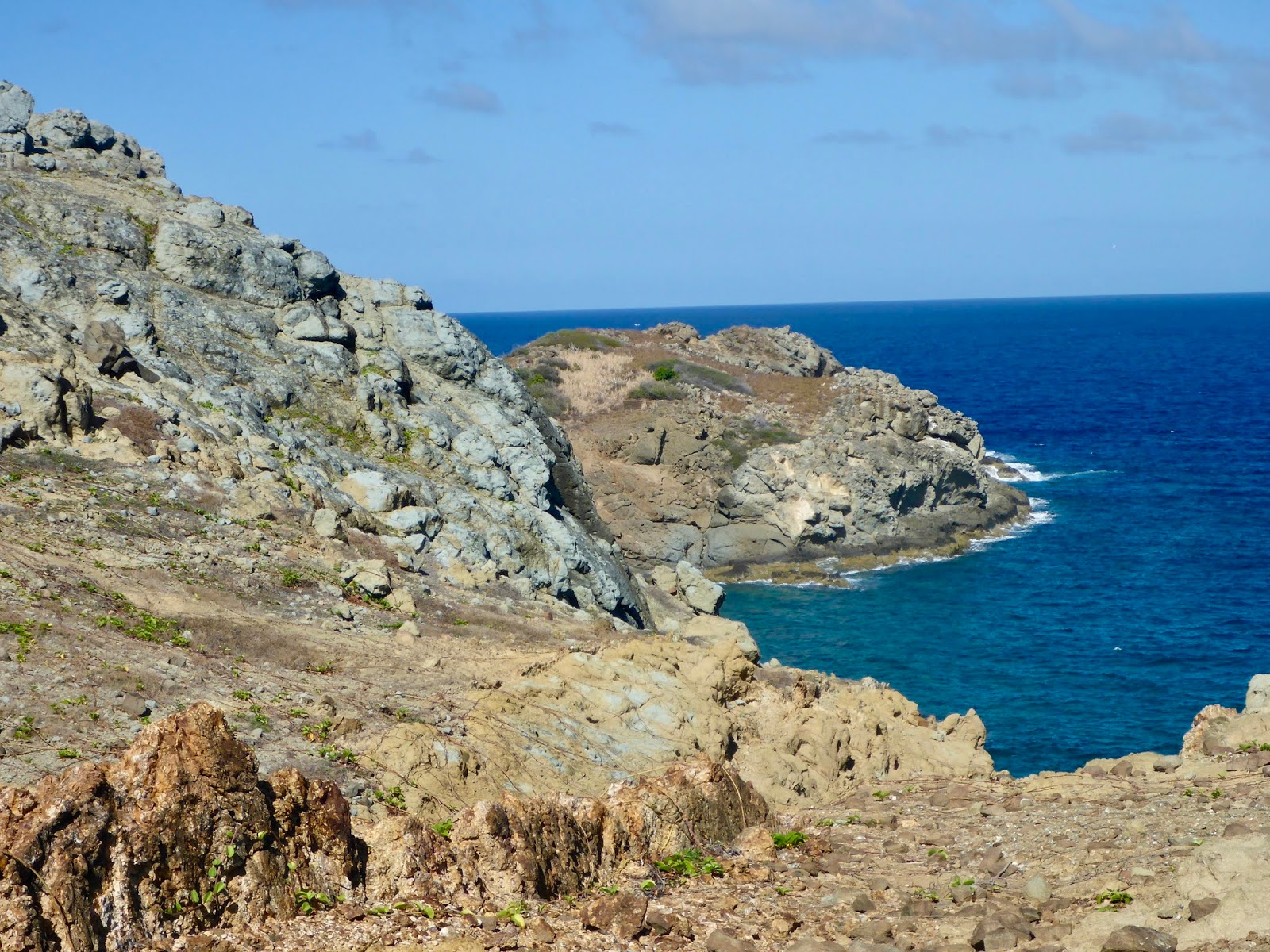
This barren, rocky, island was once home to many goats.  Unfortunately, they exhausted the food supply and the few remaining, after most starved, were relocated.

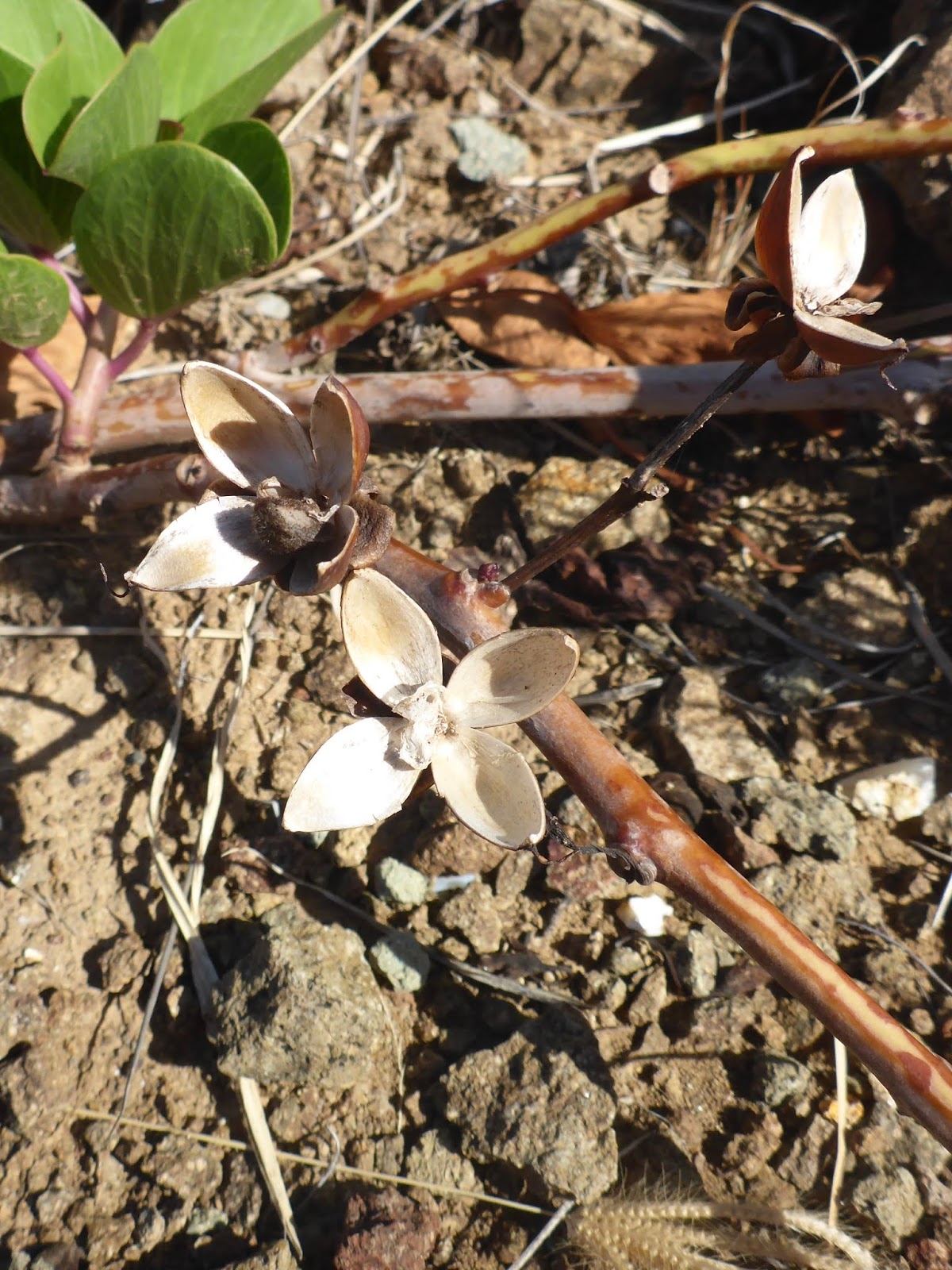
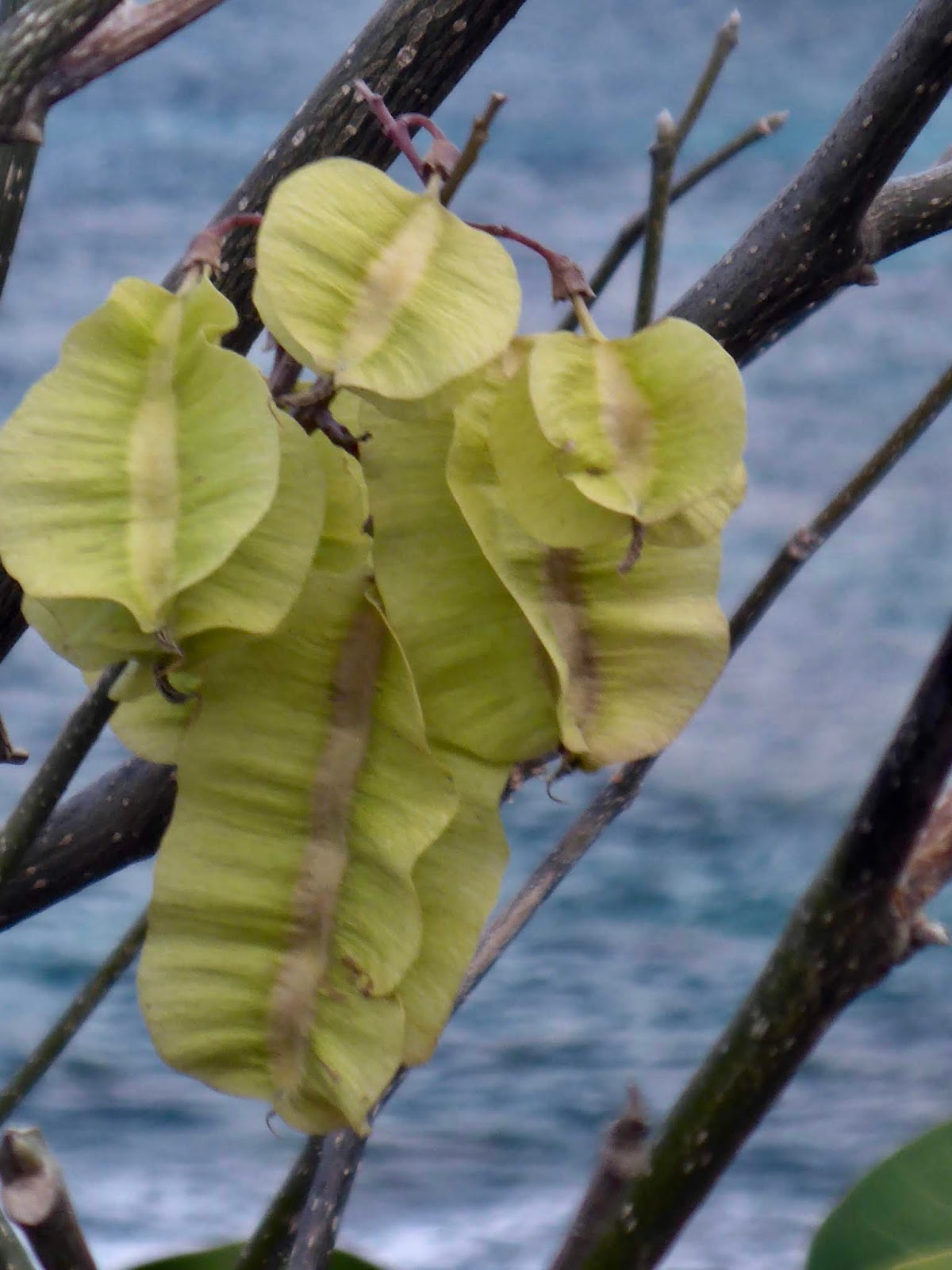
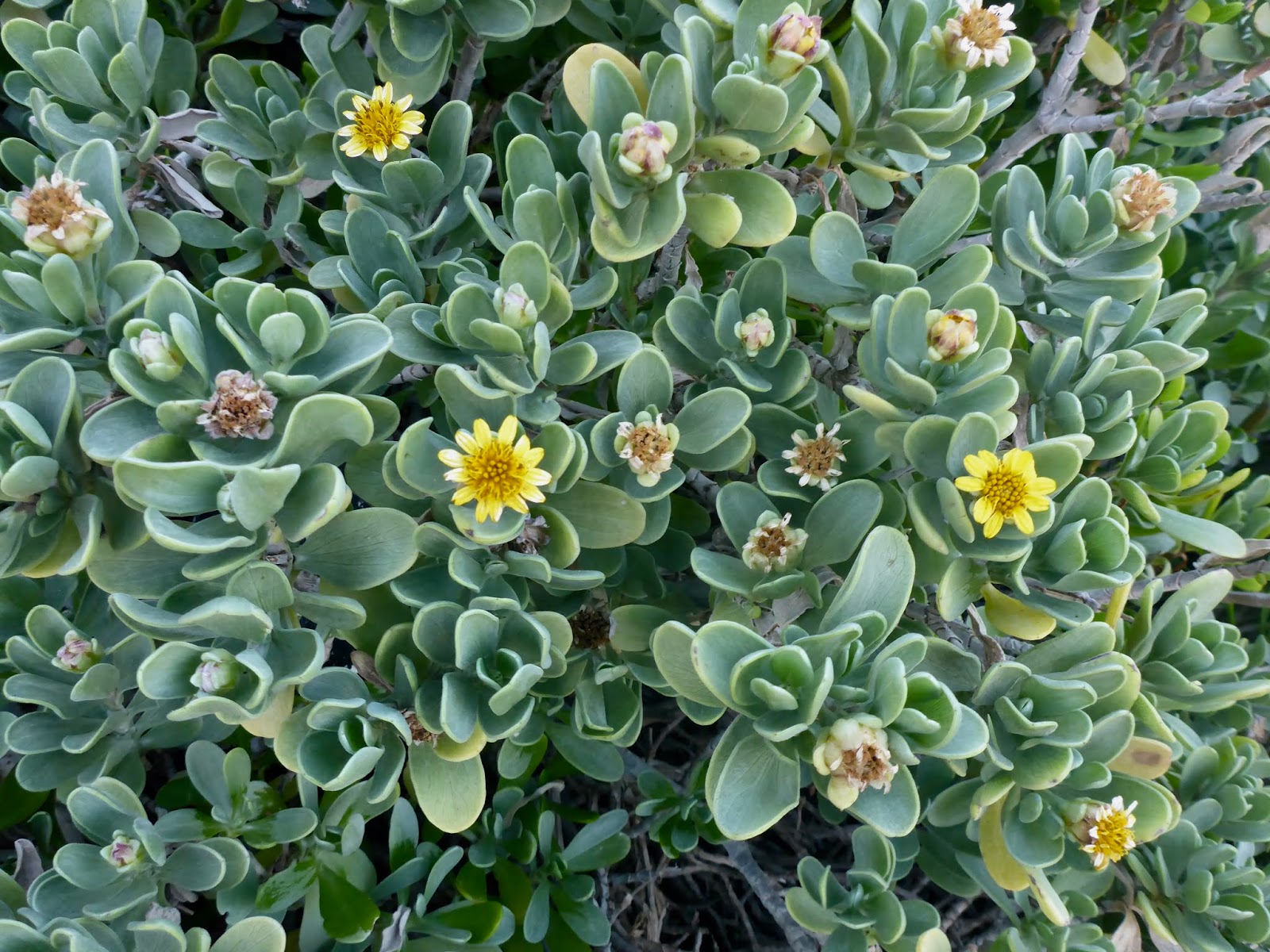
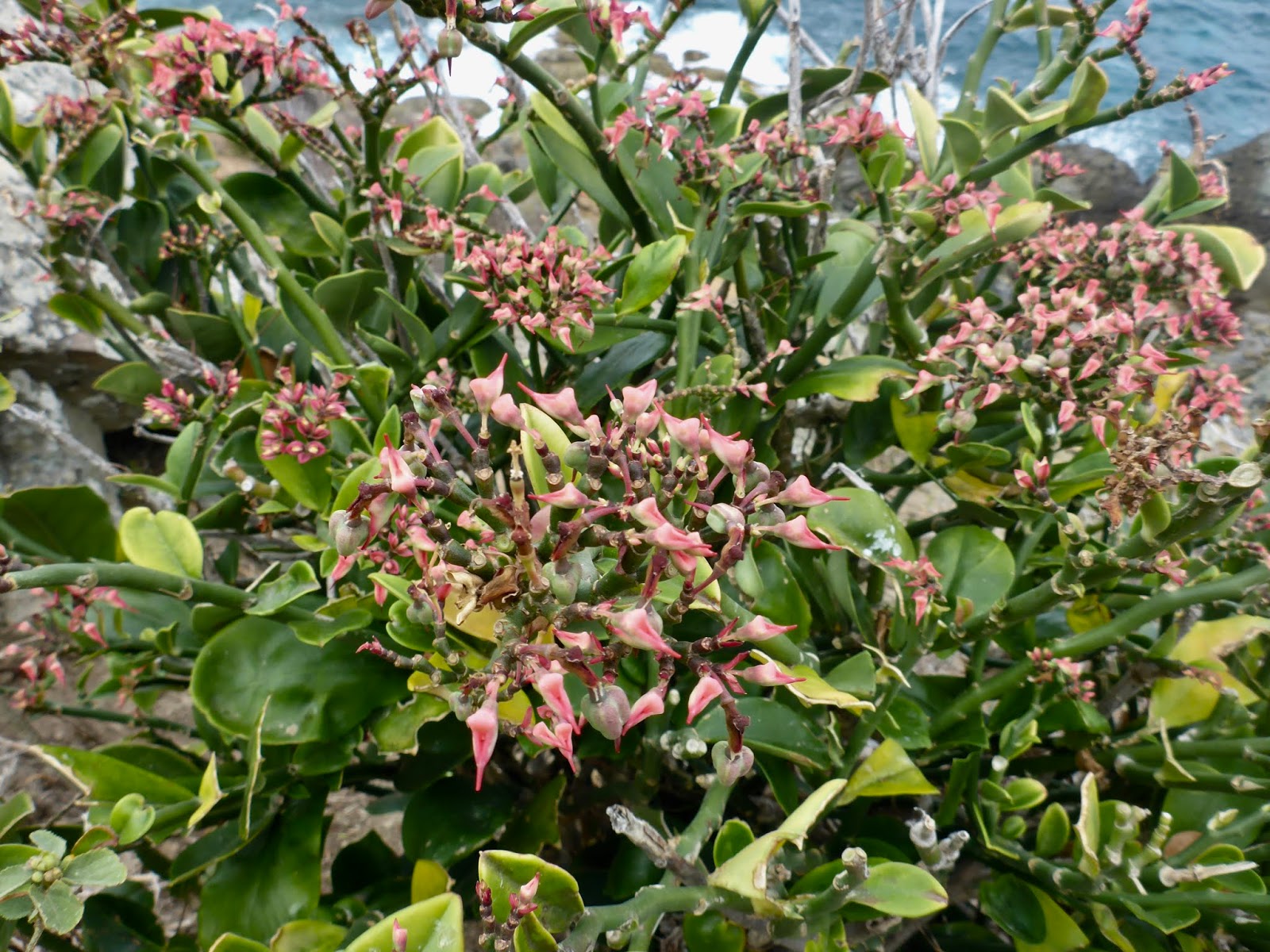
This sparcely-leafed vine left behind seed pods that sprung open and resembled silver flowers.
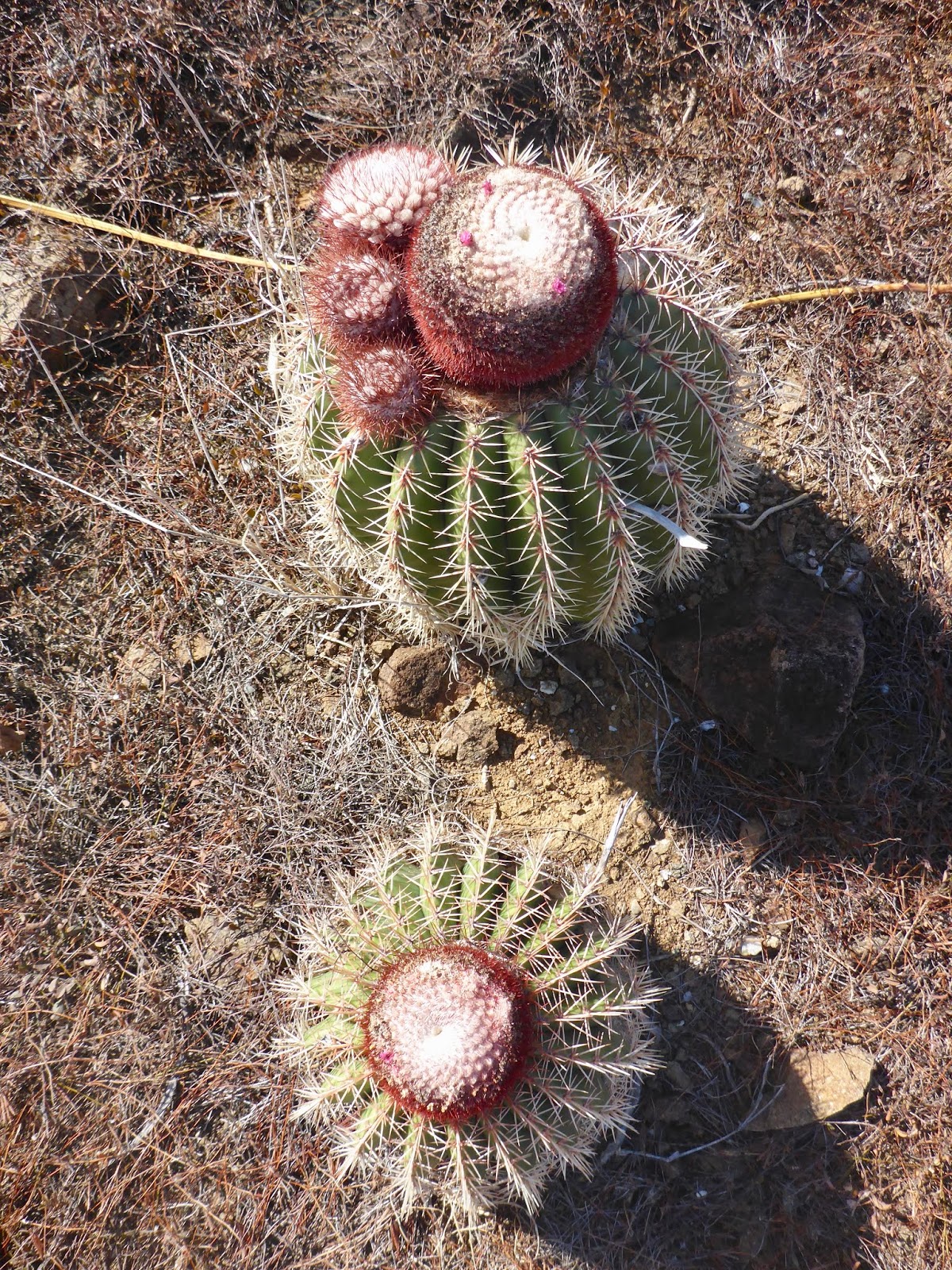
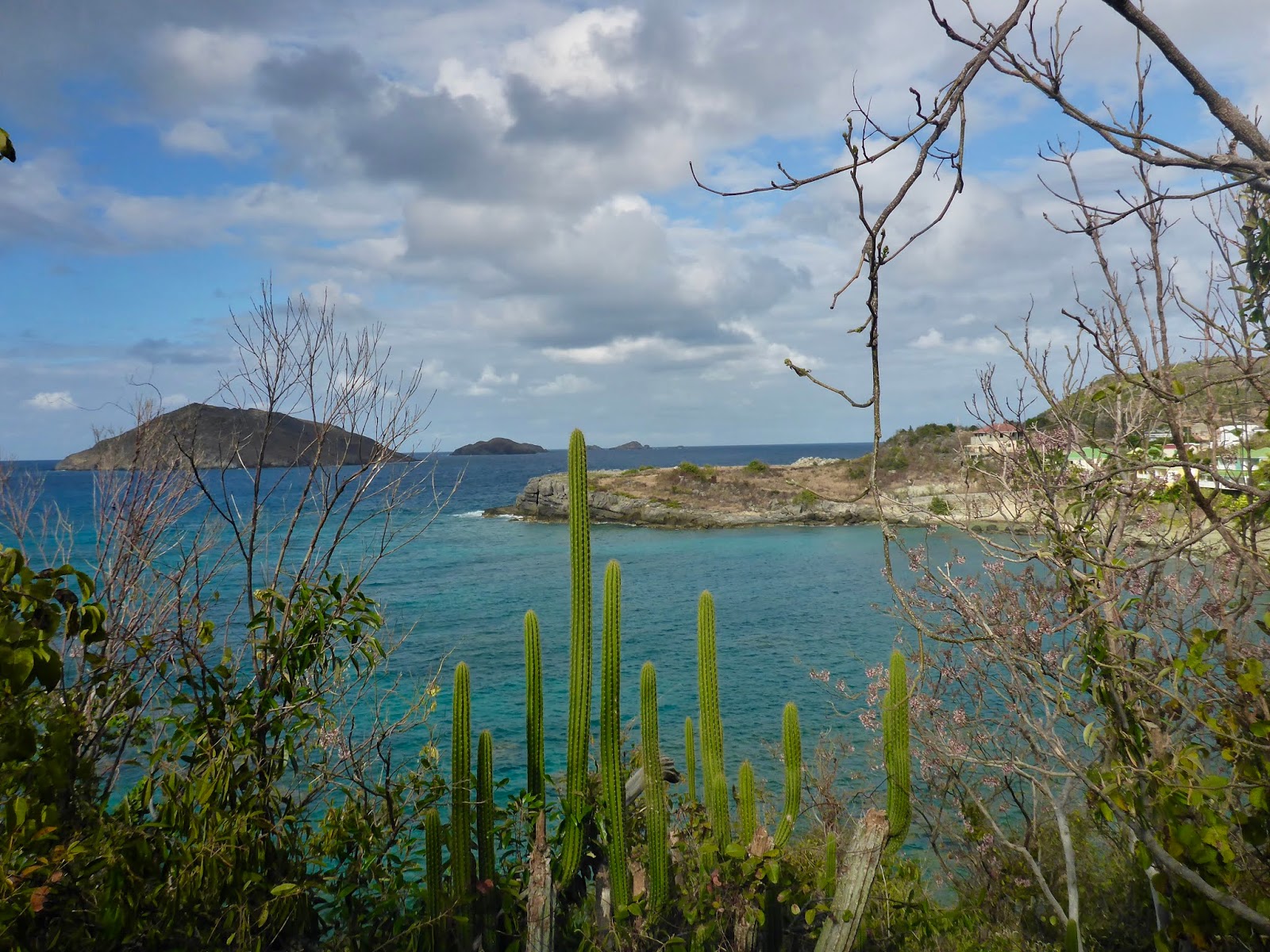
Areas of the island were covered with these beautiful barrel cactuses.

It was now time to move on to our next Caribbean island in the French West Indies, Guadeloupe.

A Must Do Hike in St. Barthélemy, French West Indies

From our beautiful, quiet mooring in Anse de Colombier, you can take a short hike that provides mountaintop views of several bays (Colombier, Petite, Paschal), as well as, very diverse flora and fauna.  If you are not traveling by boat, this hike can be taken in the opposite direction starting in the Village Flamands.
You begin this hike from the left side of Anse de Colombier beach (looking from the water).  There is a stone staircase that leads to the trail.  While there is some elevation for the hike, the path is well established and I would describe it as appropriate for anyone accustomed to climbing stairs and walking on a dirt and rock path.

Our Experience

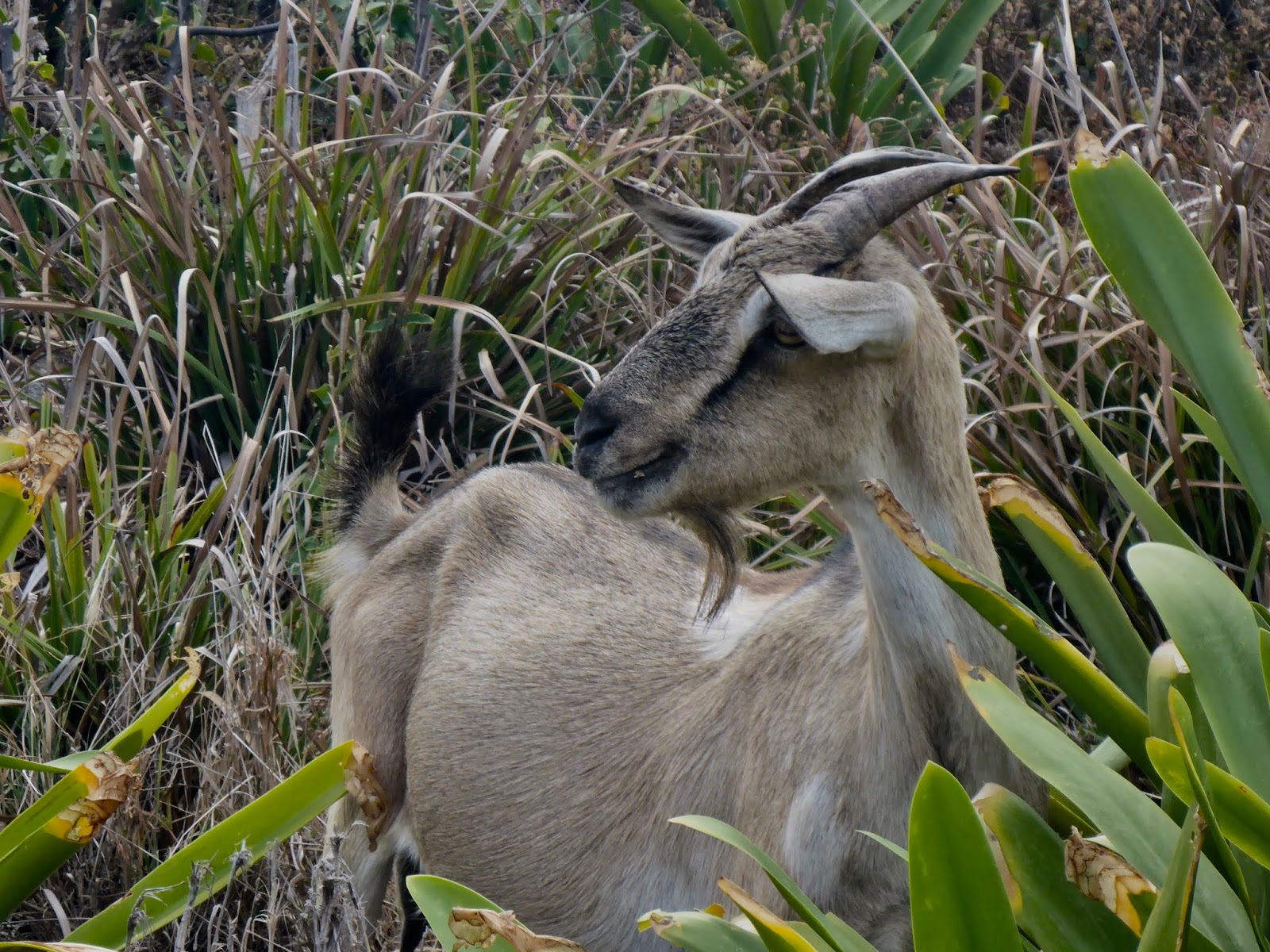
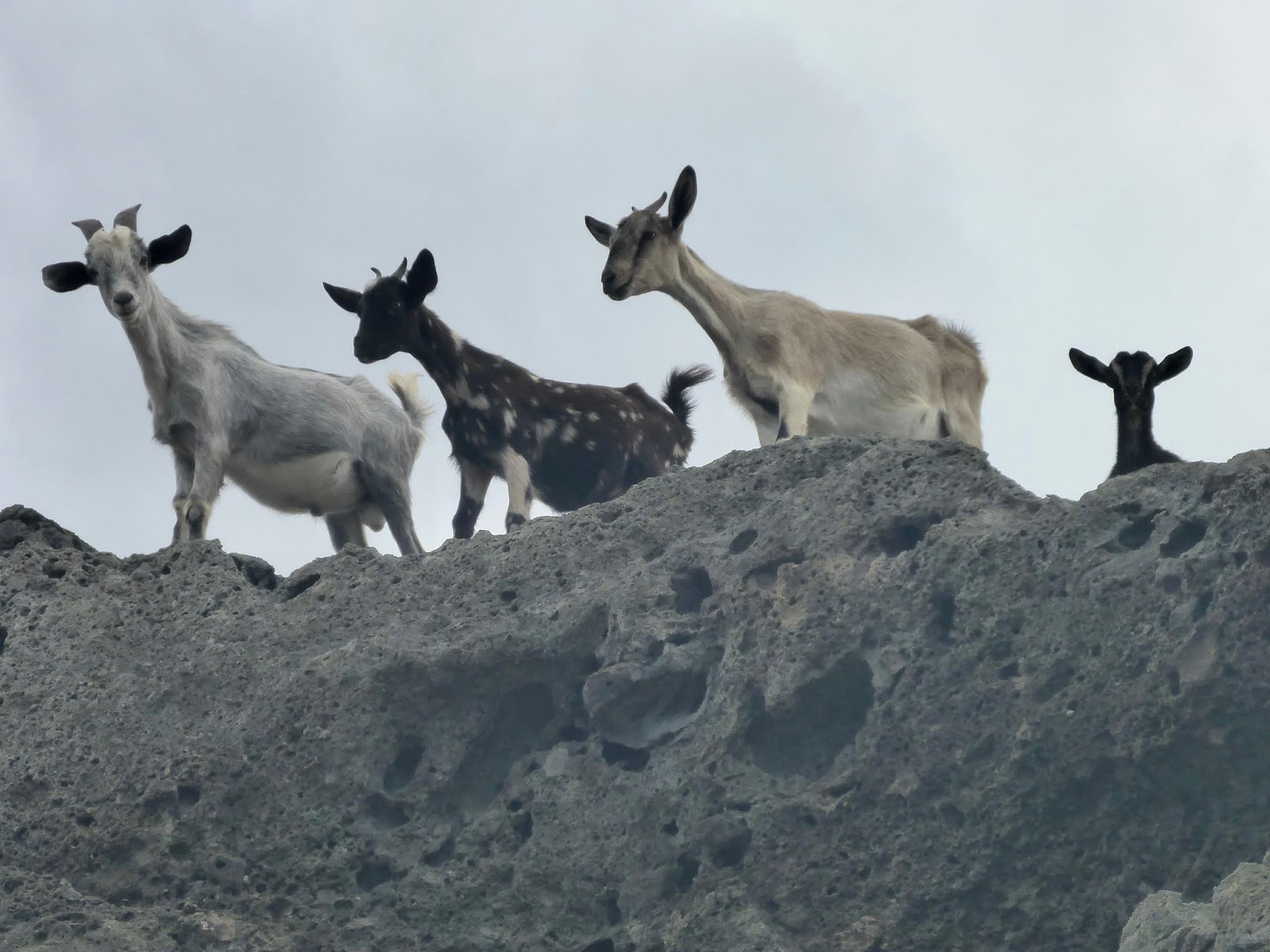
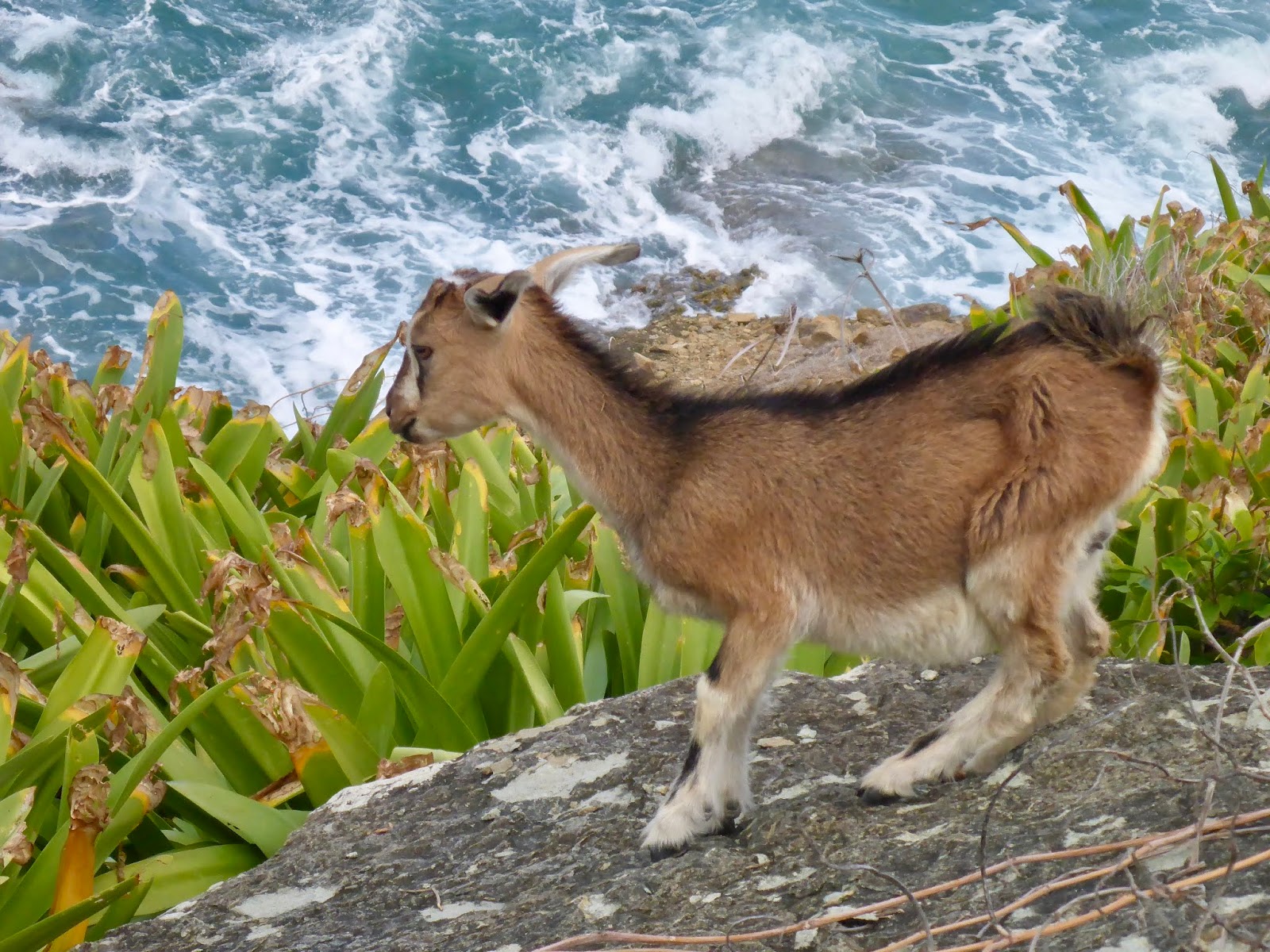
As the hike neared the crest, we encountered many goats.  They were not timid, even when Duhkxy barked.  Many were accompanied by their spring babies.  We continued to encounter goats throughout much of the hike.
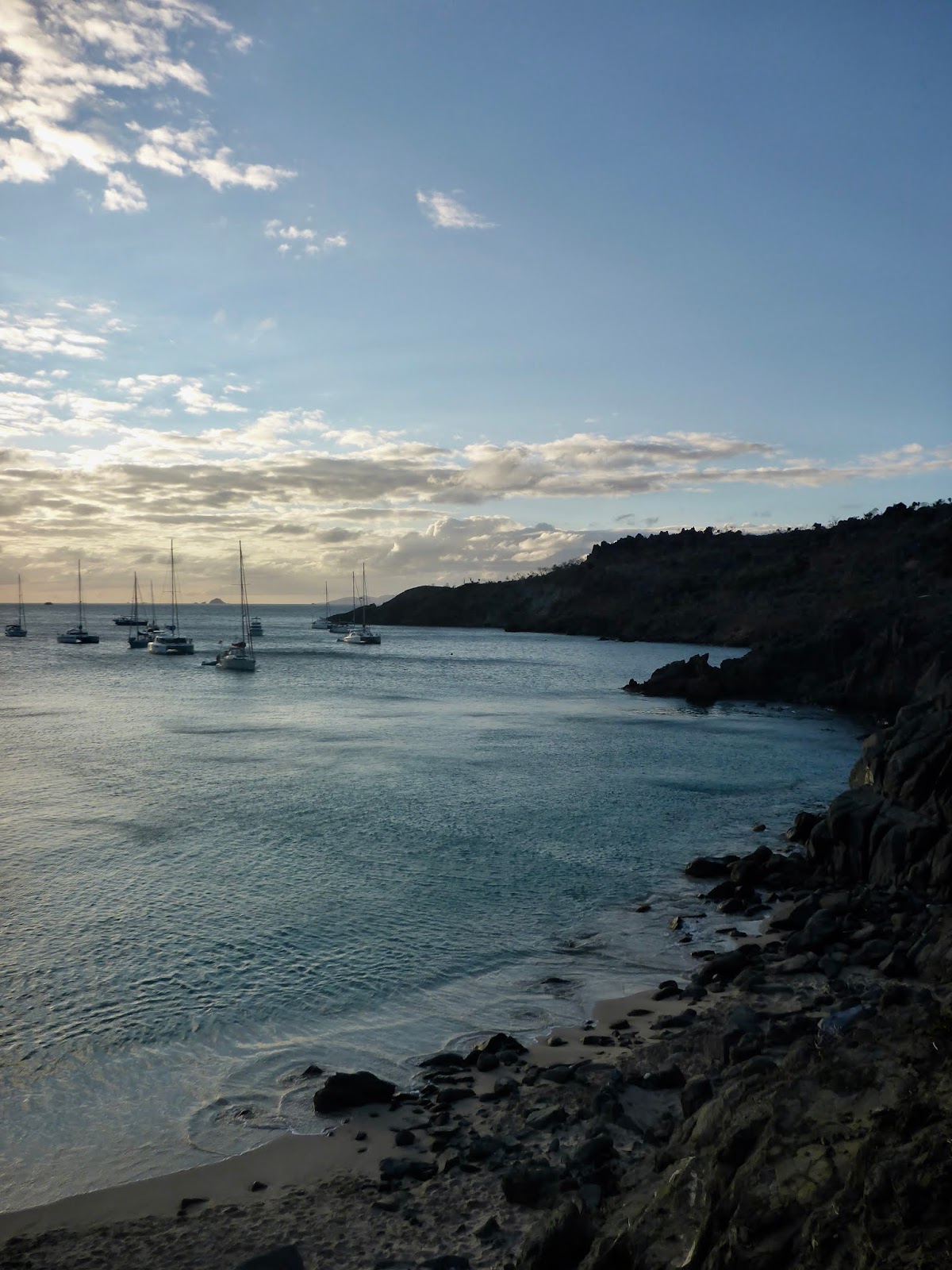
We were immediately rewarded with a hilltop view of the tranquil Anse de Colombier where we moored for several days.  The bay is teaming with sea turtles and offers a quiet, less crowded setting compared to the anchorage off Gustavia, the capital of St. Barth.
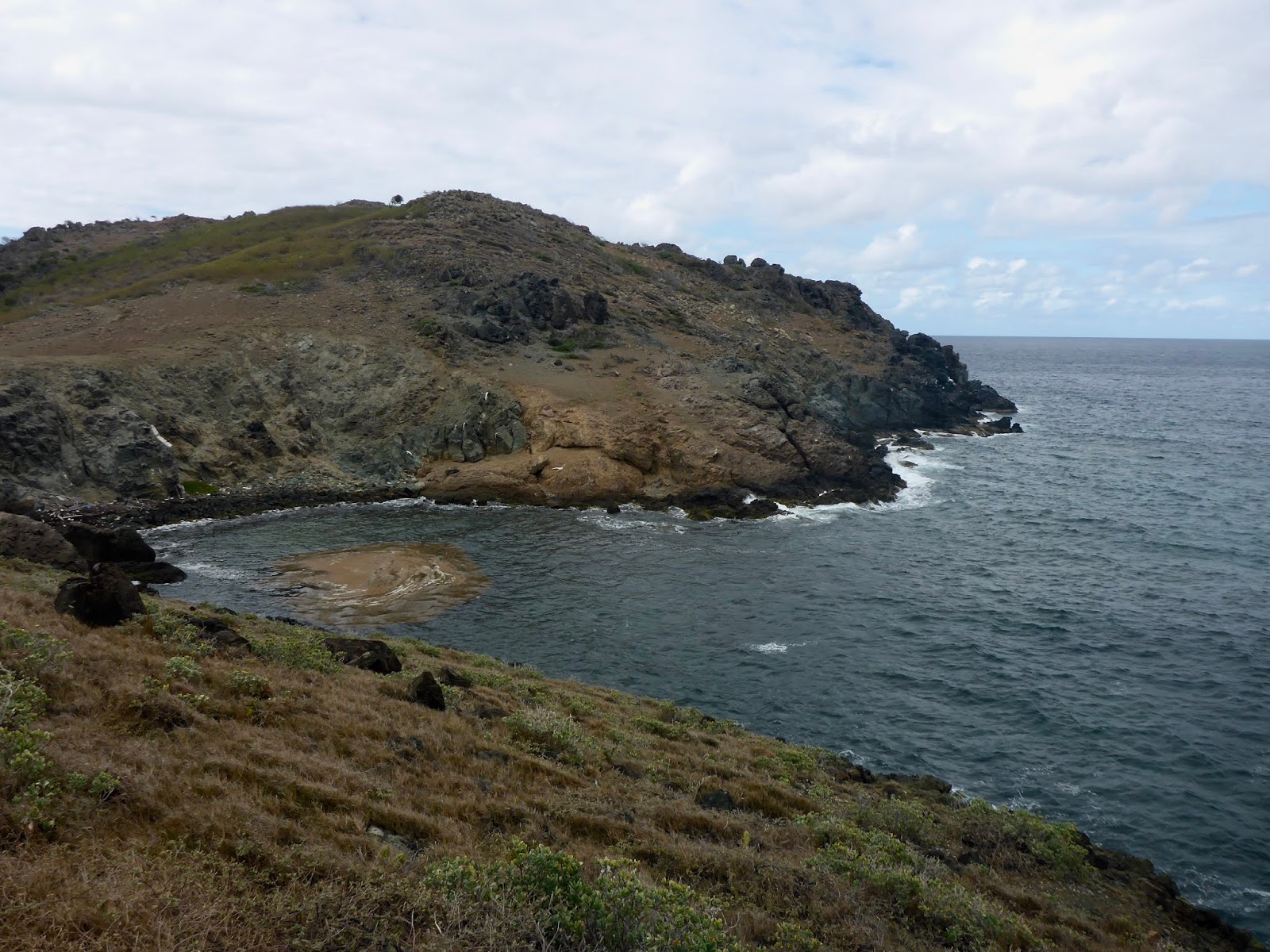
Directly north we saw Anse Paschal, with its massive collection of sargassum seaweed.
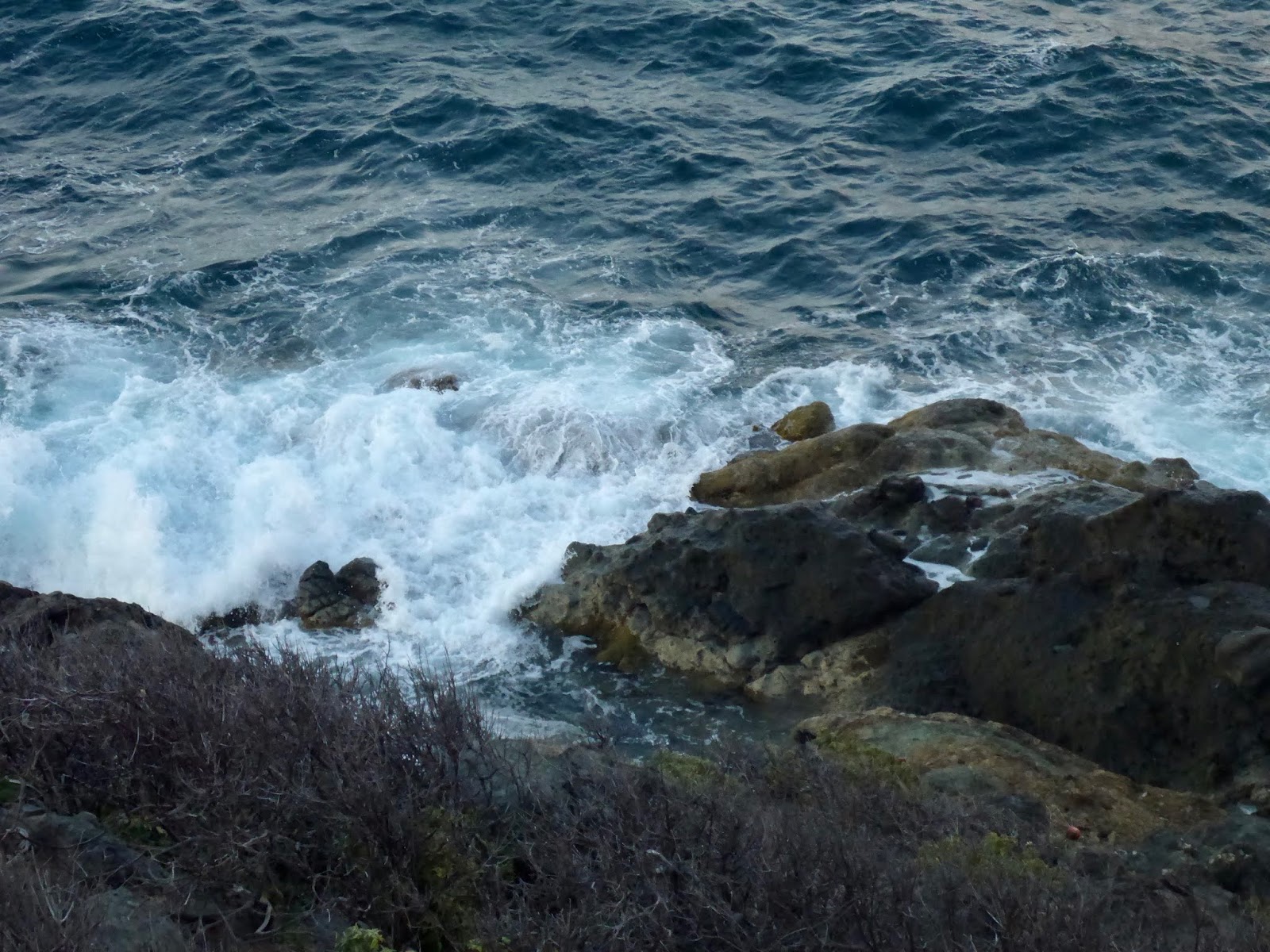
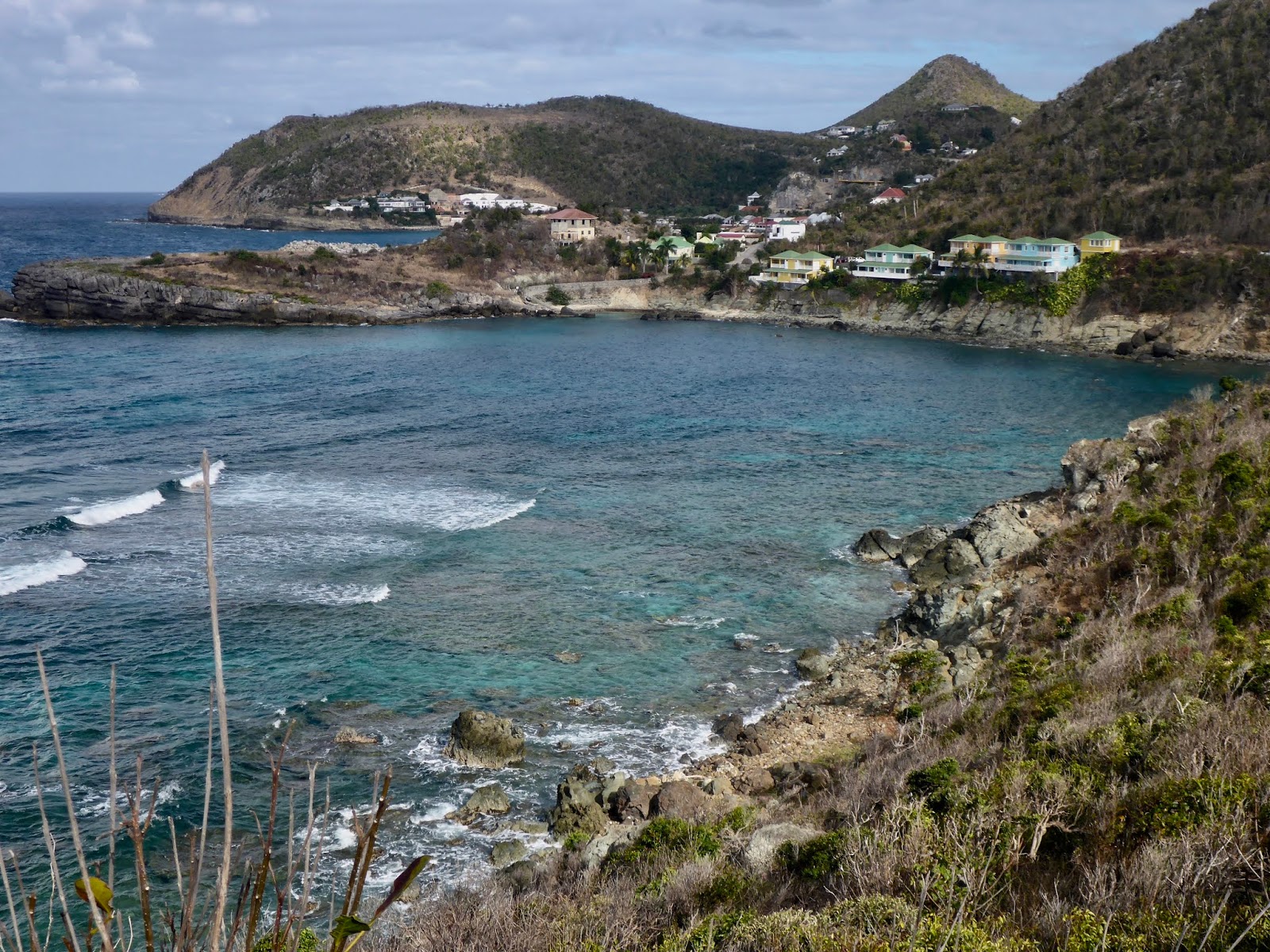
A short way on, waves crashed against the shore of Le Petite Anse (also on the north side).
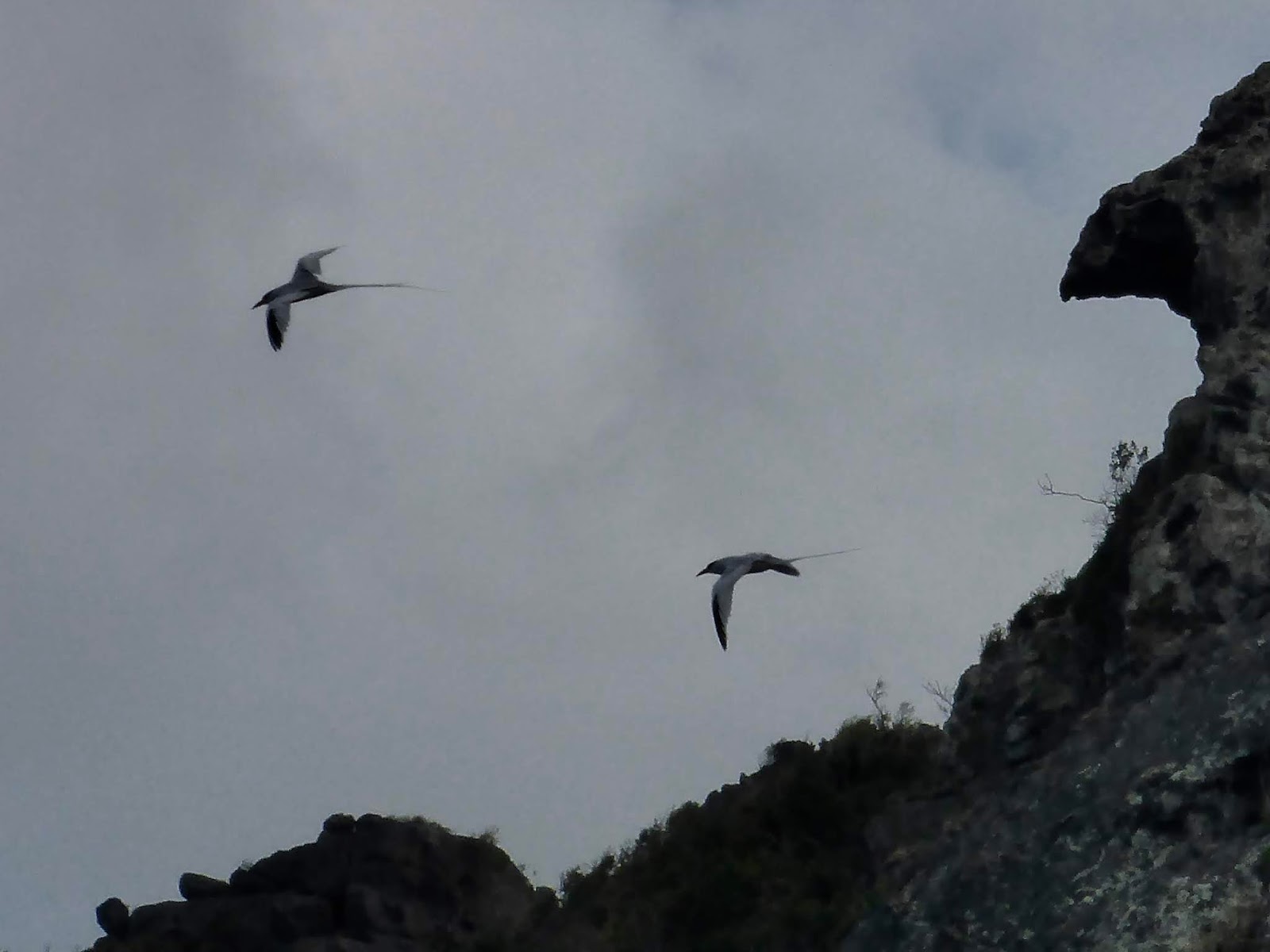
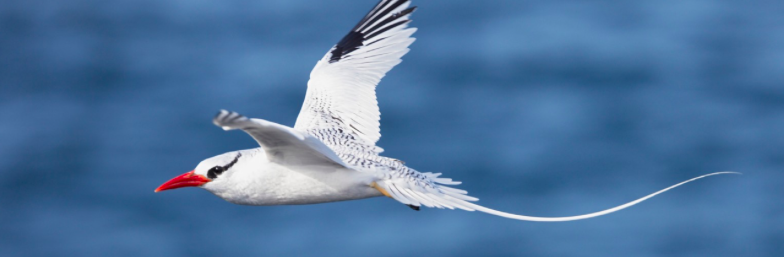
Flocks of Tropic birds soared above and around us.
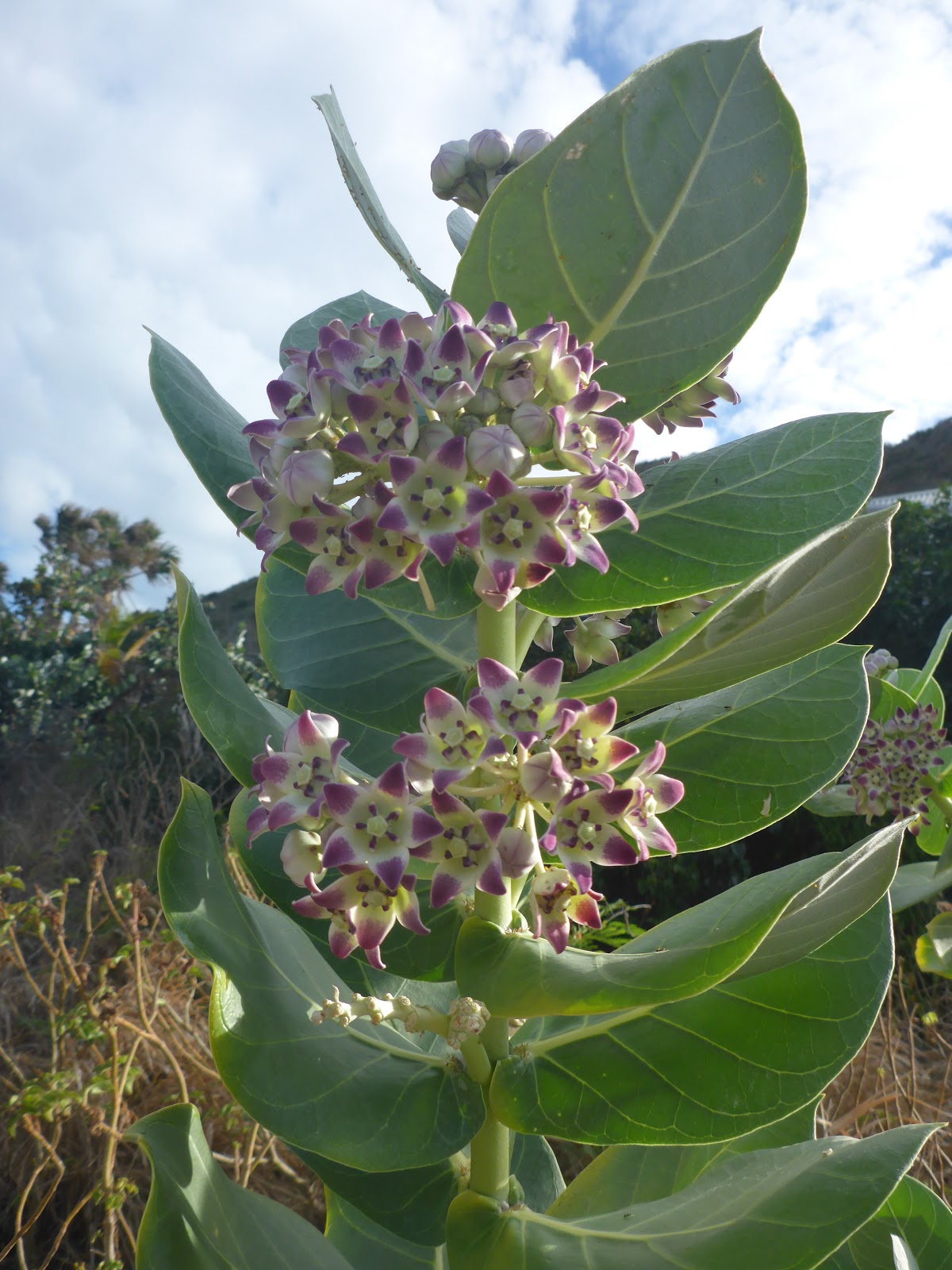
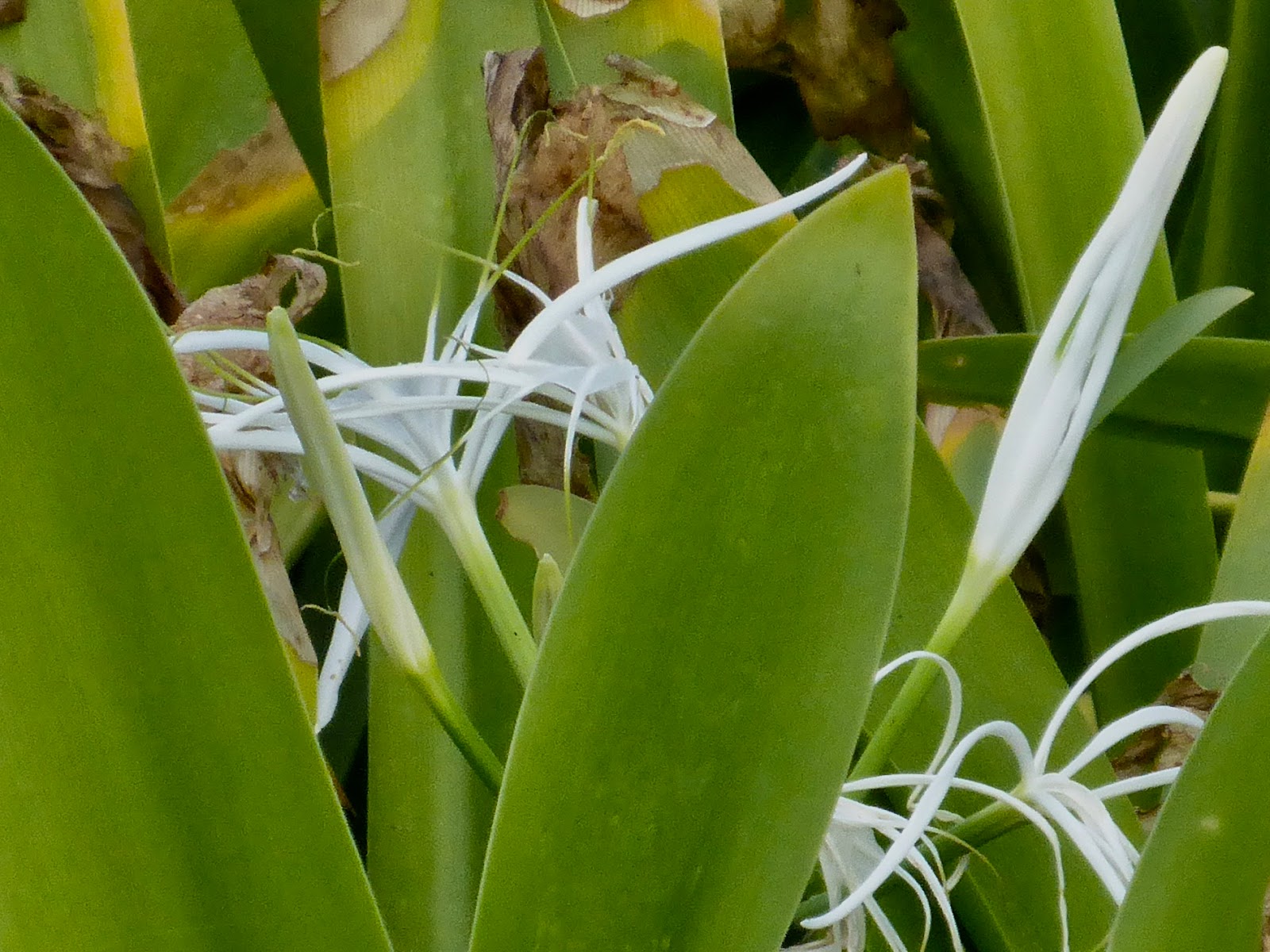
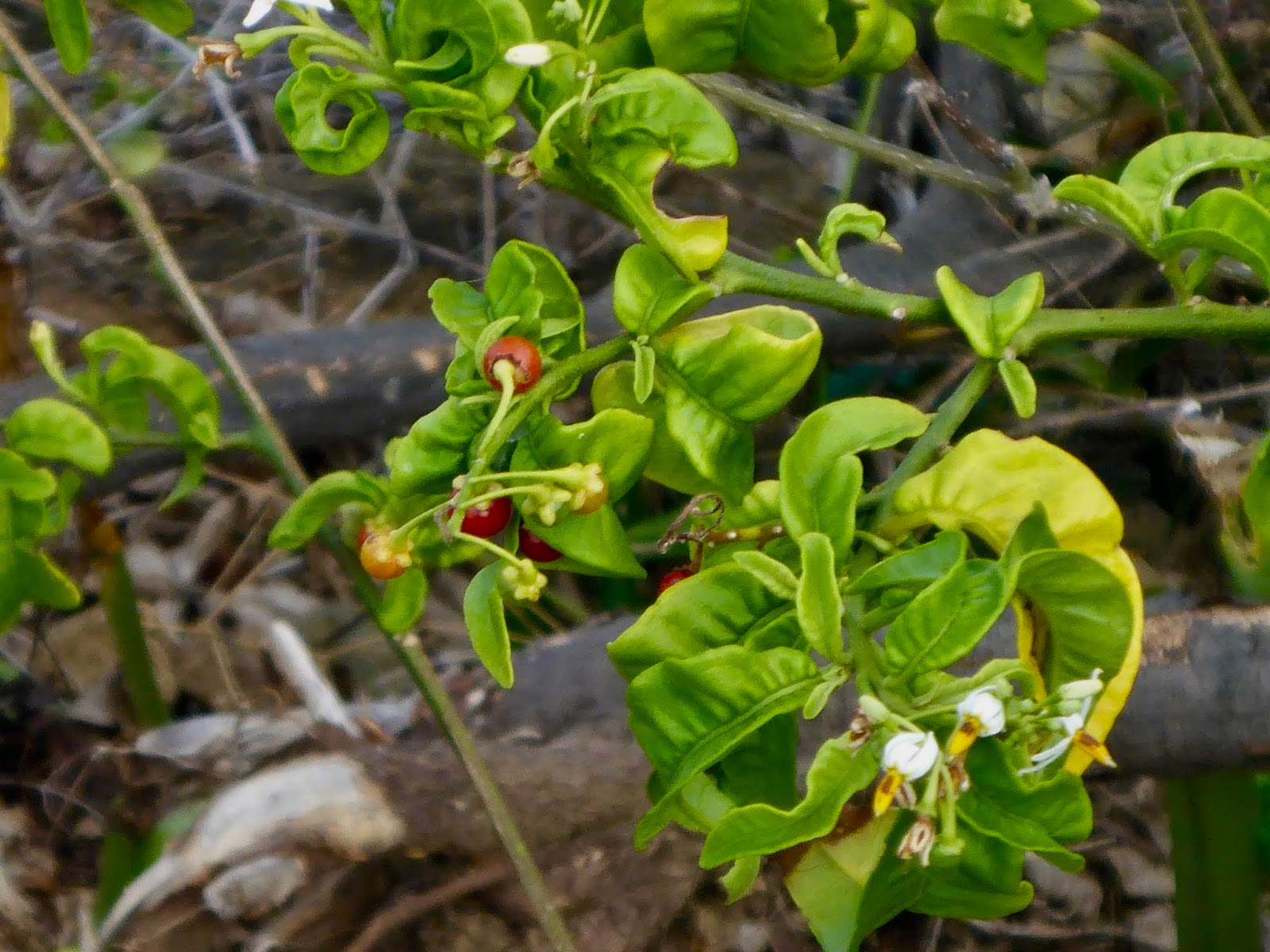
We always enjoy observations of pants with unusual features and flowers and this hike did not disappoint.  The rocky coast seemed as though it would be inhospitable to pant life, but its abundance and variety is a remarkable testimony to adaptation and evolution.

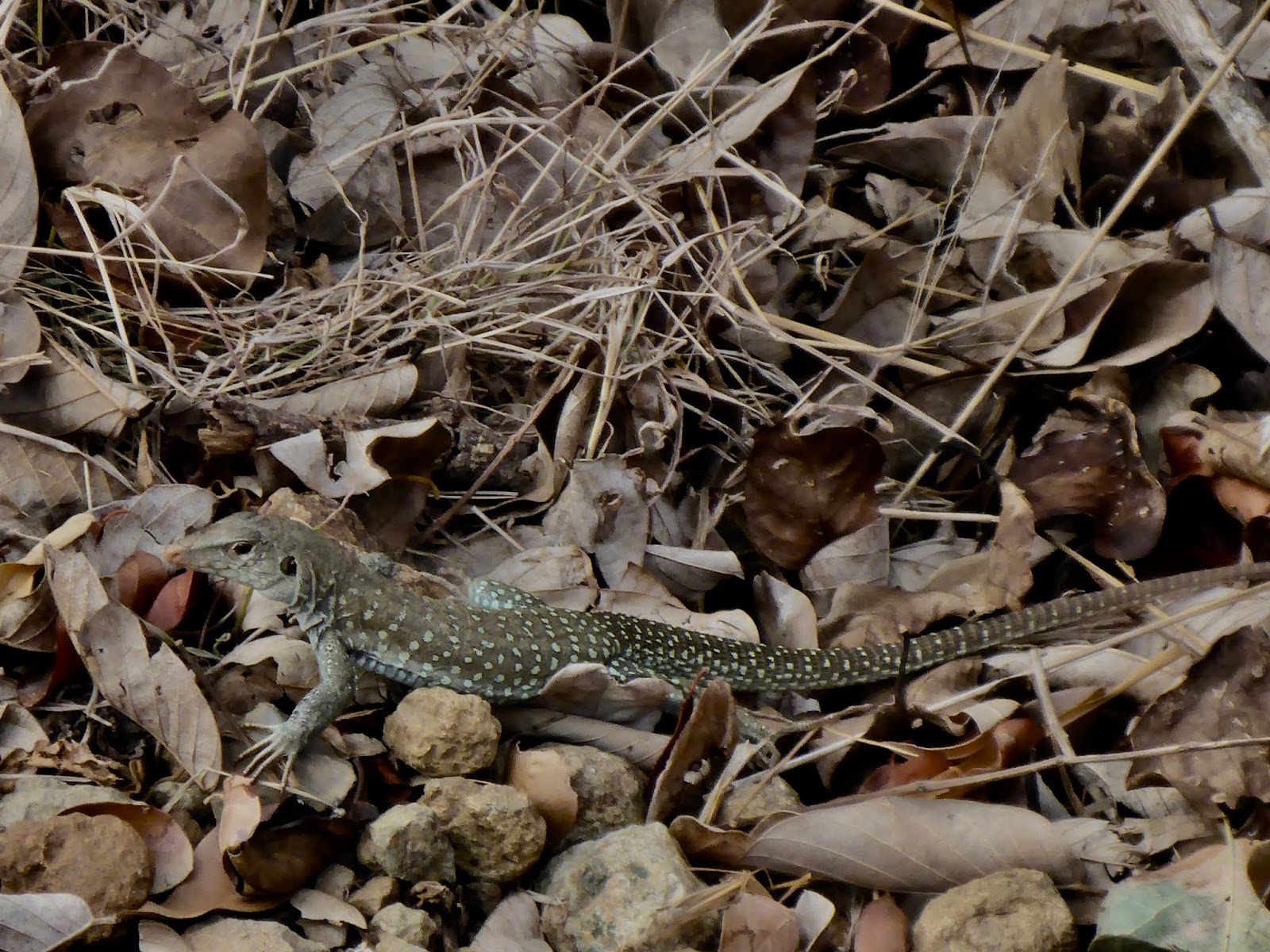
small and mid-size lizards darted across our path.

Views of the villages ahead beckoned us on.
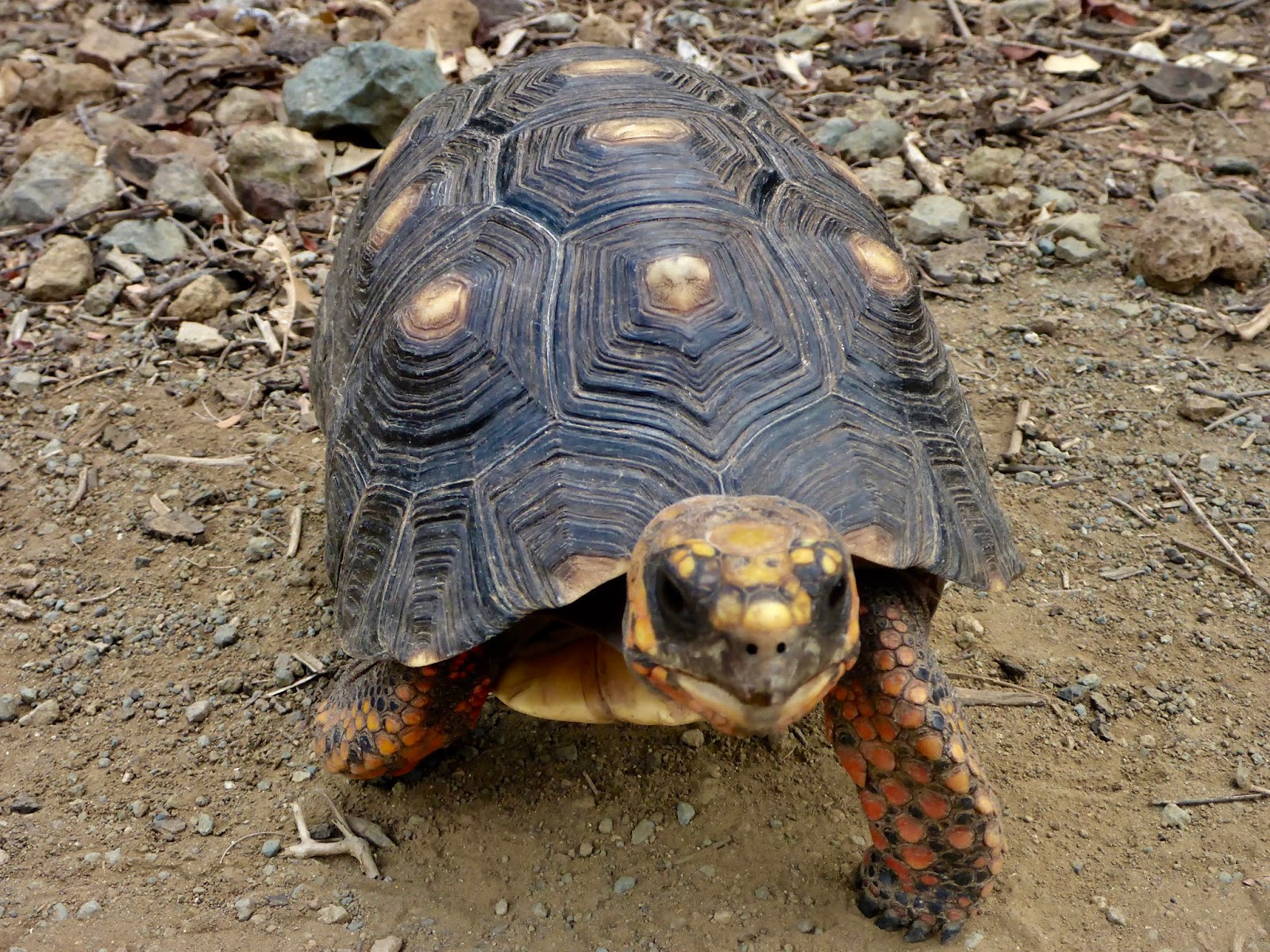
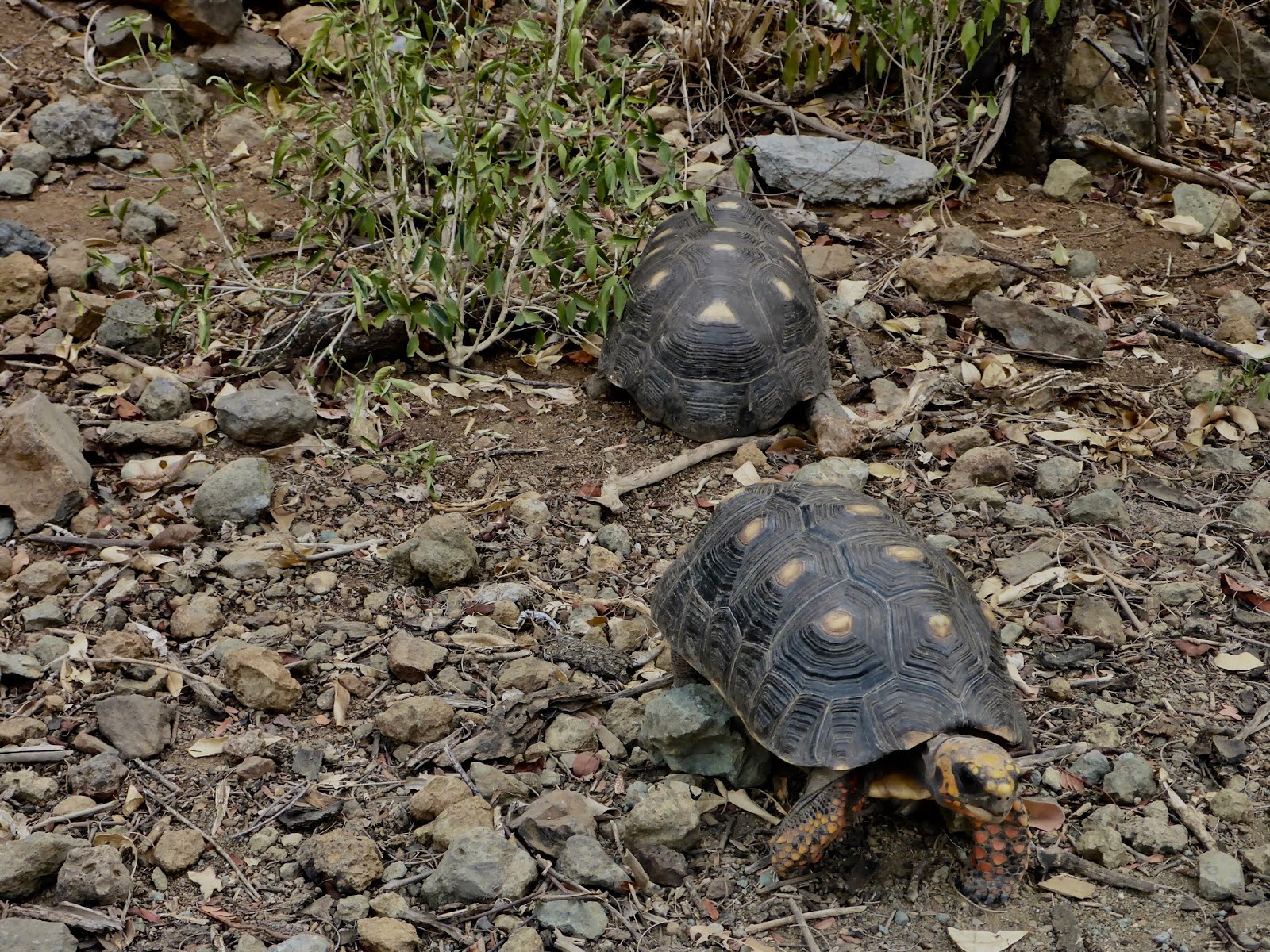
As we neared the end of the trail, we saw a tortoise.
And then two more another, then several more, and still more.  We speculated as to why the tortoises would be congregating in this particular spot.  Closer to the village of Flamands we got our answer – a tortoise watering station had been set up.  We have subsequently seen tortoises throughout our travels in St. Barth, but never in such numbers, and never, fortunately, as roadkill.
Lovely cottages sit on top of the ridge overlooking Le Petite Anse.  The view of this cove and the villages beyond must be seen from this vantage point.

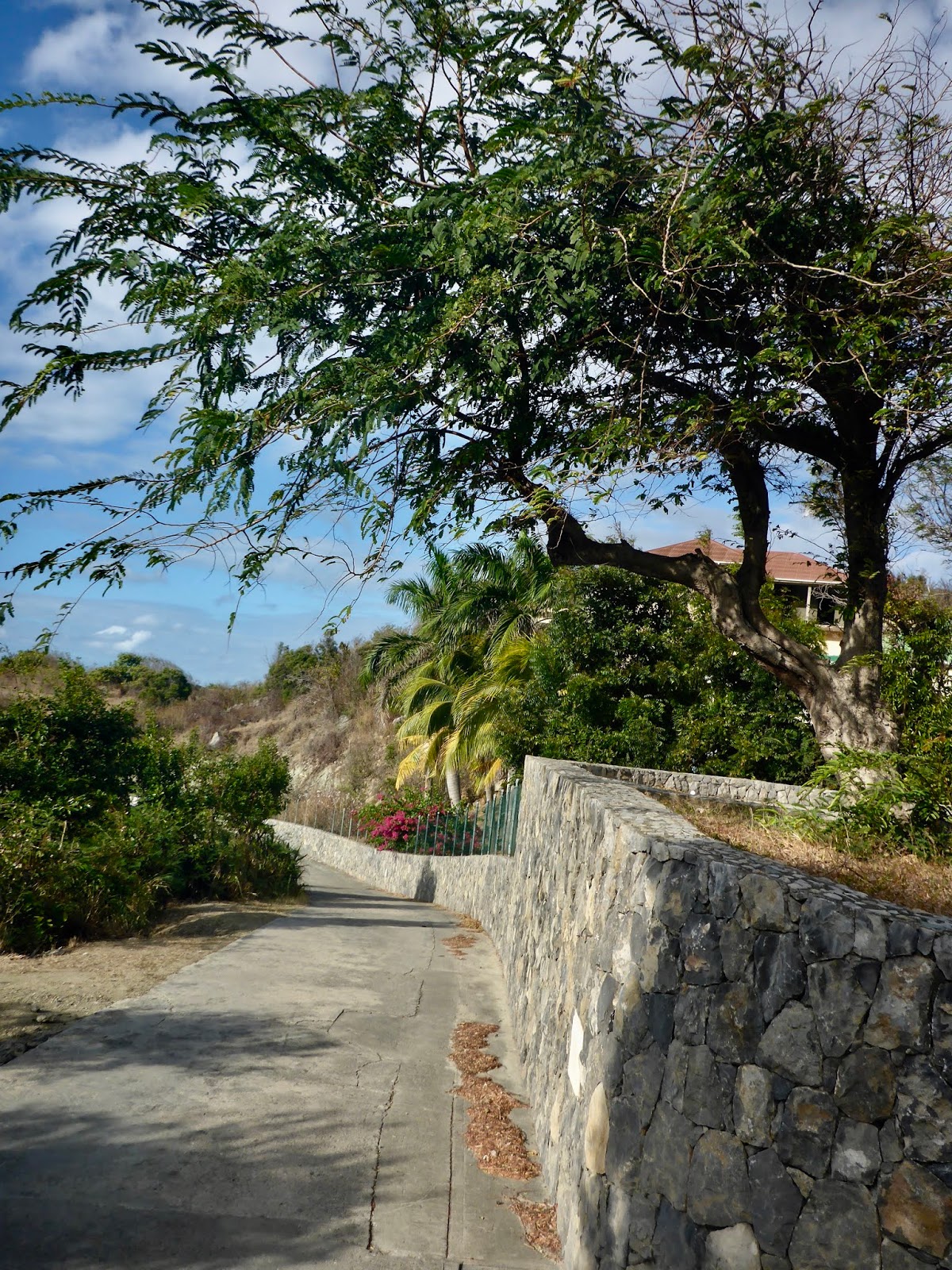
The trail led directly to a street within Flamands.

As we visited Flamands, Duhkxy was admired by several villagers, but most did not give him a second glance – this is very characteristic of French culture.
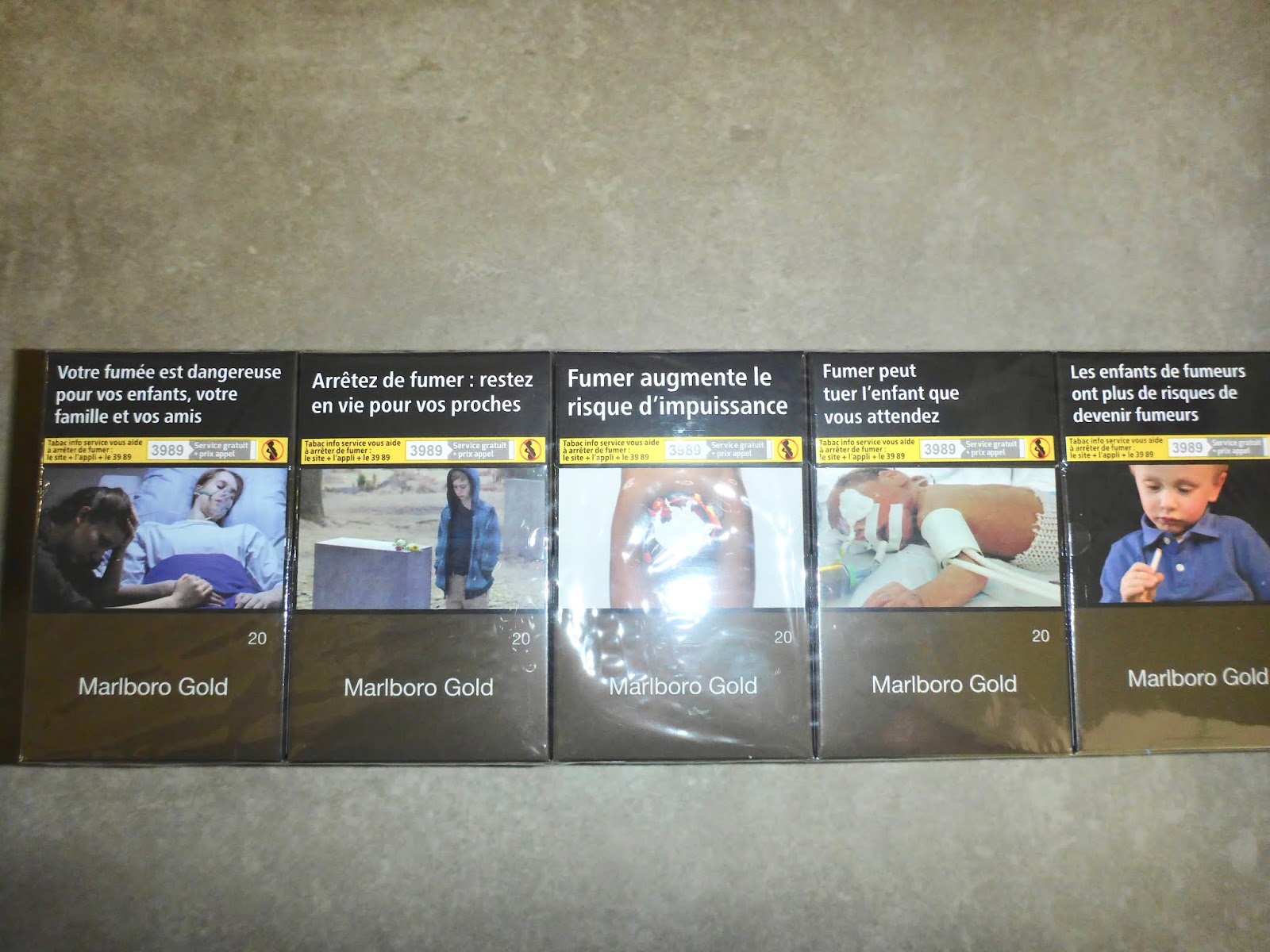
We visited a small grocery store for some libation.  Duhkxy was not permitted to enter.  I commented to the woman at the checkout “Ce n’est pas La France” (This is not France), to which she smiled and nodded.  She let me photograph the cigarettes she had for sale.  The frightful visual warnings of diseases linked to tobacco were exactly as in France.
Private properties in Flamands commonly fruit-bearing trees (sour sop, papaya, coconut), much like in France.
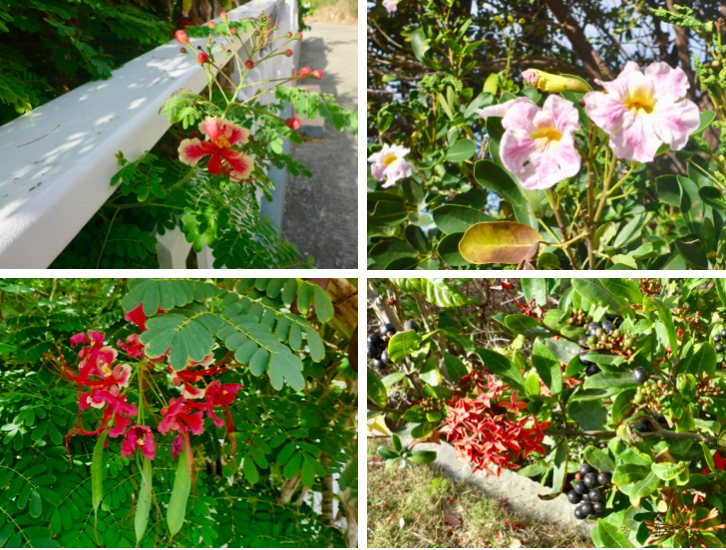
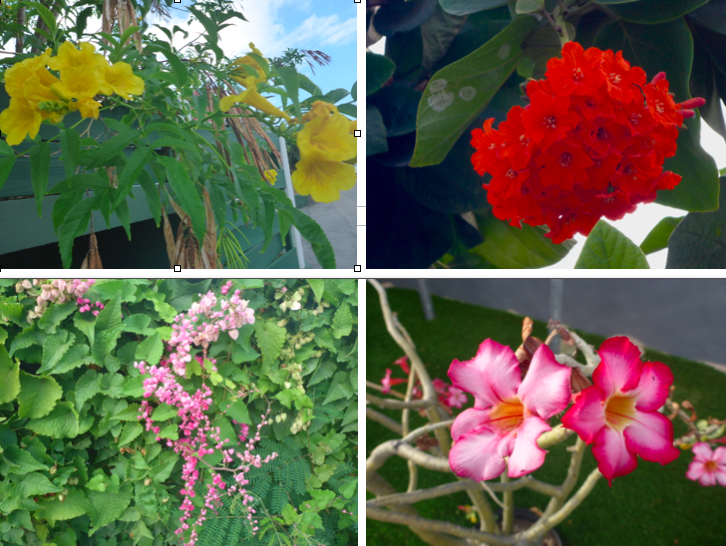
And there were flowering shrubs everywhere – much like France.  Beautiful hike, beautiful village, beautiful day.

St. Martin to St. Barthélemy

St. Martin to St. Bethélemy

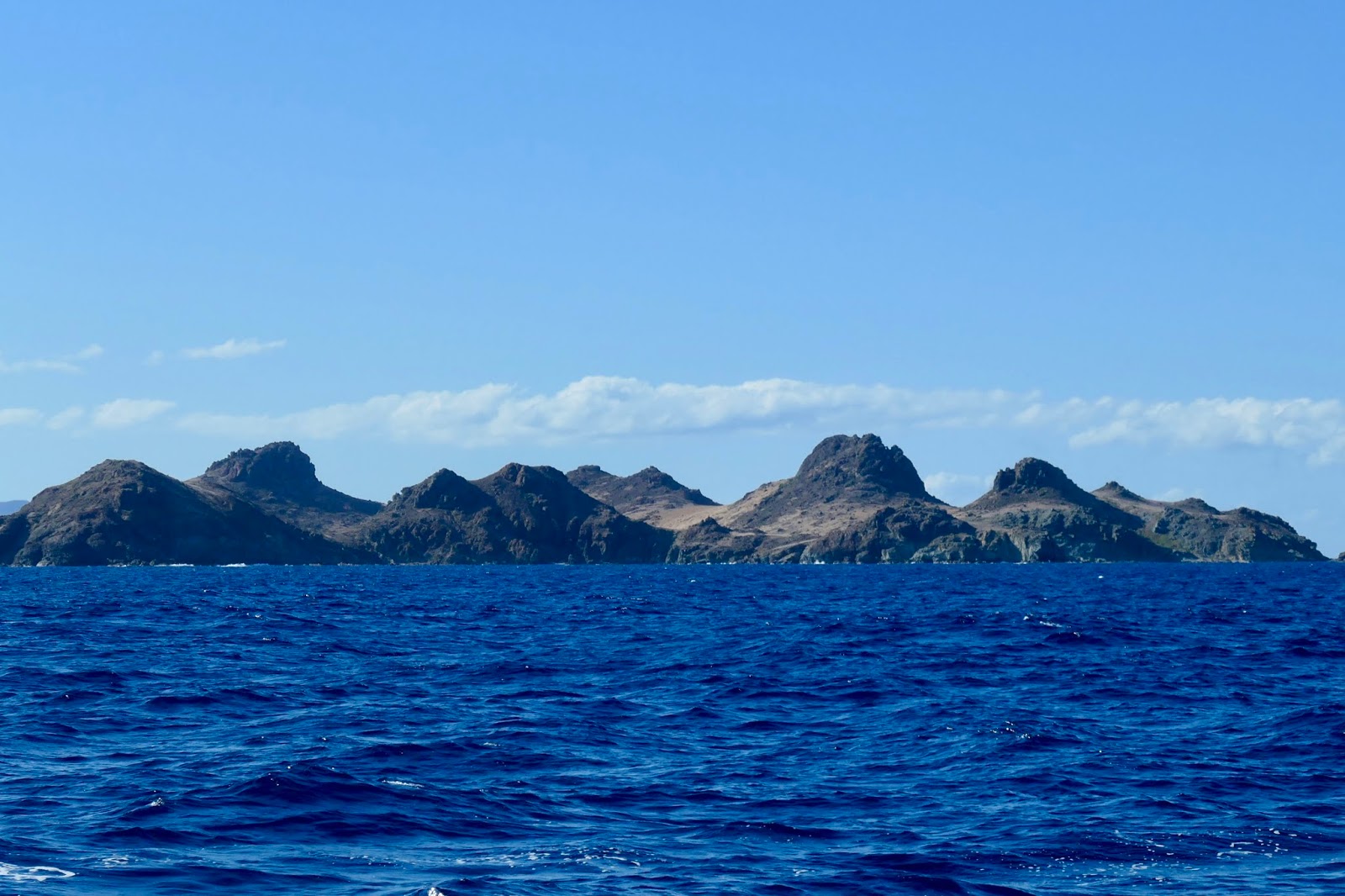
We woke from our much-needed sleep to a beautiful sunny day.  Winds were moderate (10-12 knots) as we sailed close-hauled from St. Martin to St. Barts.  With George’s tweaking of the rigging, we managed 5- 7 knots over ground despite unfavorable current.  The combination of the boat’s heeling and a 3-4 foot swell made it challenging to move around, but we only needed to tack once, so we sat back and enjoyed the ride.  We passed by uninhabited islands with distinctly different topography.  We saw turtle heads galore and our first siting of tropic birds.
The first time we saw tropic birds was in the Bahamas.  Sometimes, the white bottom side of the bird takes on a reflection of the turquoise water below – doubly gorgeous.
Our delicious pancakes in the morning held us for quite a while, but eventually, hunger becomes a force compelling enough for me to head down into the hot, stuffy cabin (you can’t sail with the hatches open) to make lunch.  I had a simple lunch planned – burritos – and I have a method where I assemble them and then heat them which requires few dishes and very little time below.
I had the burritos heating up when a large wave threw the boat to the healing side.  At that same moment, one of my kitchen cabinets opened and the contents came careening out, much to the floor.  George called out “Are you OK?”  I hesitated for a moment as my full concentration was holding back the cabinet contents that were still on the counter and assessing the situation.  I then simply said “No” and George from the companionway replied something like “Oh Man…”

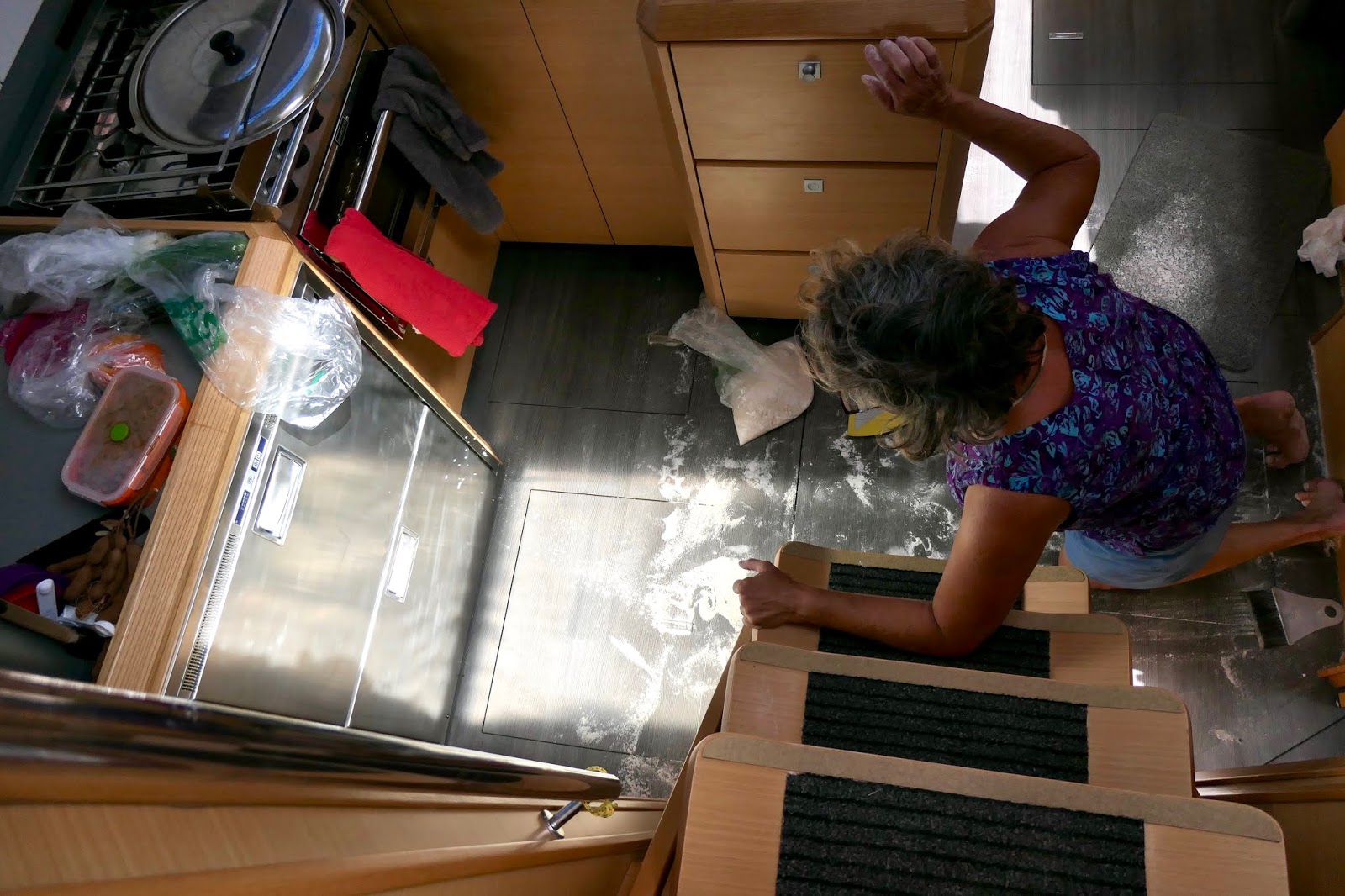
The worst of what had fallen was our flour canister (that had been filled the previous day) and our sugar canister.  The sugar acted like tiny ball bearings creating a treacherously slippery floor.

This photo taken mid-way through the clean-up after the bulk of the flour and sugar mixture had been collected off the floor with a dustpan.

As cleanup progressed, waves continued to tip the boat.  The sugar began to absorb moisture, transforming from ball bearings to syrup.  I began to sweat.  As the boat tipped, the slimy mixture below my knees, facilitated my slip-sliding away.  In the picture above, I am grasping the stairs and cabinets as I slid to the starboard side of the boat.

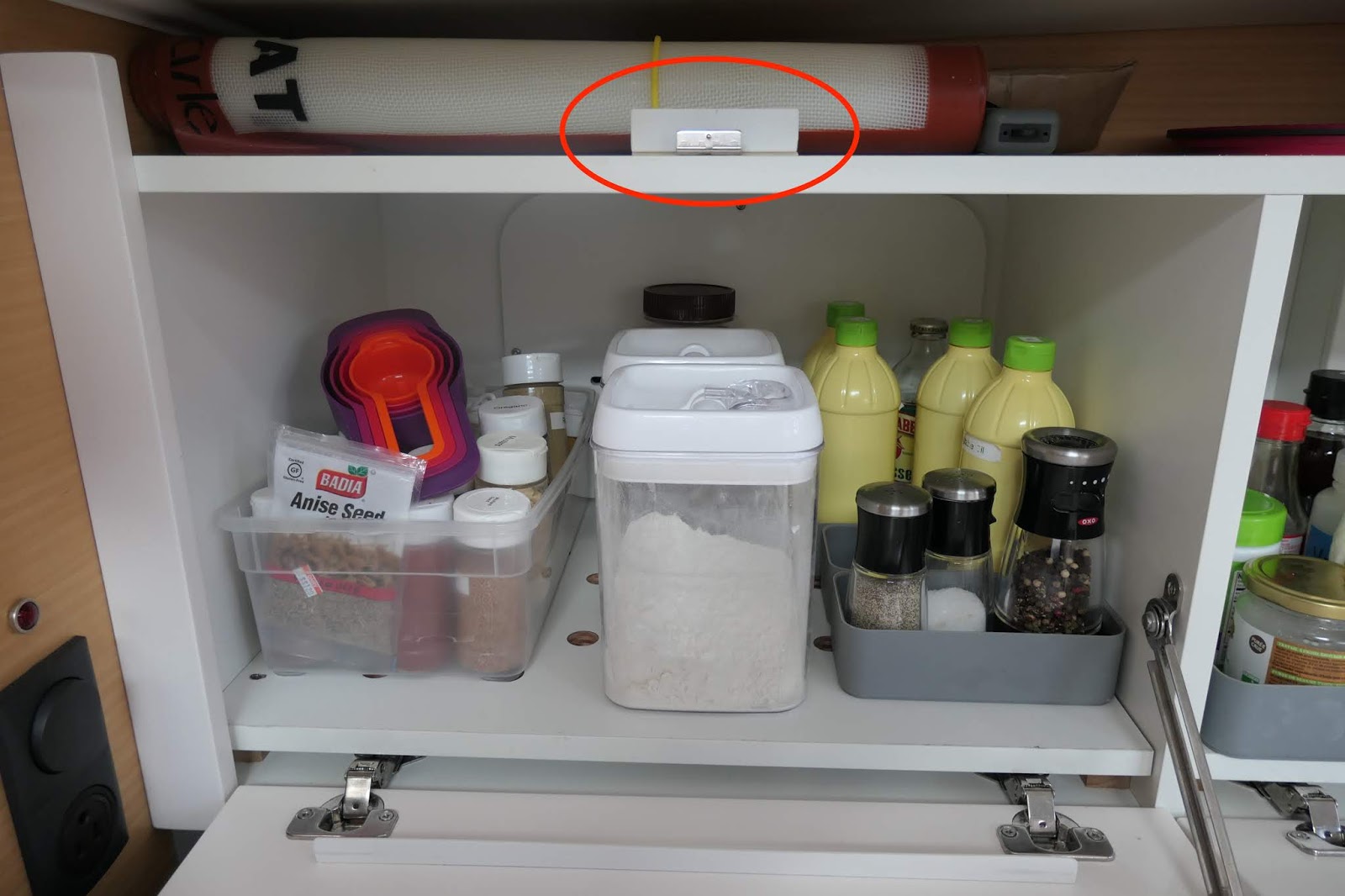
The worst part was that we were aware of the fact that objects on top of the cabinets could bang into the cabinet latch and open it.  We had already purchased a 90 degree plastic strip to install behind the latches to prevent it.  George installed them the following day.

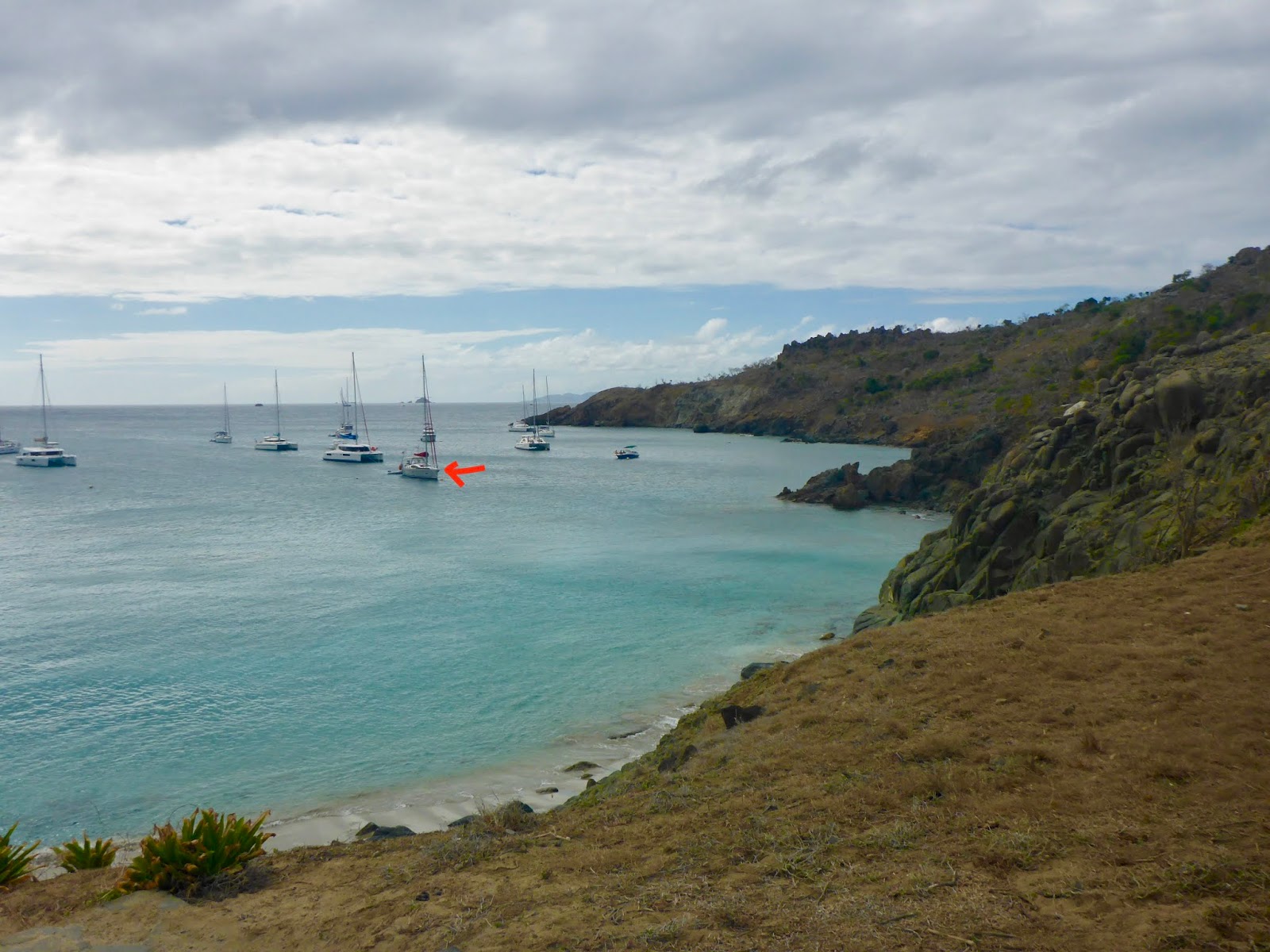
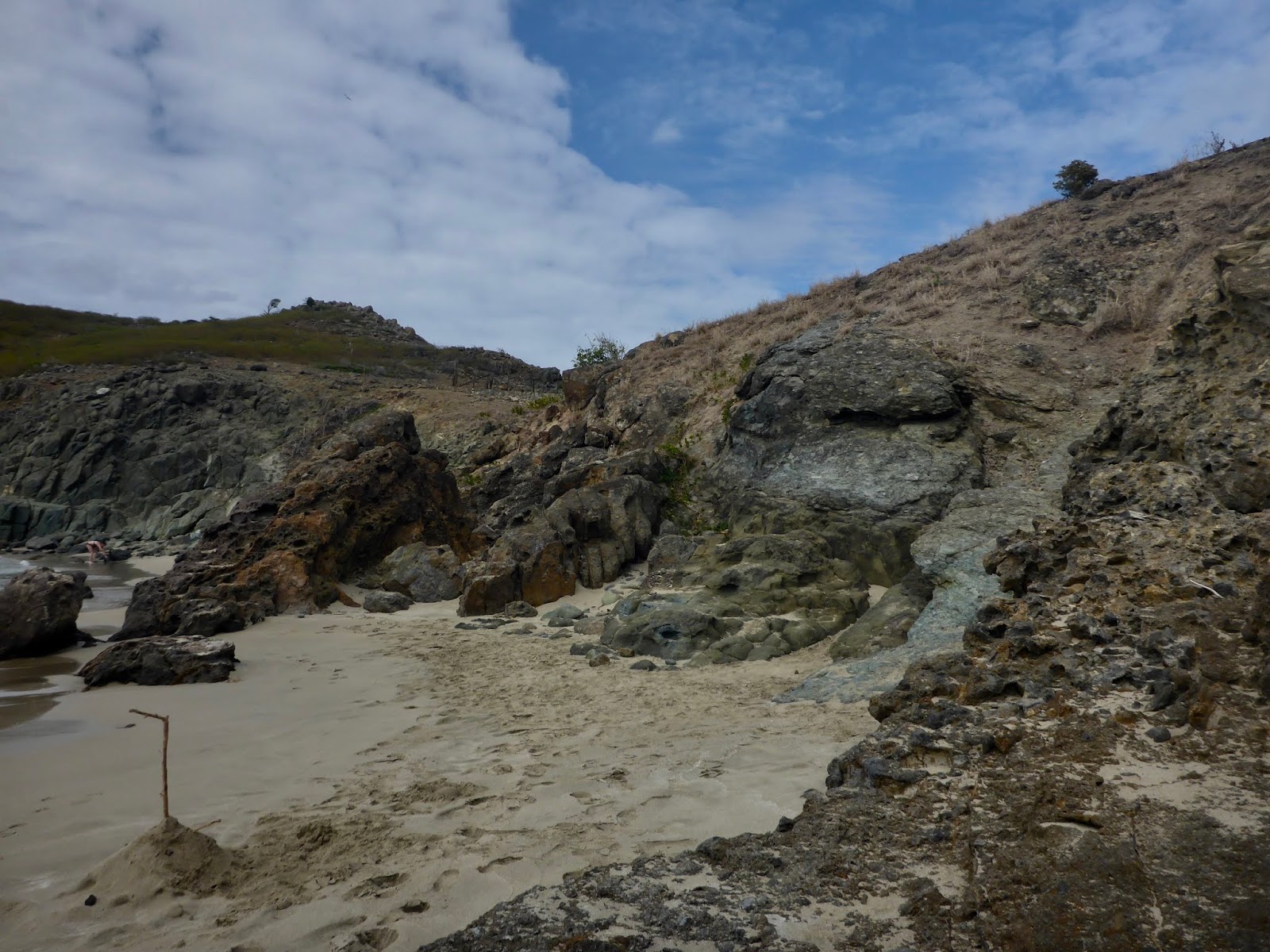
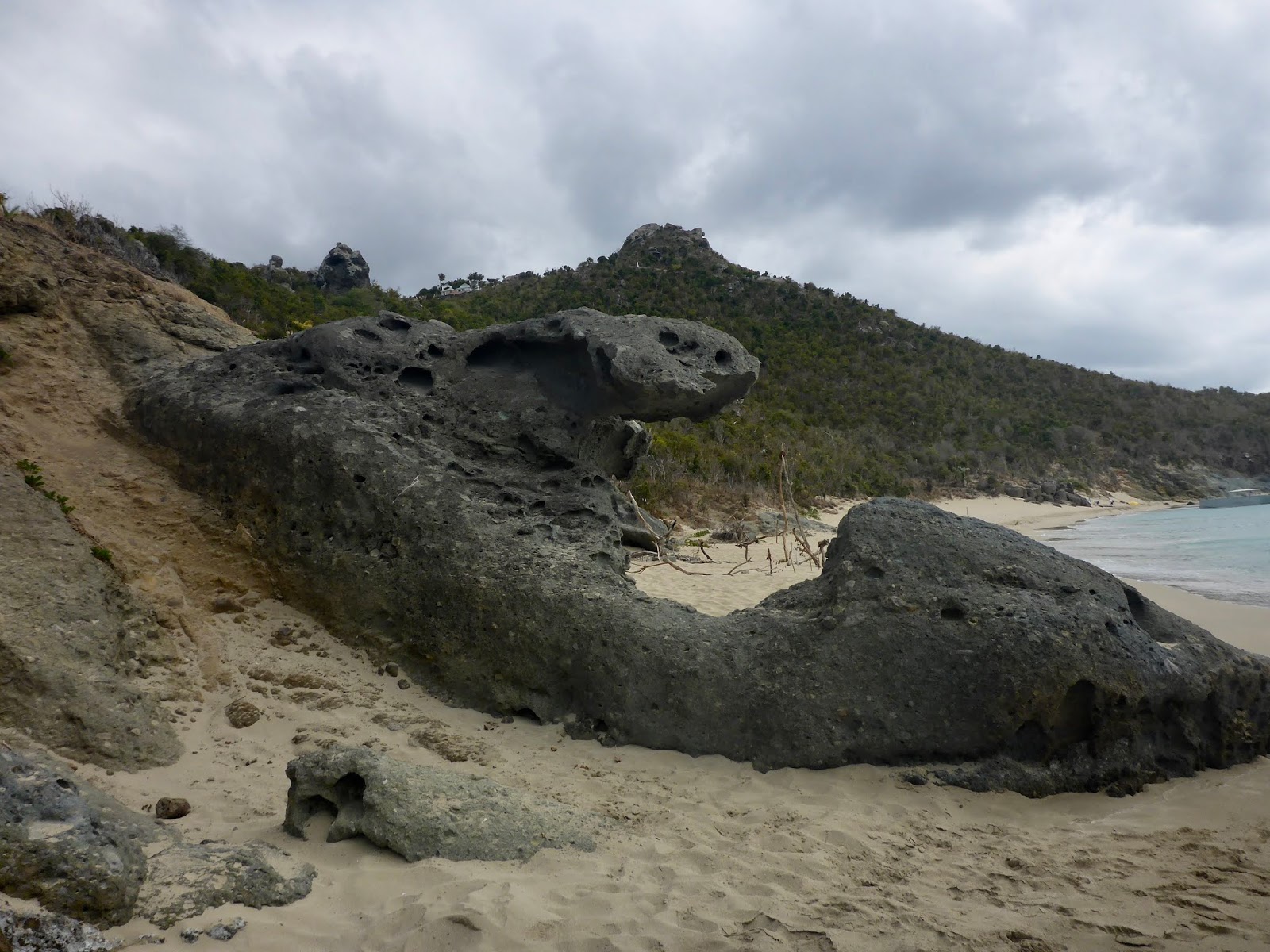
Our mooring in Anse du Colombier (Cove of Colombia) is off a lovely beach banked with boulders sculpted by years of winds and salty waves.

Anse du Colombier (Ice Floe marked)

First thing upon arrival, George took the dinghy to check in with Customs and Immigration.  He could not bring Duhkxy as he had not been cleared for land yet.  Duhkxy and I waited on Ice Floe.
Duhkxy expresses his anxiousness, particularly when parted with George, with ear-piercing shrieks and yelps.  He has gotten much better, but still objects vehemently if he is left behind for a dinghy ride.

Check in went smoothly as George had submitted much of the needed information on-line beforehand.  The Customs agent did not mention Duhkxy so George offered “We have a dog.”  The agent responded in a French accent “You have a dog”.  George went on to offer “He does not bite” that elicited nothing but a blank stare from the Customs agent.  George says he was a bit punchy from being over-tired 😀

Sailing the Caribbean

Overnight Sail from St. John to St. Martin

In retrospect, the weather, wind, and sea forecast for the evening was a bit confusing.  It forecast clear skies, moderate wind and seas, with winds from the east / northeast.  The conclusion of the report was that it was not favorable for our planned sail, nor would it be for at least another week.  We felt moderate winds and seas sounded good and, as we would be traveling southeast, the wind direction could work, if not ideal.  We decided to go – we were ready to get on our way.
Our passage was without event, albeit 26 hours, 19 of which were spent motor-sailing.  The winds were more out of the southeast – right on our nose – and varied from 5 knots to over 20 when we encountered small squalls of short duration.
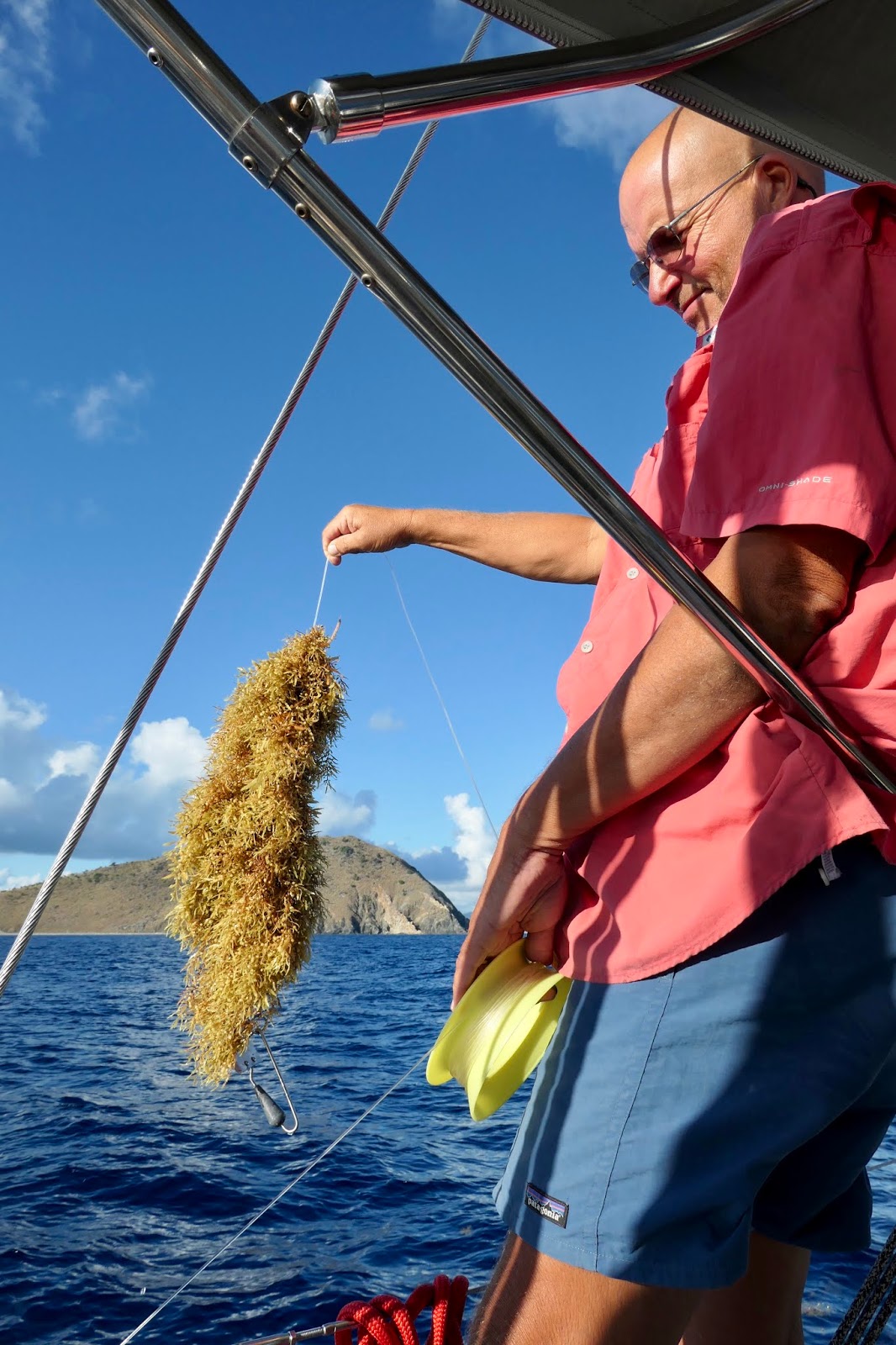
Fishing remains a challenge due to the sargassum seaweed that catches on the line and hooks.  After less than a half hour in the water our planer popped to the surface with a load of weed it could no longer bear.  We ran a couple of lines right behind the boat that tend to be clear of the weed for a few hours and then called it quits.  You can’t catch a fish if you aren’t fishing, but I can’t find any recipes for sargassum.
George with the best catch of the day
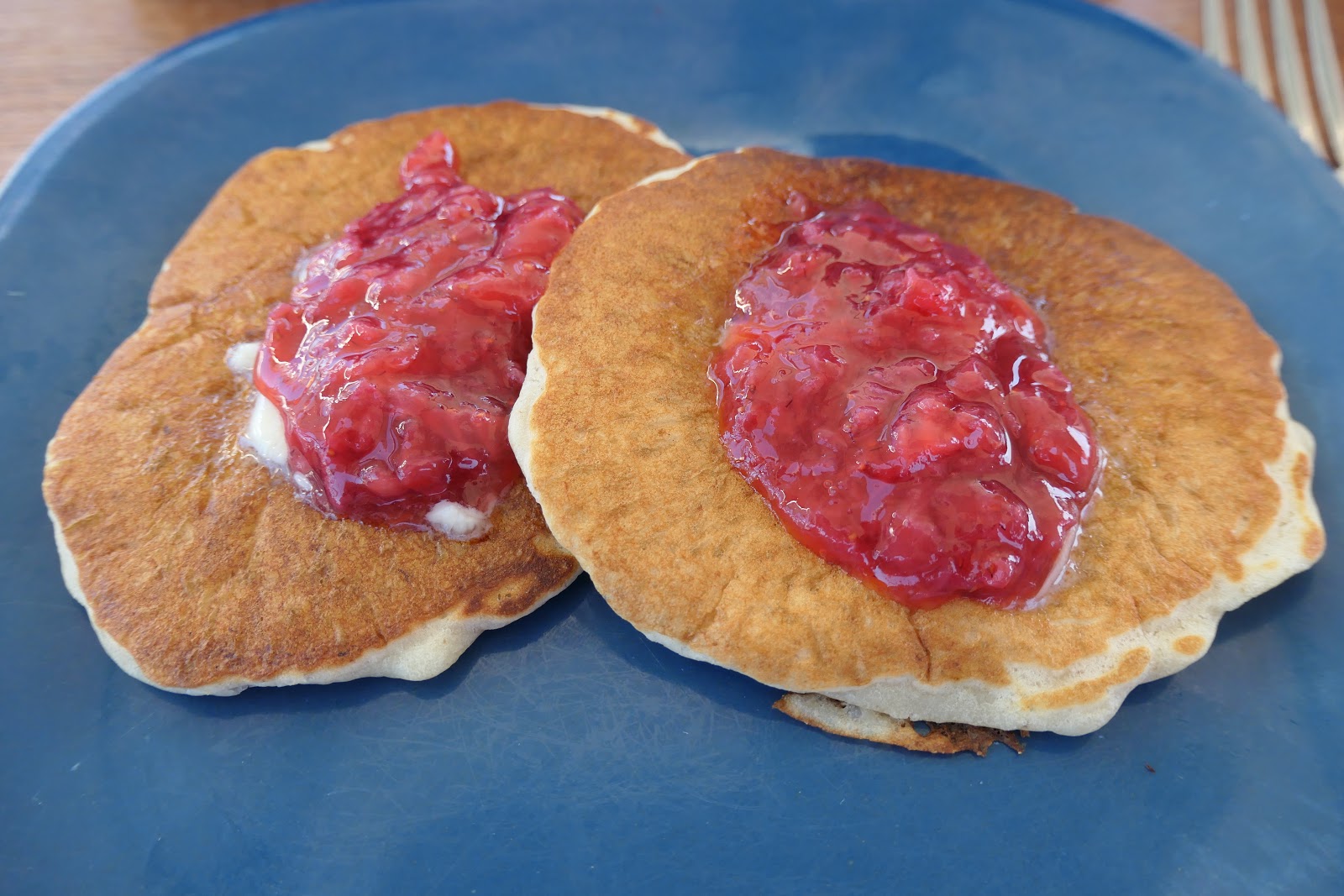
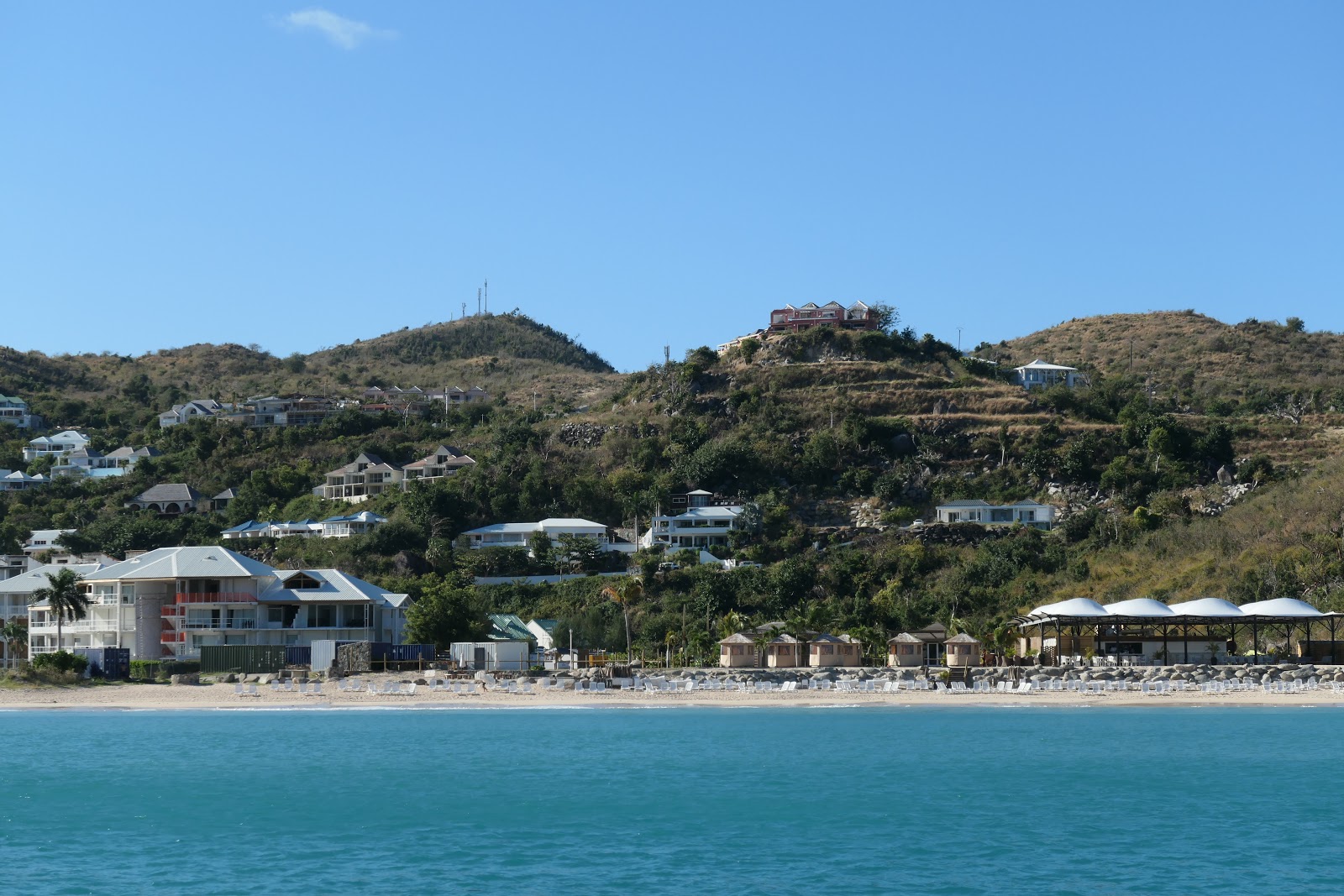
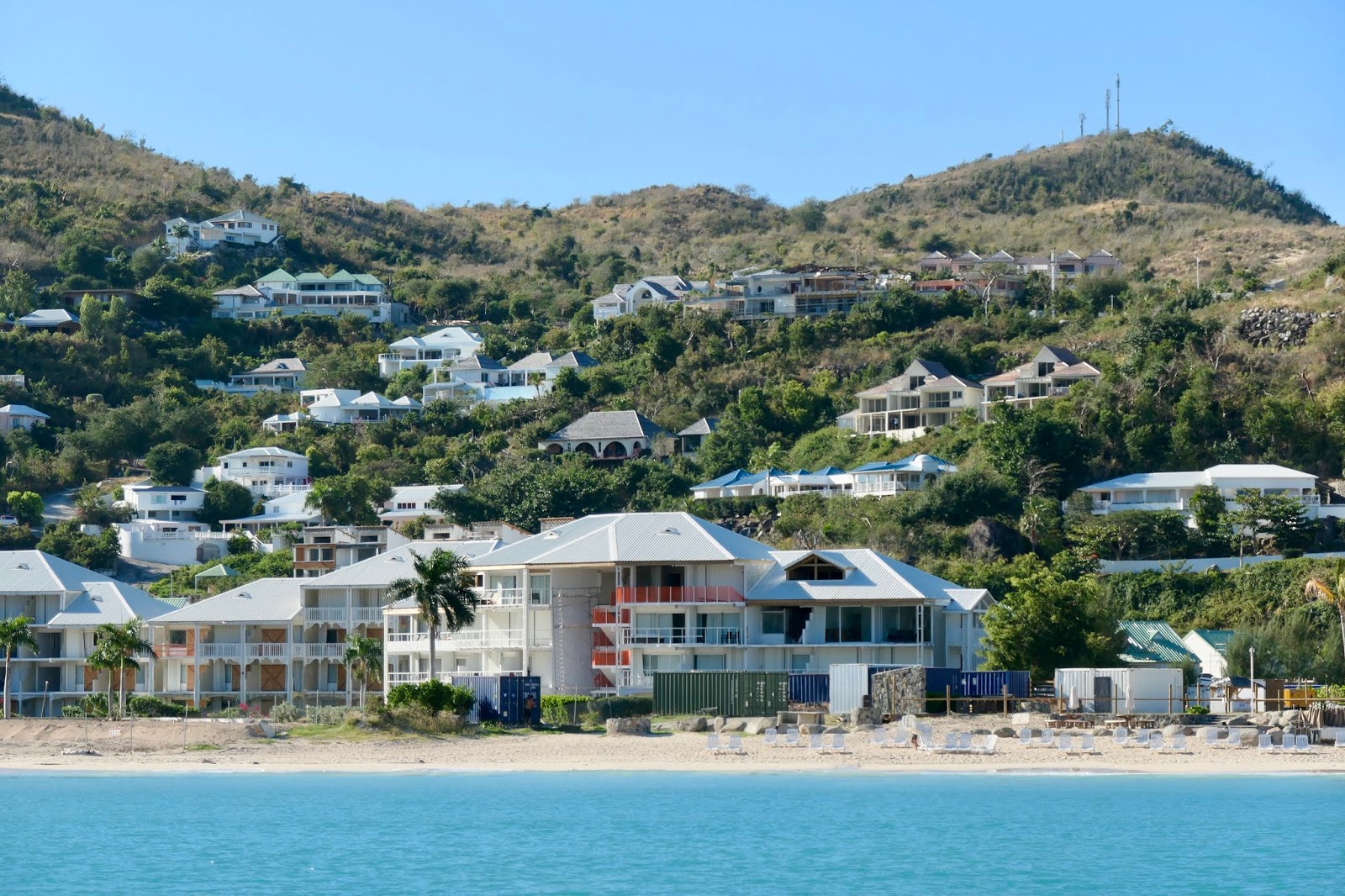
We anchored off St. Martin in Anse Marcel, with a view of incredibly turquoise waters and the Riu Palace Resort.  We are not cleared to visit St. Martin.  Although we are on the French side of the island, the pet restrictions follow those imposed by the Dutch side, and Duhkxy will not meet those until next year.  The VHF wafts French and we are lusting after pain au raisons and croissants but we must be patient.  We are having pancakes with freshly made strawberry jam.  George is prettying up Duhkxy and checking (on-line) into St Barthélemy (aka St. Barts), and then we will be off.  
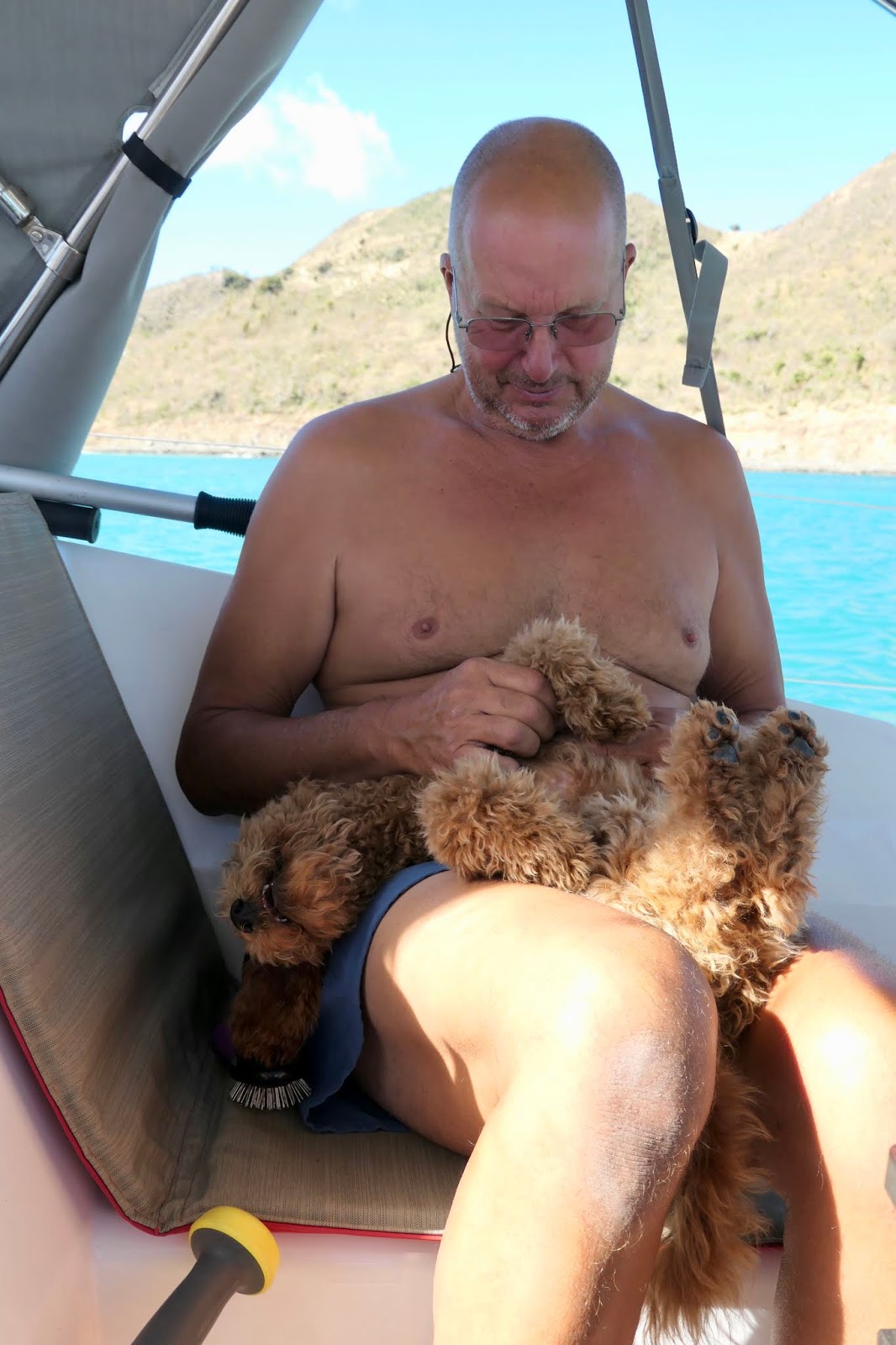
Dreadlocks are popular here, but not on dogs.  To keep them at bay, we keep Duhkxy’s hair short and he gets brushed at least several times each week.
Pancakes made with Mitch’s awesome sourdough.  He grew it from thin air in Flagstaff and we can revive it after it has been dried for travel.
Anchoring in the bay Anse Marcel

One of two hotels affiliated with the Riu Palace Resort, St. Martin

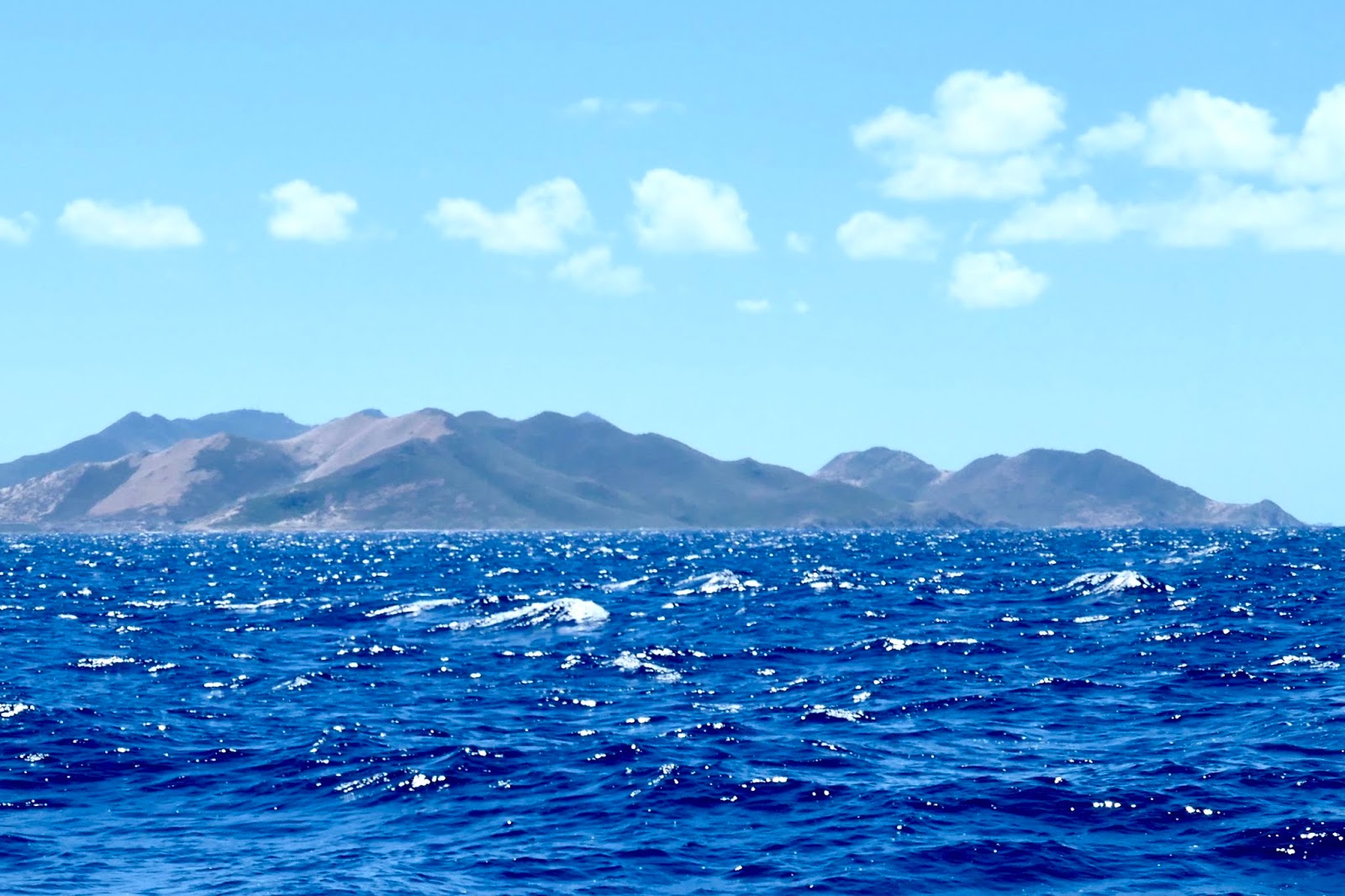
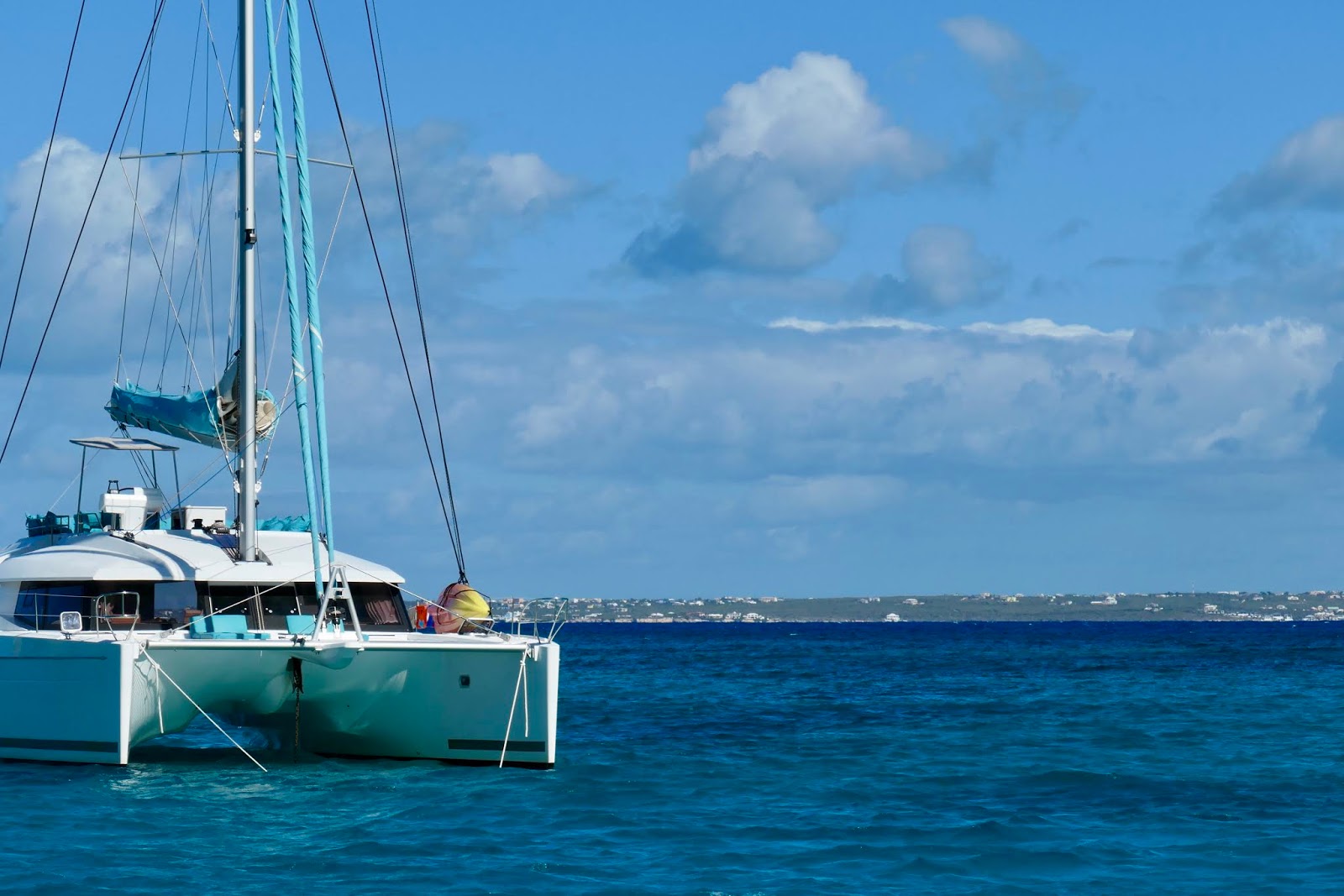
Off our stern, we see the heavily populated British territory, Anguilla, and a really smart-looking catamaran.  This 60ft cat is chartered and crewed.

Anguilla, viewed from Anse Marcel

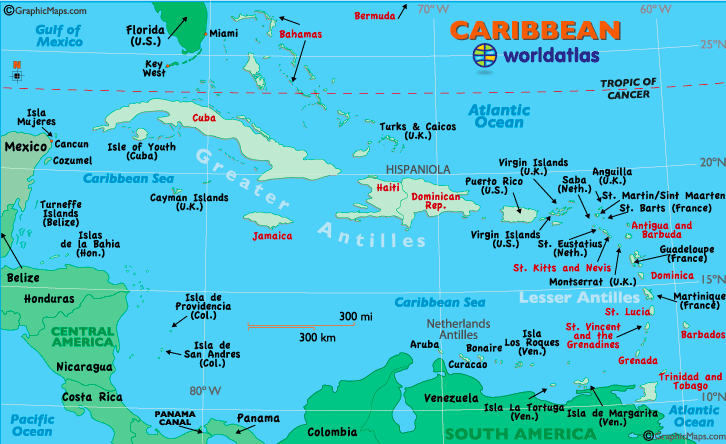
Caribbean Islands

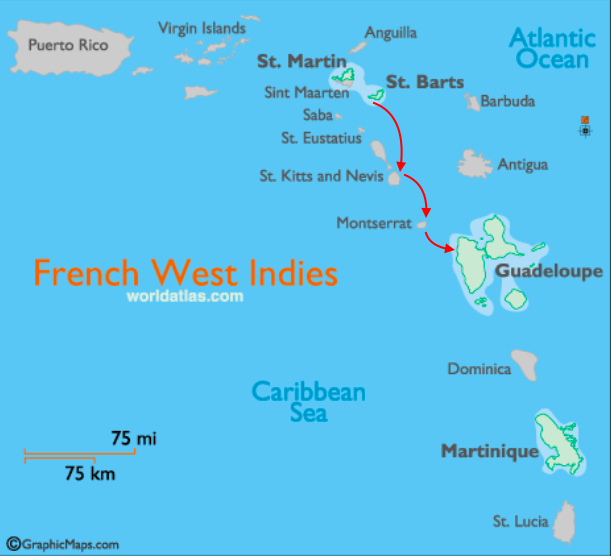
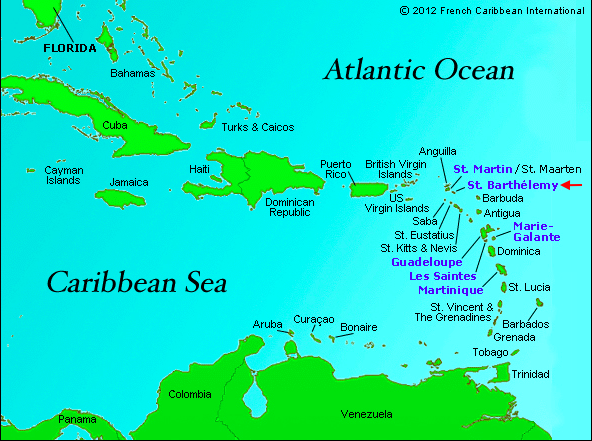
I have often referred to the Caribbean as a collection of islands I imagine to be tropical paradises in the general geographic region south of the United State mainland and east of Mexico.  As we travel I make small efforts to be a bit more informed and find that I am not alone in my vague understanding of both the definition of what constitutes the Caribbean, as well as, the diversity of this combination of independent Island Nations and islands “belonging” to or with various types of affiliations with, remote sovereign nations (ie territories, commonwealths, et al.).
I now understand the Caribbean to be defined as those islands either, surrounded by the Caribbean Sea, or bordering it on one side with the Atlantic Ocean on the other.  However, some islands that fit that definition (ie those which are a part of Columbia, Honduras…) are not referred to as Caribbean islands and some islands that do not fit the definition (ie Turks & Caicos) are sometimes lumped in.
So, not so different from my original description.
This map was reproduced from (Graphics.com)
However, when sailing through “The Caribbean Islands”, it becomes very important to know where you are, as each island, or group of islands, has its own regulations concerning Customs, Visa requirements, visiting pets, length of stay, et al).
This is very different from our previous explorations in the Bahamas and the Mediterranean, where, as citizens of the US, our passport obviated any need for a visa and allowed free passage between all the islands that constitute the Bahamas, and all countries that are part of the European Union.  You simply checked in with customs and border control once when entering the designated region, and once when exiting.  BTW – starting in 2020 US citizens will need a VISA to visit countries in the EU.  I can’t imagine how that happened!!

Where we plan to visit this year (2019)

The islands we will be visiting this year has largely been determined by their respective requirements for visiting pets and the fact that our boat started out in St. Thomas, US Virgin Islands.

Pet restrictions revolve heavily around concerns of rabies.  Britain and her territories have never had rabies and their requirements are the most restrictive (other than some which require quarantine).  Your pet need to be in good health, have all its shots up to date, be micro chipped or tattooed, have a UDSA certification of health.  This is pretty much the same for most of the islands.  However, those which like Britain, have not had rabies, require a rabies titre.  This is a measurement of the level of anti-rabies antibodies the dog has.  Dogs who have not had at least their first and second rabies vaccination, rarely mount enough rabies antibodies to pass this test.  We will not be visiting these islands until next year.  In addition, as previously noted, some islands require a lengthy quarantine.  We will not be visiting these islands at all.  

We will be heading east and south of the Virgin Islands to Grenada where Ice Floe will be stored on land throughout the hurricane-prone months.  Our current boat insurance policy requires you to store your boat further south in Trinidad / Tobago.  However, Duhkxy will not meet all the requirements to enter this country.  So we are switching to a company that, for a premium, will allow Grenada, which has rarely sustained a direct hit.  Along the way, we hope to visit the French islands (St. Barts, Guadeloupe, Martinique), Dominica, and St. Lucia. 

Cruz Bay, St. John

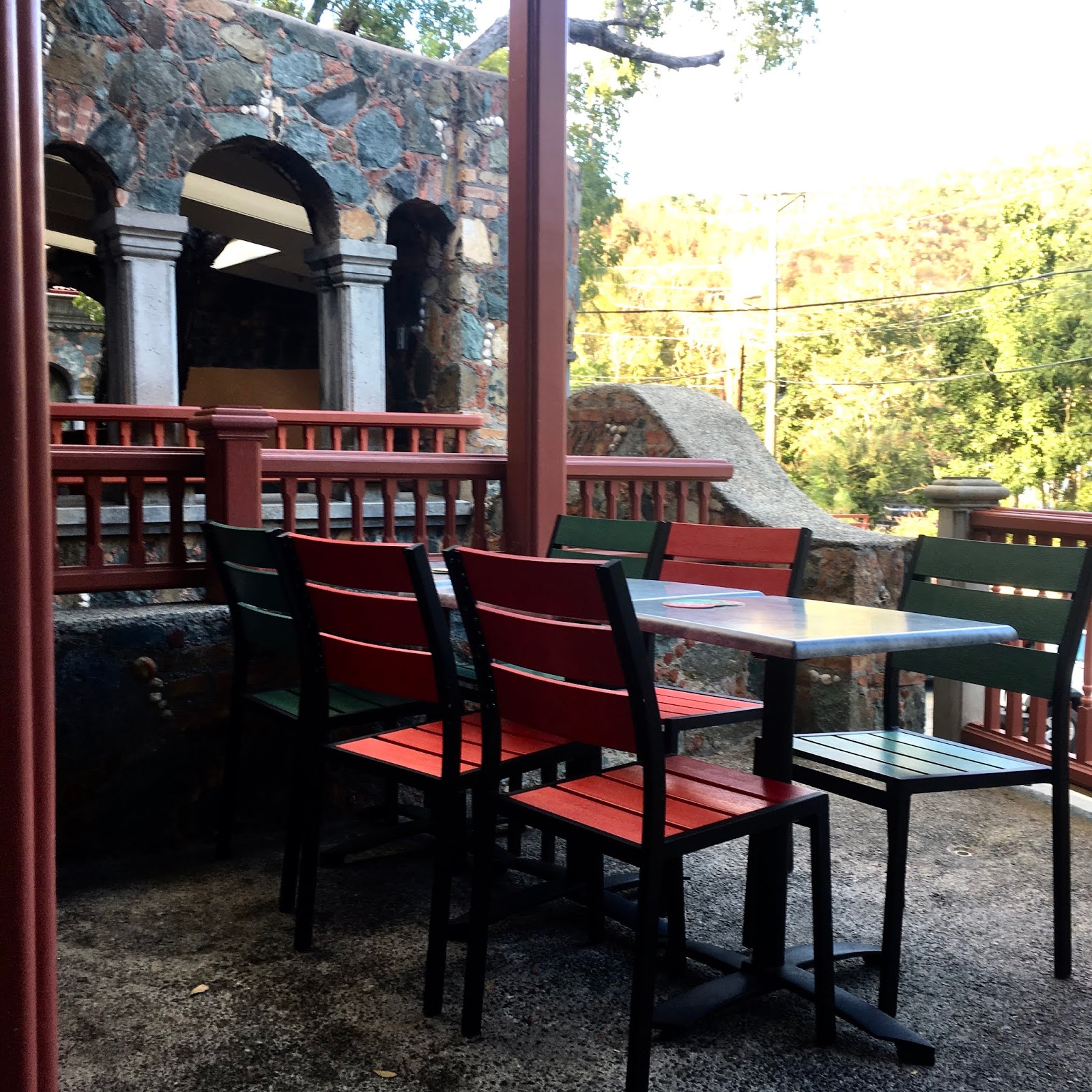
The Tap Room, Cruz Bay, St. John

Cruz Bay, St. John

We spent our last day in the Virgin Islands sailing the north coast of St. Thomas and then headed to St. John and moored in Caneel Bay.  We hopped in the dinghy for a ride to Cruz Bay to clear ourselves through US Customs and Border Control in preparation for our sail to St. Barts.  We missed the customs office by 30 seconds.  On line information indicated the offices hours were 7:00am to 6:00pm.  The agents’ information indicated they were open from 10:00am to 5:30pm.  These kinds of disconnects occur so often in the Caribbean, they are not worth mentioning.
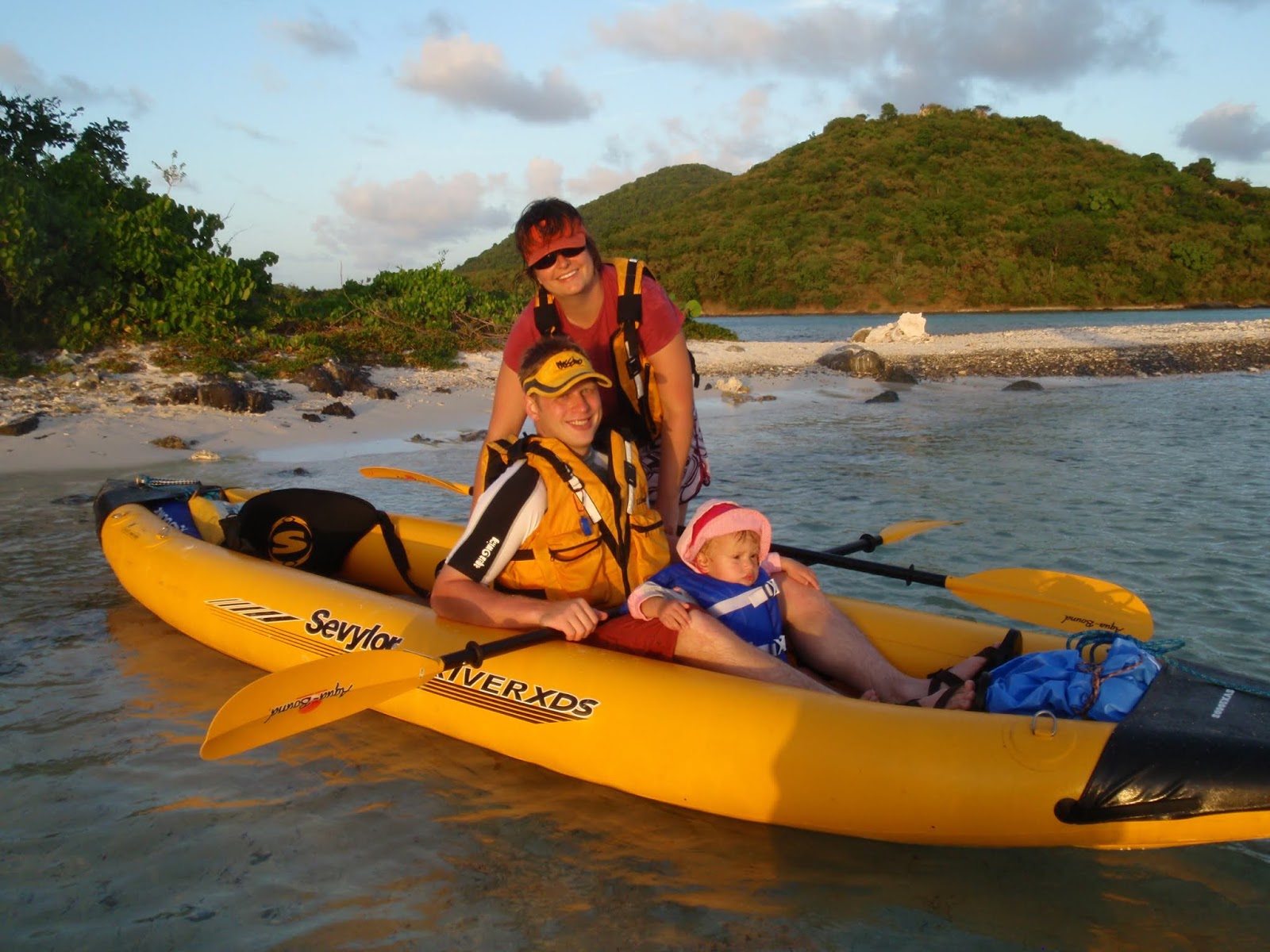
Next stop – The Tap Room – where we enjoyed nachos and wonderful beers while we sent texts back and forth with Allison and Michael, recalling the summer vacation in 2009 we had on St. John when we rented a cottage.  We all had the same recollections of having enjoyed the beer and the R&Rs (rum and root beer) and saw our first iguana in a tree beyond the outdoor balcony where we were seated.  Riley, less than 2 years old at the time, went absolutely mad one evening – racing around and being silly – much to everyone’s delight other than her parents who knew she was exceedingly tired.
Allison, Mike, and Riley setting off in one of our blow up kayaks (St. John, US Virgin Islands, July, 2009).
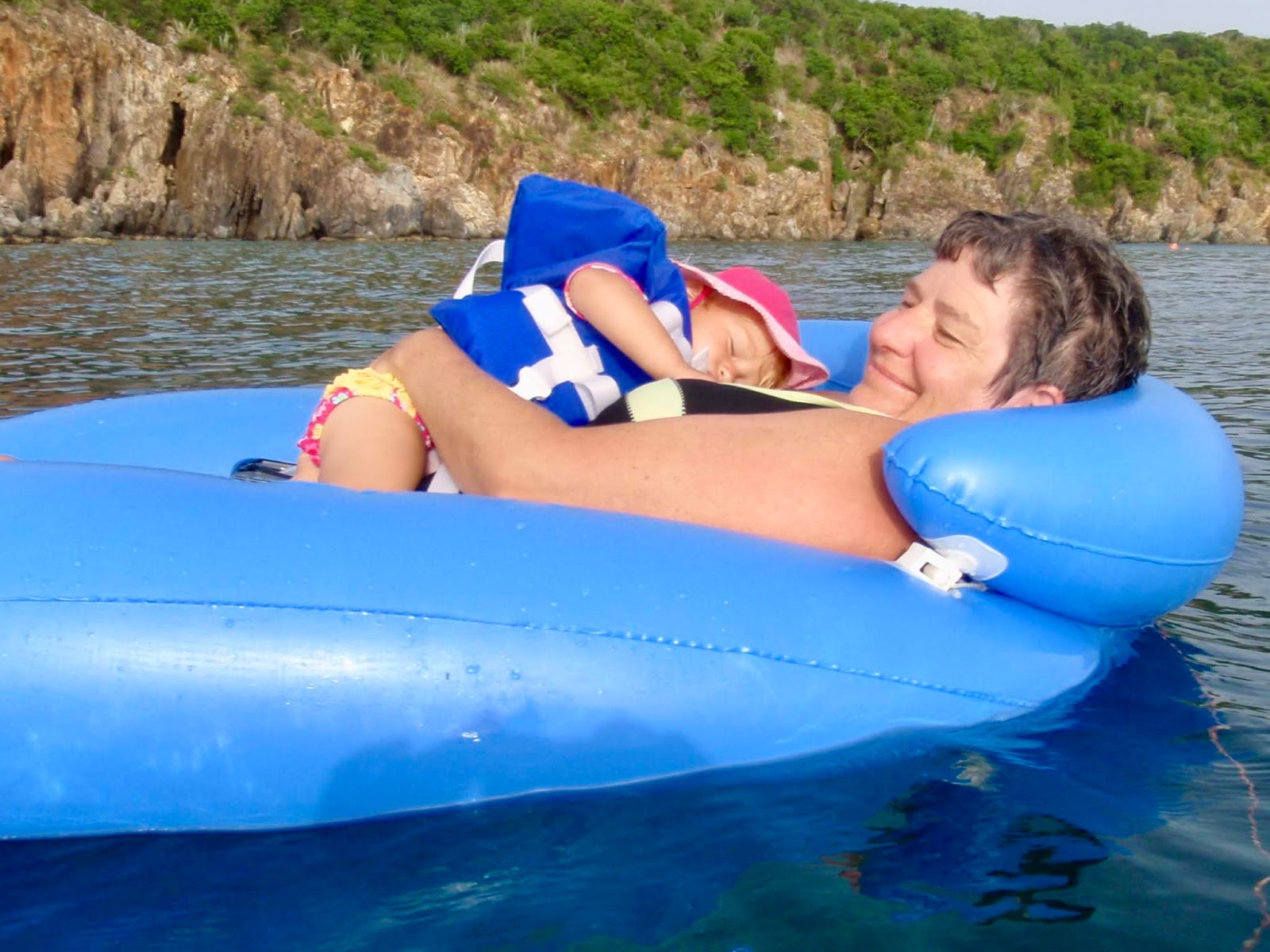
Mimi, always the first to volunteer for snuggling while the rest of the troupe is snorkeling (2009)]
St. John brings back so many wonderful memories. We rented a catamaran and sailed in the US and British Islands in 2011.  Marilla, Allison, Mike and Riley joined us for that vacation (Tristan and Mitch were not yet present in our lives).  This vacation solidified our dream to own our own cruising sailboat – and that was that!
Marilla assisting with first catch from our rented Catamaran out of which the girls made yummy fish tacos (US Virgin Islands, 2011)
Chartered (bareboat) catamaran, US Virgin Islands, 2011)

Visiting St. John in 2019 we find much is the same as our memories, albeit damage from the 2017 hurricanes is still in evidence, especially in the shallow water reefs that took a beating.

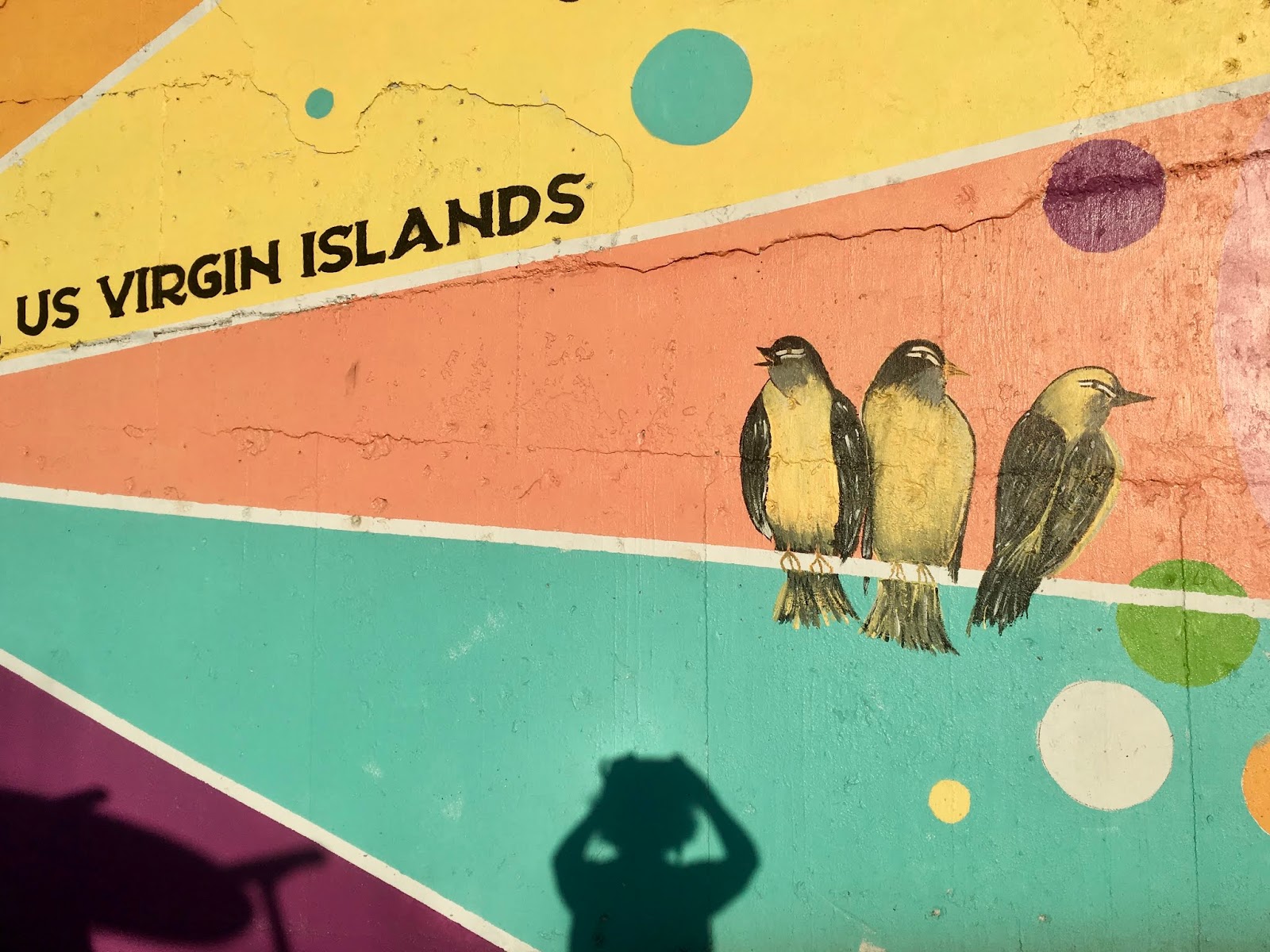
Mural depicting the ever-present, and beautiful Bananaquits
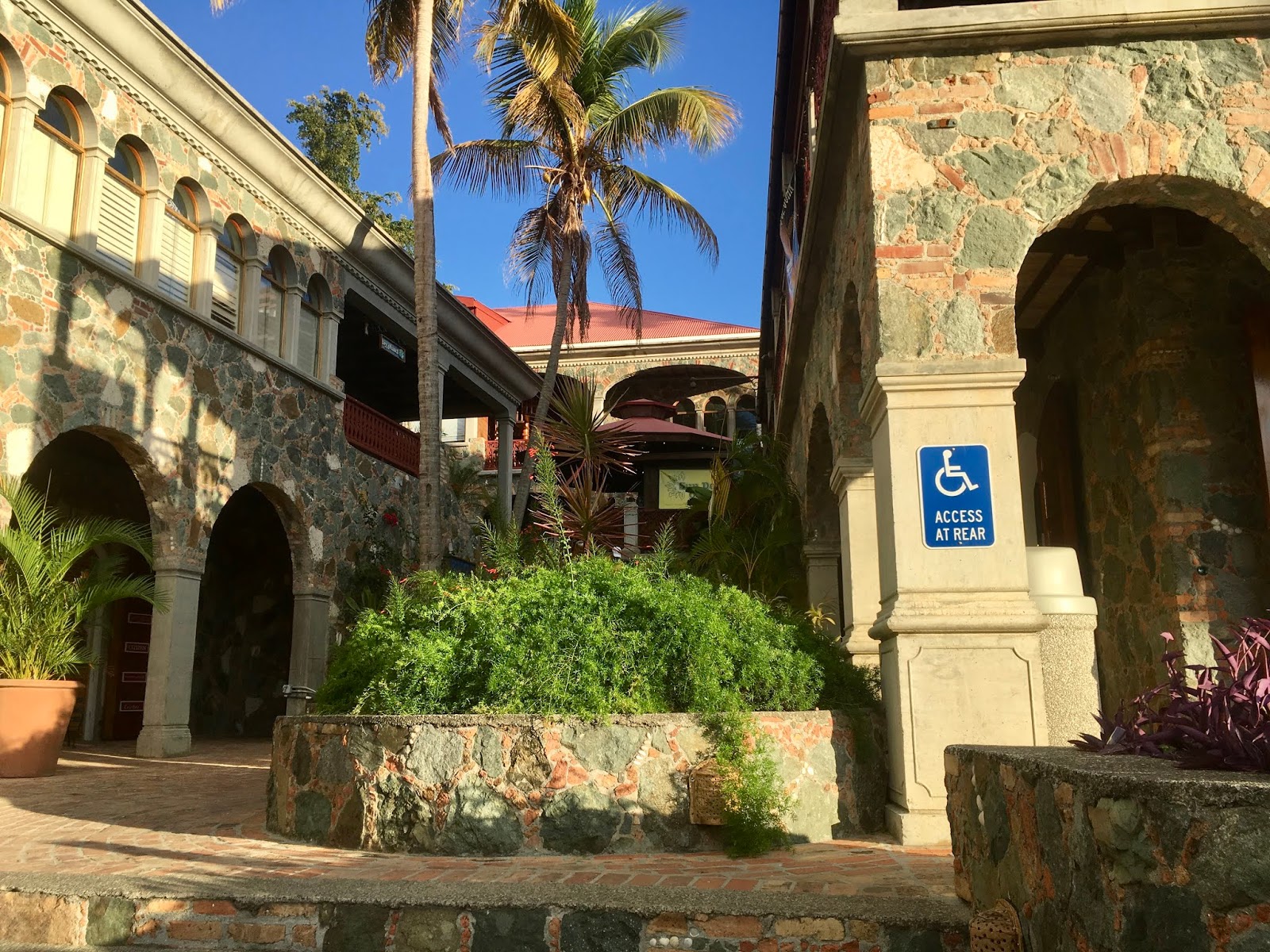
Beautiful shopping and restaurant area in Cruz Bay, St. John, US Virgin Islands

We are headed “down island” today, on an overnight sail to St. Barts.  We will start from the British Virgin Islands and exit just north of Virgin Gorda to make as much ground going east before turning south (as wind permits).

From the Mediterranean to the Caribbean

Catching Up

So much has transpired since my last post.

We arrived home from Italy mid-November.  To our delight and extreme indebtedness we found our property and home as if we had never left.  Our gardens were weed-free, our houseplants thriving, our home dusted and vacuumed, and our refrigerator provisioned with an assortment of fresh food including homemade salad, dressing, and curried butternut squash soup.  All, courtesy of Diana who wasn’t busy enough with her own life.

We had just enough time to catch up with some friends and we were on our way to Allison’s and Michael’s home for Thanksgiving.  Thanksgiving has always been my favorite holiday and doubly so, when family members from far away are able to come together.  We managed to have all the youngest members of our family make the trip to Michigan – Susan (California), Marilla and Mitch (Colorado), Brian, David and Brenna (Florida) – joining Allison, Mike, Riley and Tristan.  Margaret and Burt (Pennsylvania) and George and I represented the older generation.  It was a very special Thanksgiving.

Following Thanksgiving, Margaret and I spent very precious time with our oldest brother Tom. Sadly, our attempt to address his request to move to a long term care facility that would provide him with the support he needed was unsuccessful and Tom passed away less than 2 months later.  He joins, David, our youngest brother who passed away 10 years ago.  We will always love them, miss them and remember them.
David (Dave) Coughlin, left and Thomas (Tom) Coughlin, right


Life’s experiences include the highest, highs and the lowest, lows and we move forward – bringing both along with us.

Sailing in the Caribbean

Ice Floe arrived in St. Thomas the day after Thanksgiving and George flew down that same day to meet her and get her settled in at Crown Bay Marina, Charlotte Amalie, St. Thomas.  Details of the experience having her shipped across the Atlantic Ocean by Sevenstar Yacht Transport and our past two months in the Virgin Islands may be topics for future posts, time and internet permitting.  This one will serve to catch you up to the present.  

Boats are hauled from the water, put aboard ship in cradles that are welded to the ship, and strapped down for the passage.


George flew back north several days later, having already swapped the loaner prop for our refurbished one, refitted Ice Floe’s cooking fuel from butane to propane, lowered the stove so we could fully open the cabinet above it, and installed the grill.

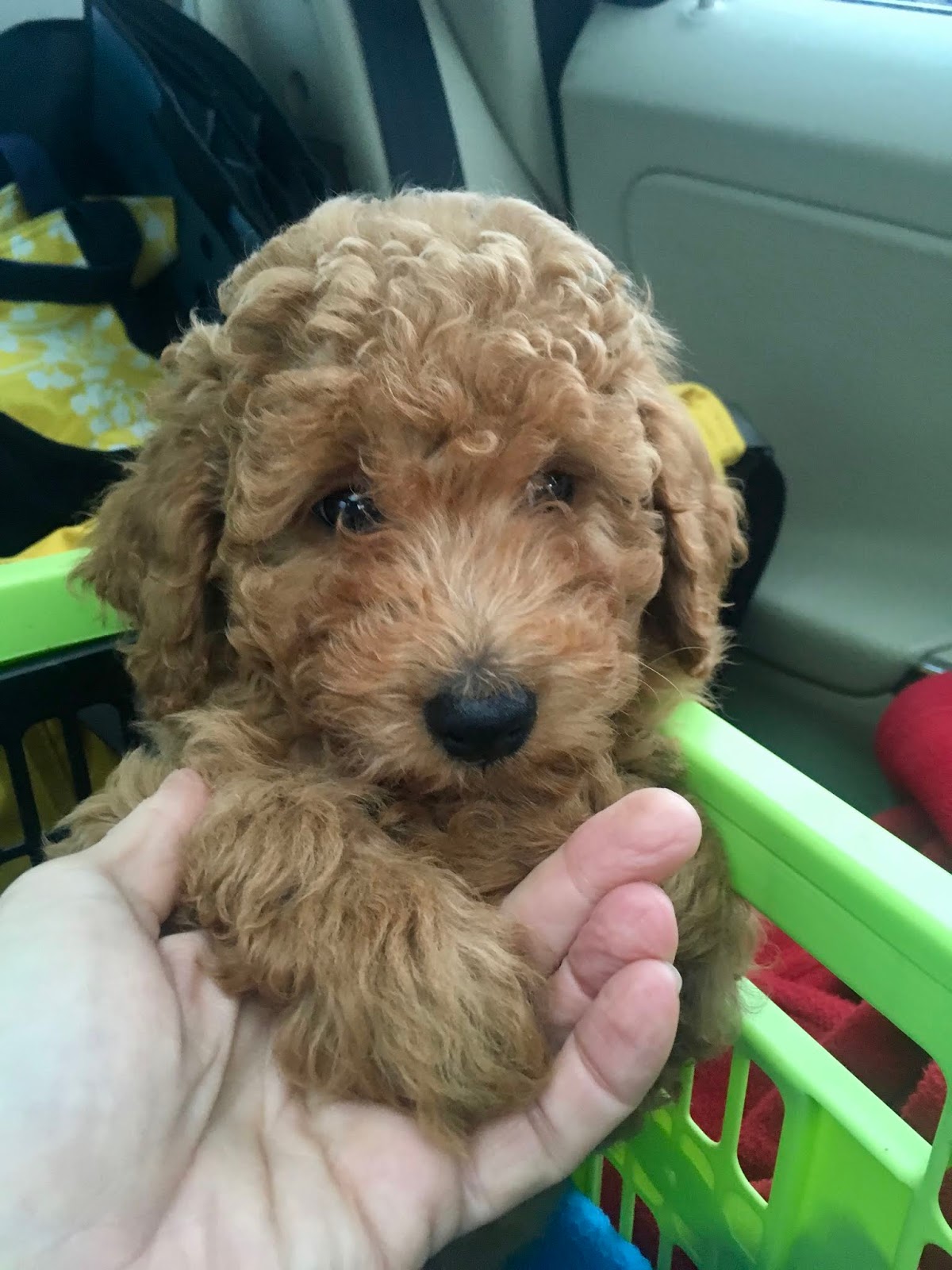
Duhkxy, (Nov 29) at exactly 8 weeks of age, on ride from Lancaster to his new home

He joined me at Margaret’s and Burt’s, who had driven me from Michigan to their home so we could visit Tom AND attend the Broadway smash hit “Hamilton”, then playing in Buffalo.  Margaret, Burt, George and I had seen it on Broadway and Margaret, and I could not miss this second opportunity.  Margaret’s friend Ruth joined us and we could not have had a crazier, more memorable, and fun time.

Next stop was Lancaster, Pennsylvania to pick up the most recent member of our family, Duhkxy (pronounced Ducksy).

After Duhkxy got the all clear from the veterinarian and we fulfilled all requirements to bring him to the US Virgin Islands, we flew back to Ice Floe on December 29.


Duhkxy – First full day on Ice Floe – No adjustment issues!
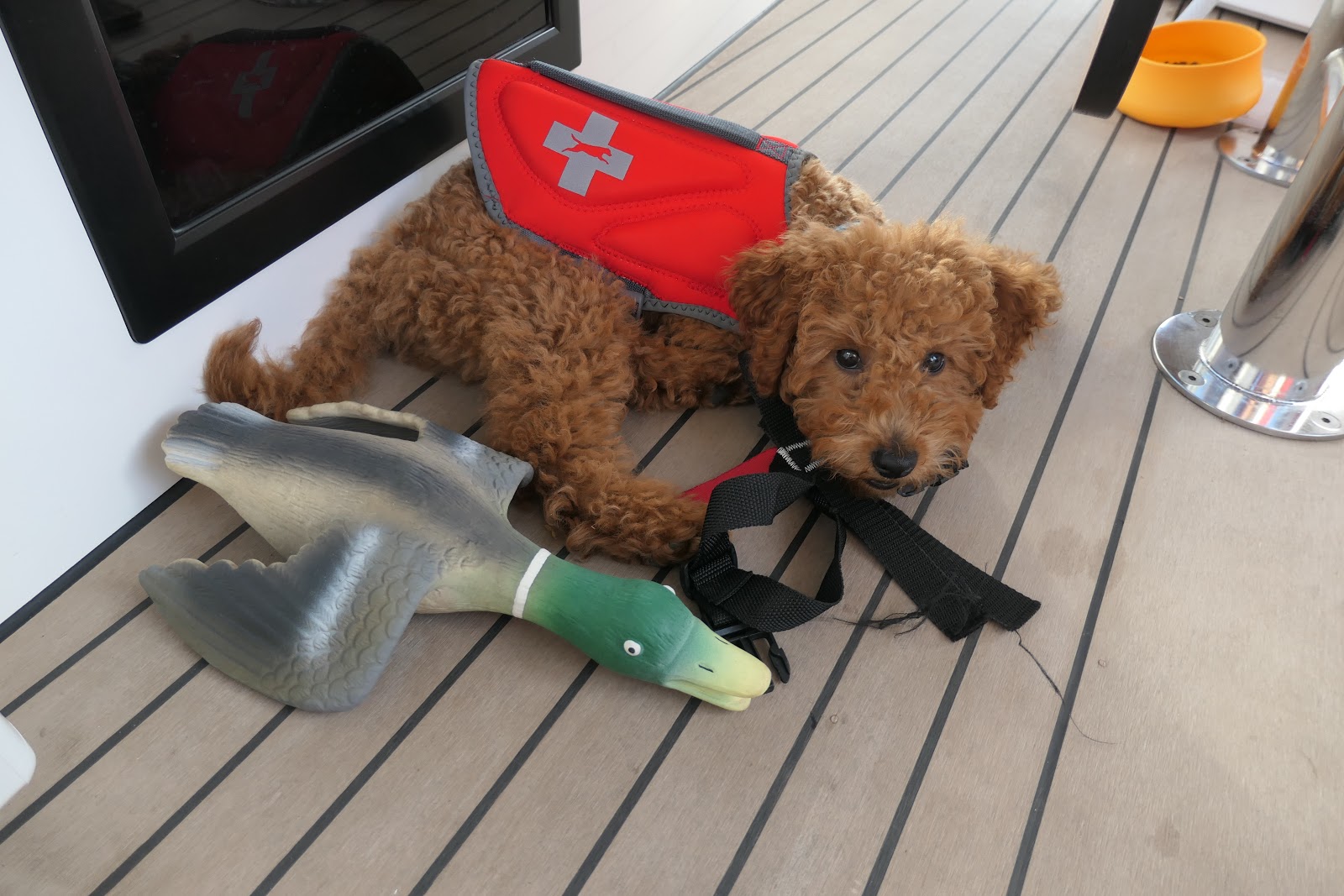
Duhkxy, Dec 23 on Ice Floe (Day 3) showing off his life jacket and rubber duck
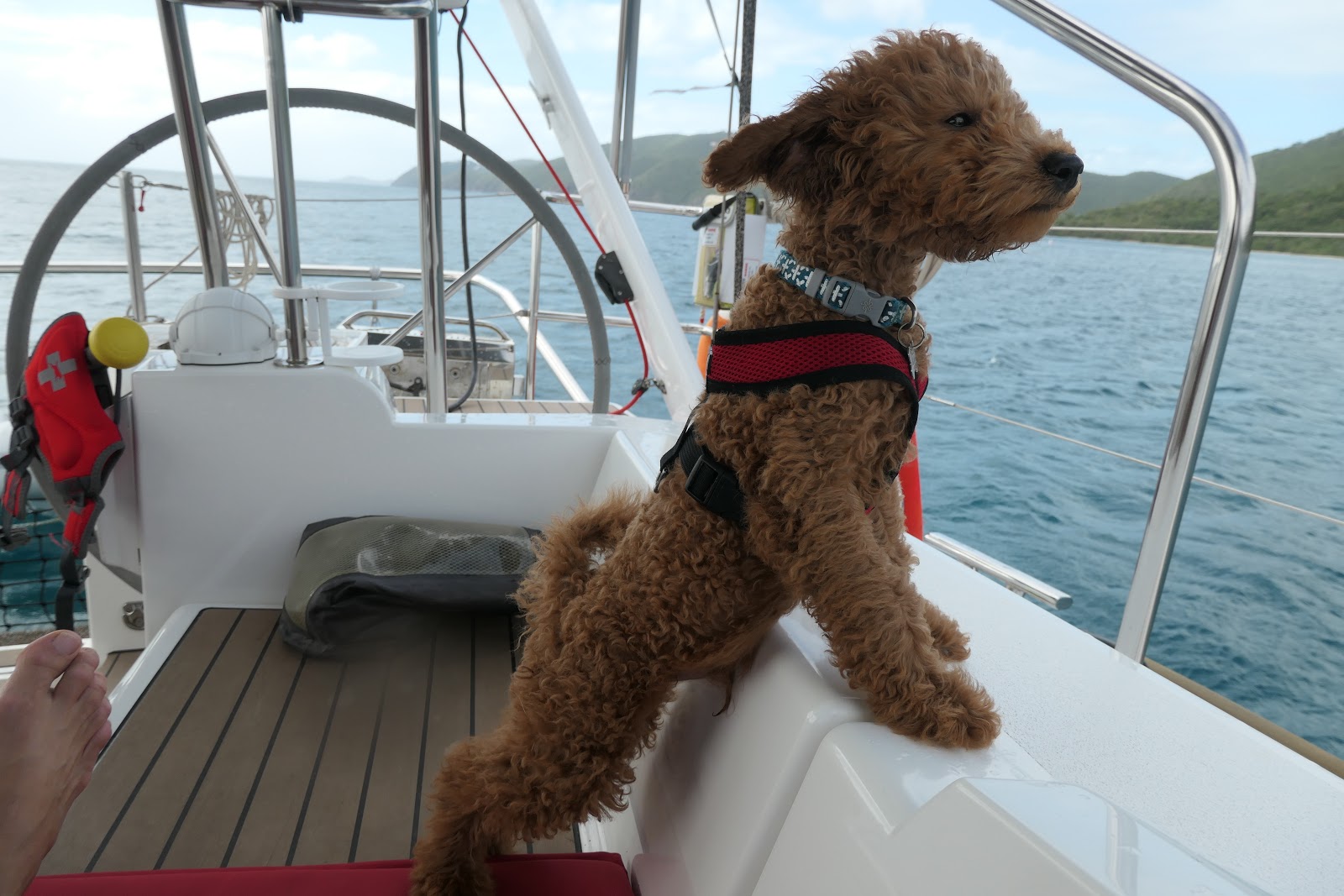
Duhkxy, Dec 29 – master sailor

We spent our first several weeks in Crown Bay Marina putting the boat back in order (cleaning, putting sails back up, and installing a wind generator and water maker).  These, in combination with our solar panel have given us independence to anchor out as long as we want rather than needing to stay periodically in marinas.  The winds are so nearly constant, we are able to sail almost exclusively – we have hardly put a dent in our first tank of diesel.

To date, we have been visiting the Virgin Islands (US, St. Thomas, St. John, and St Croix; Spanish, Culebra, Cullebrita, Vieques and Puerto Rico).  The British Virgin Islands were off limits as Duhkxy is not old enough to have completed some of the requirements for a dog to visit.

Zoni Beach in Culebra

Marilyn came to join us for a bit over a week in February which we spent in the Spanish Virgin Islands.  George and I were visiting these islands for the first time, as well, so it was all new for all of us.  Through Marilyn’s eyes we remembered our first impressions of countries where poverty is prevalent, litter is heartbreaking, and waste management stretched beyond capacity.  In combination with the damage from the 2017 hurricanes, this paradise has been sorely challenged. 


Nonetheless, we had a wonderful time snorkeling off beaches (turtles!) and touring via golf cart in Culebra.
Touring Culebra by golf cart
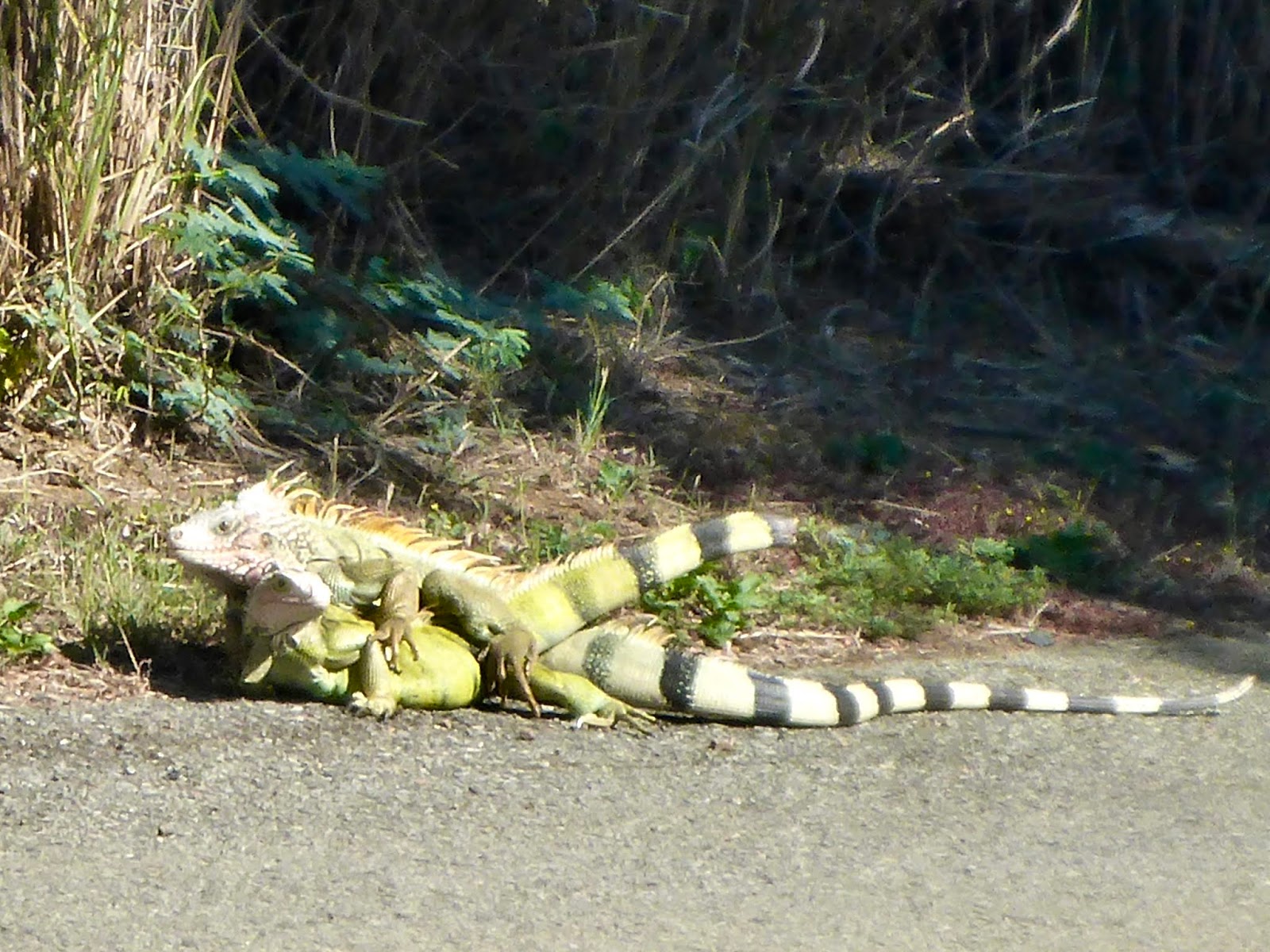
Fornicating Iguanas interrupted while touring Culebra via golf cart
We spent a night anchoring off Vieques and kayaked that night in the most amazing bioluminescent bay (Mosquito Bay) you could imagine.  The bioluminescent dinoflagelates lit up to show every fish swimming by (and there were hundreds).  If you placed your hand in the water and drew it out, it was as if the Milky Way was in the palm of your hand.  Just amazing.

 We enjoyed some local dishes and relaxed on the boat.  Winds were relatively calm.
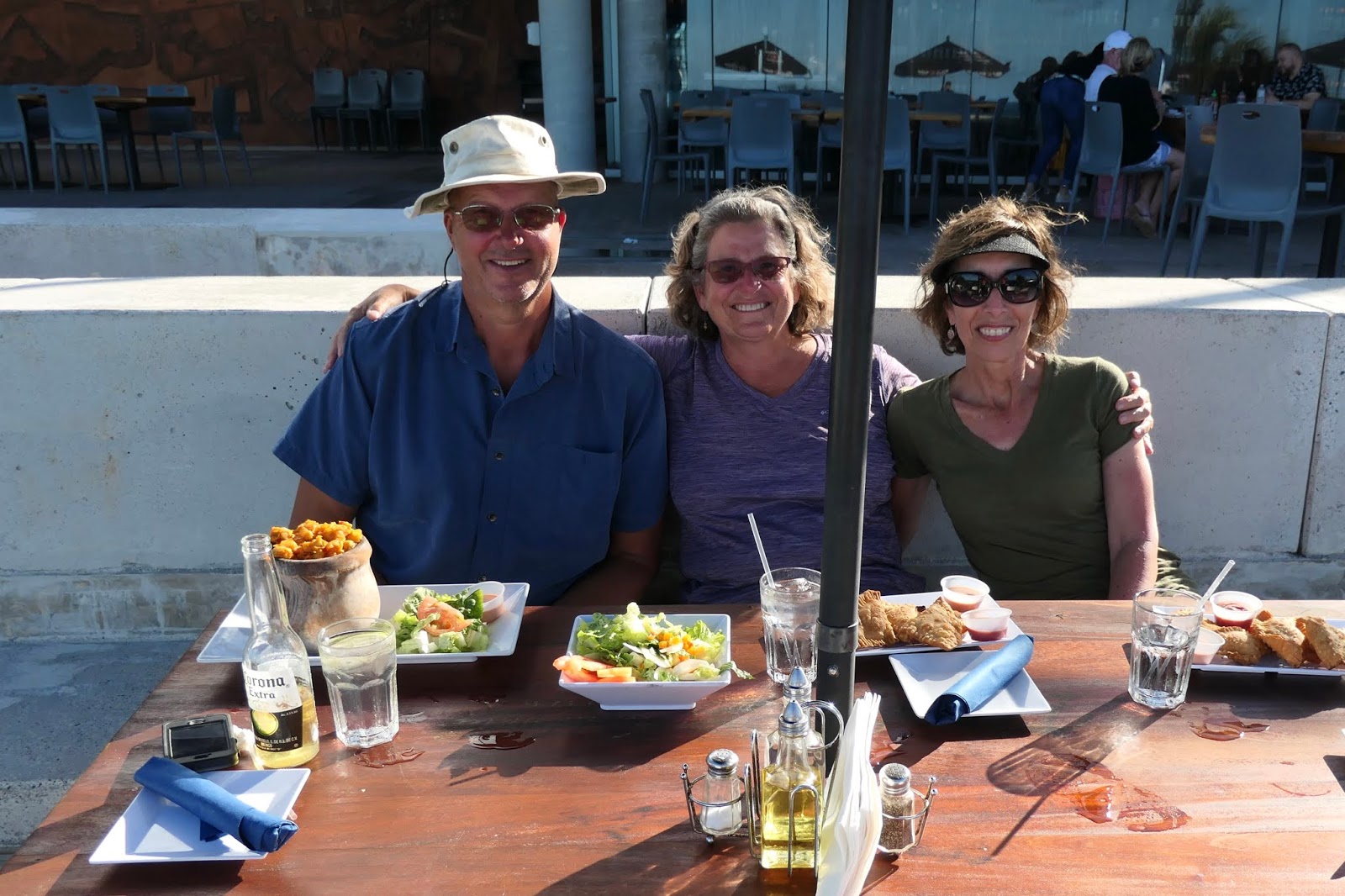
Marilyn ate everything on her plate (mostly)
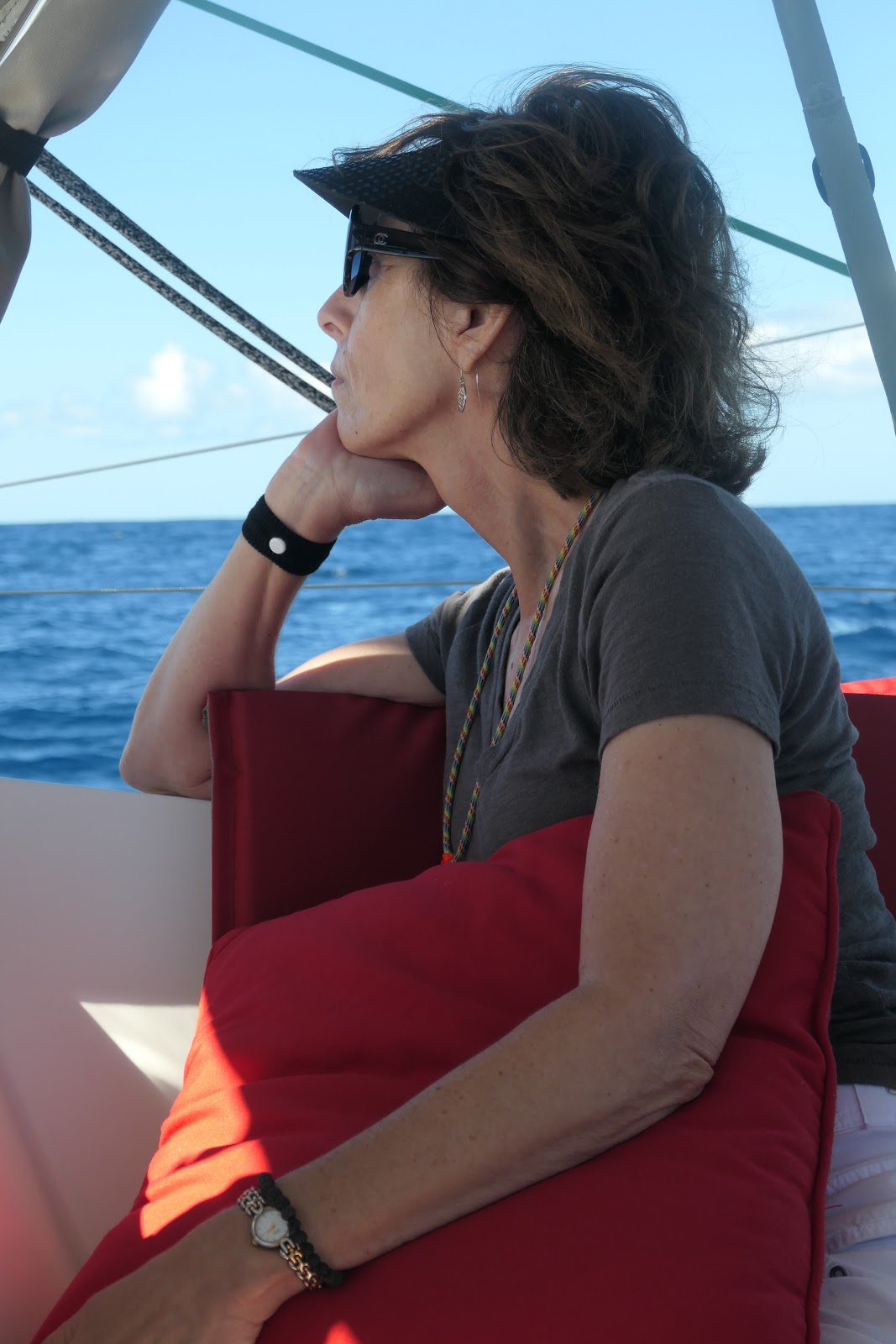
Marilyn on Ice Floe
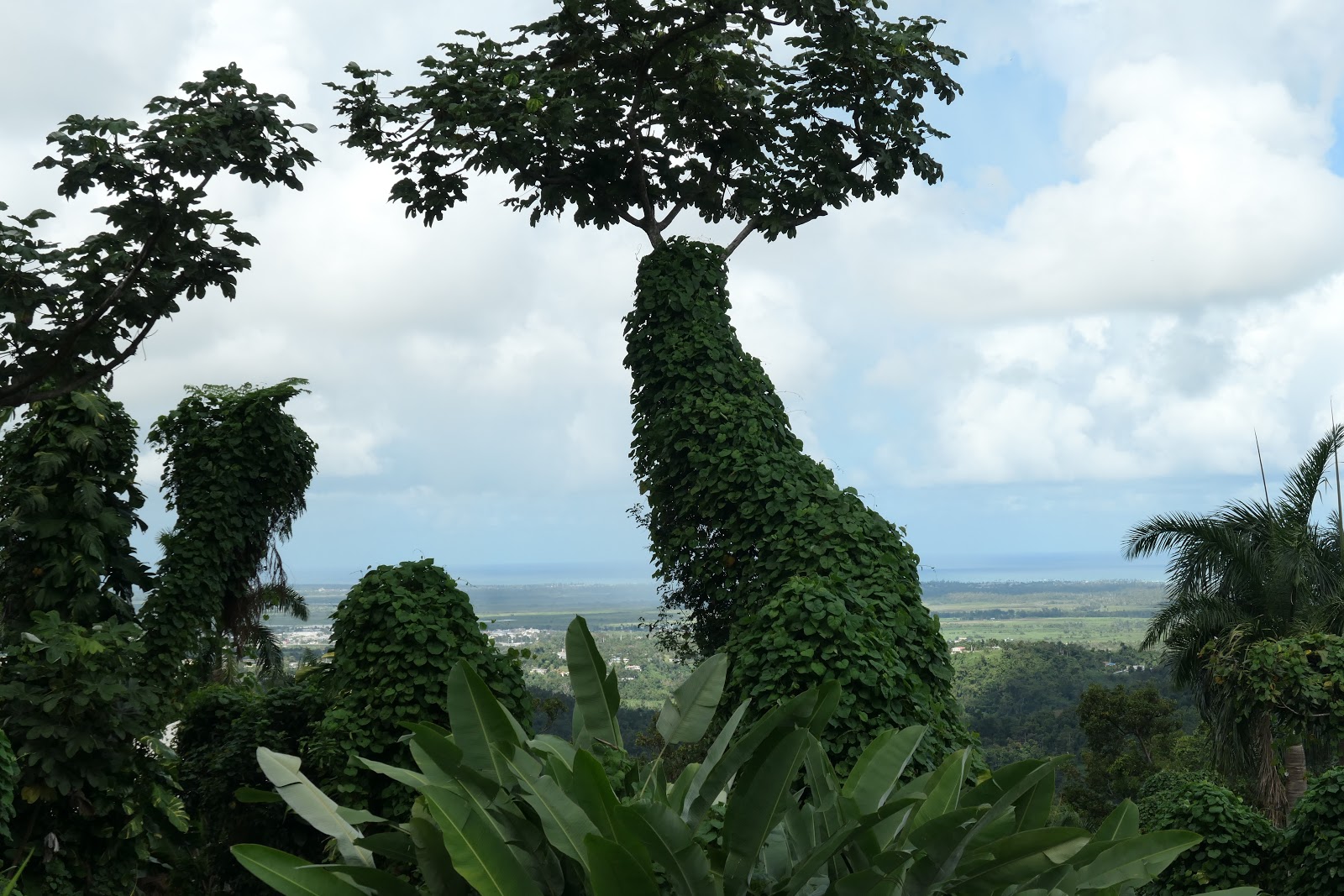
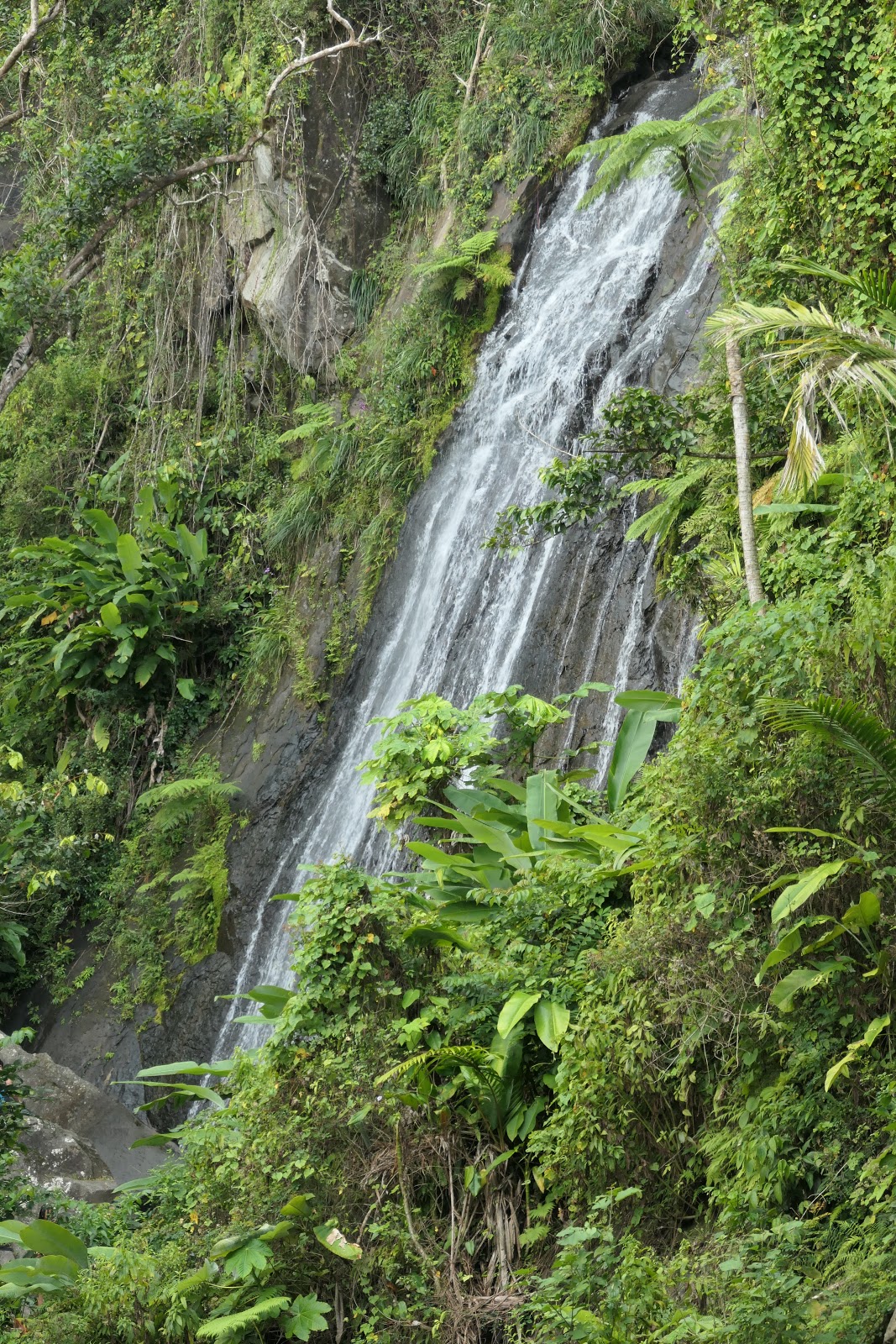
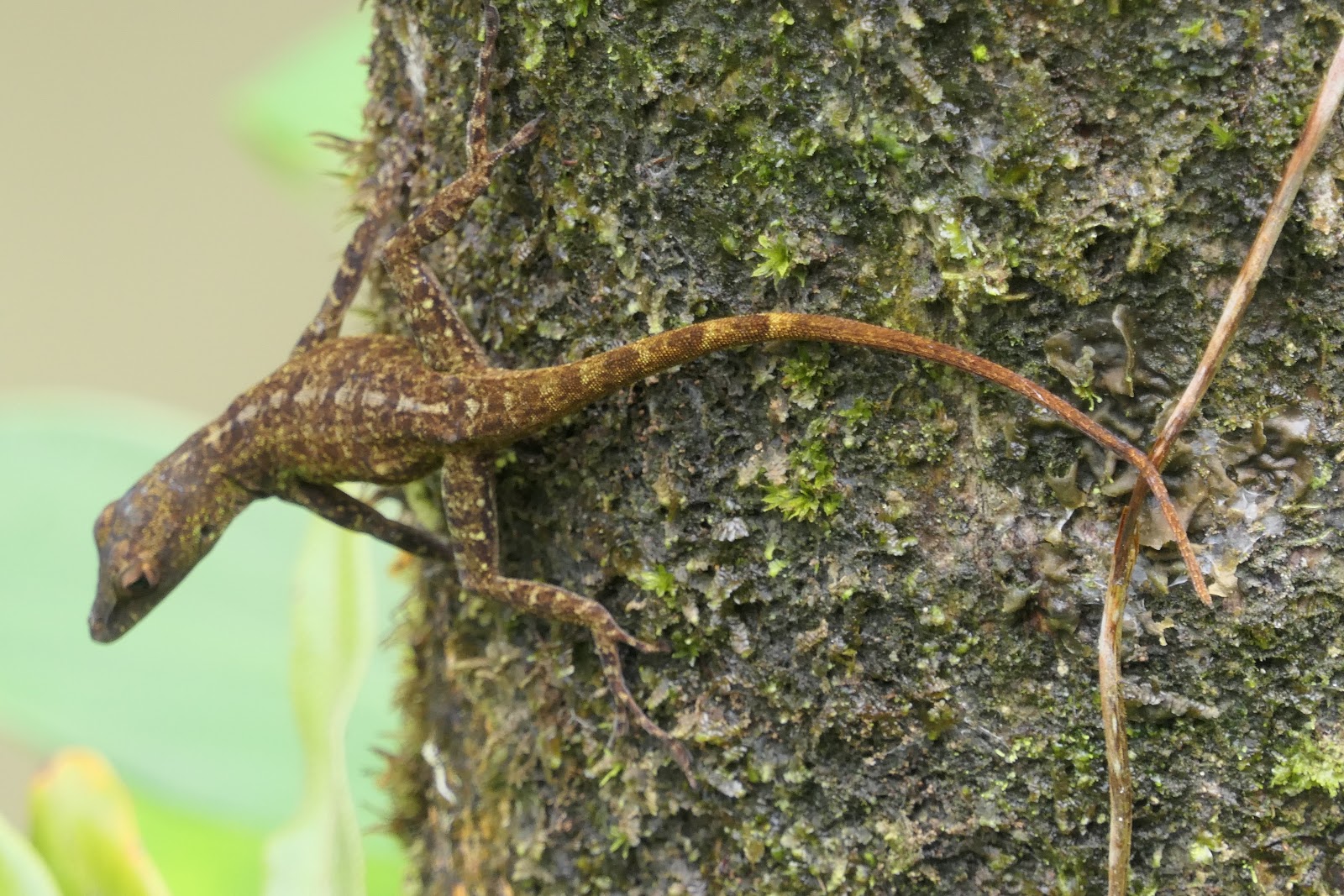
We rented a car to explore Puerto Rico.  First day out we visited the El Yunque Rainforest.
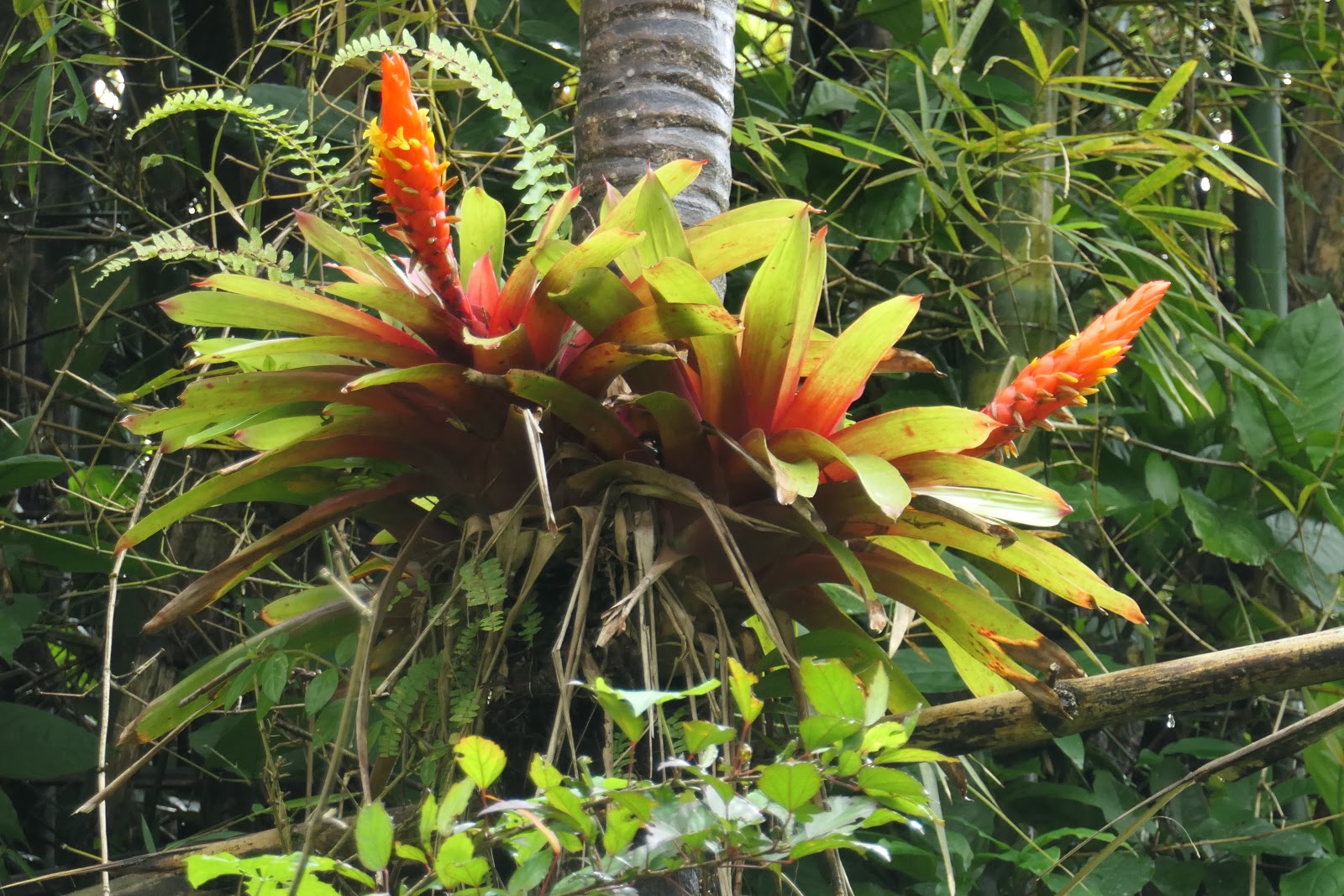
Bromelids in El Yunque Rain Forest
El Yunque Rainforest


Artfully cropped from this photo were some strikingly beautiful young girls in bikinis
who appeared to be posing for a portfolio.
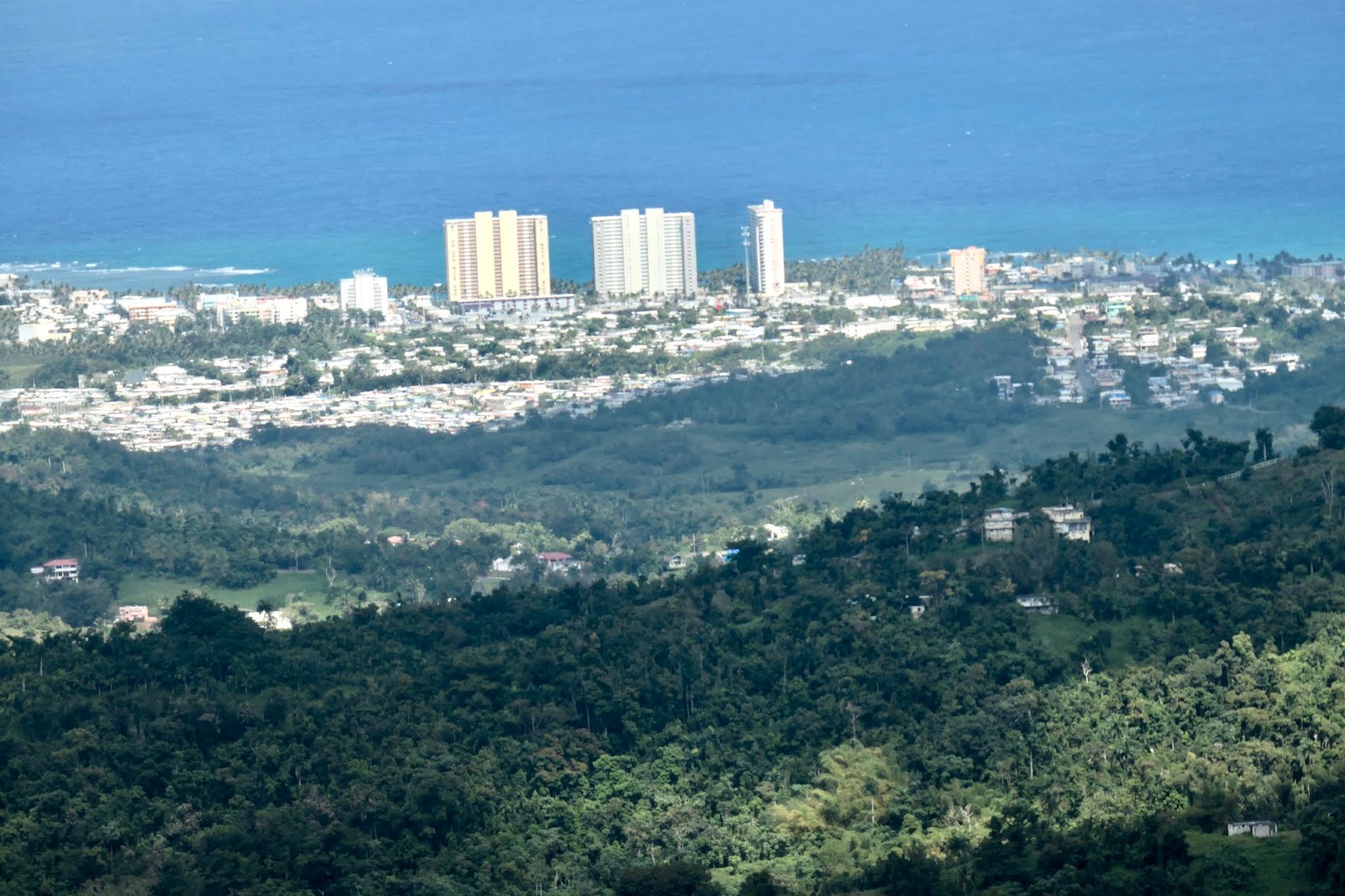
View of San Juan from tower in the El Yunque Rainforest
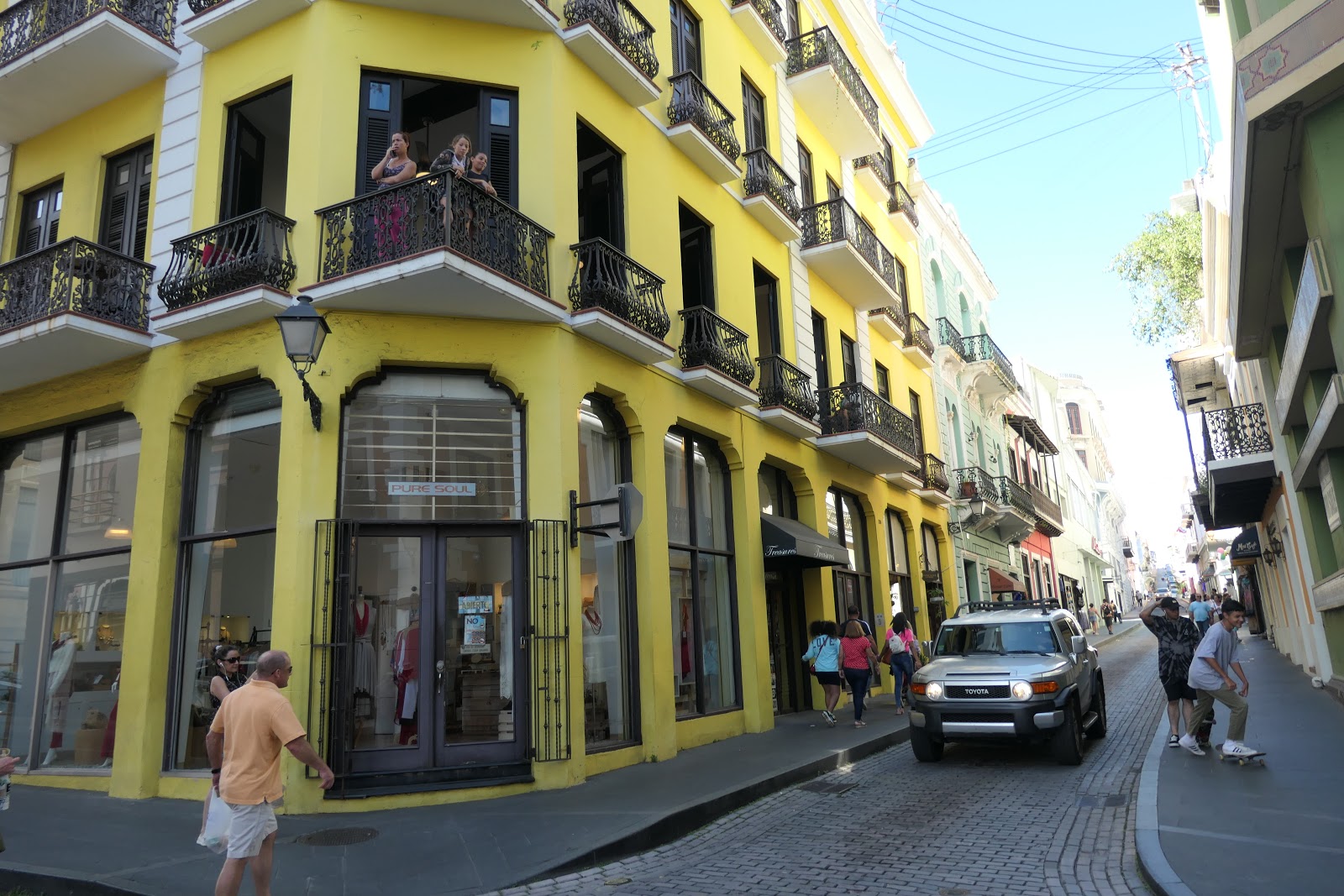
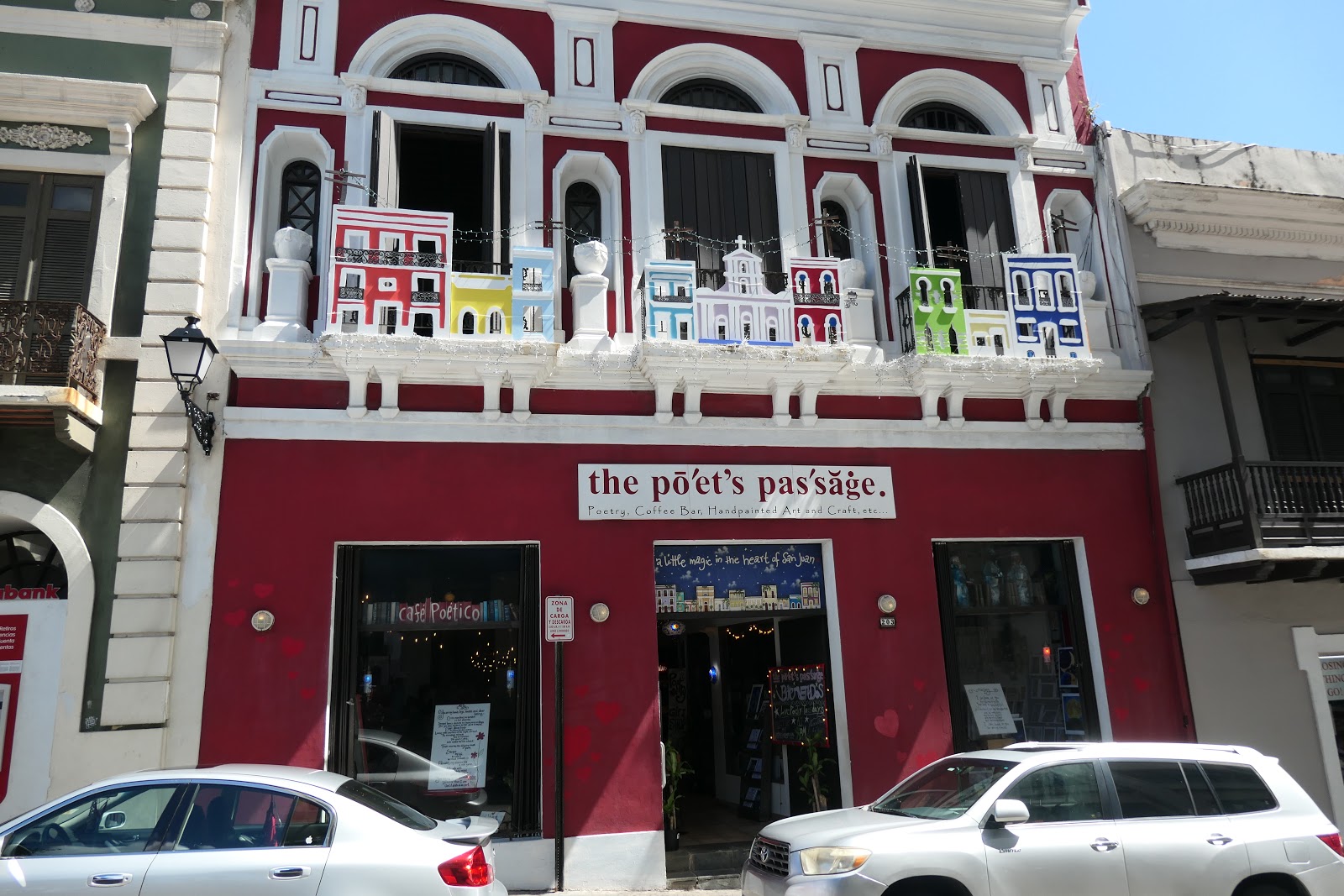
We spent a long and interesting day in Old San Juan.
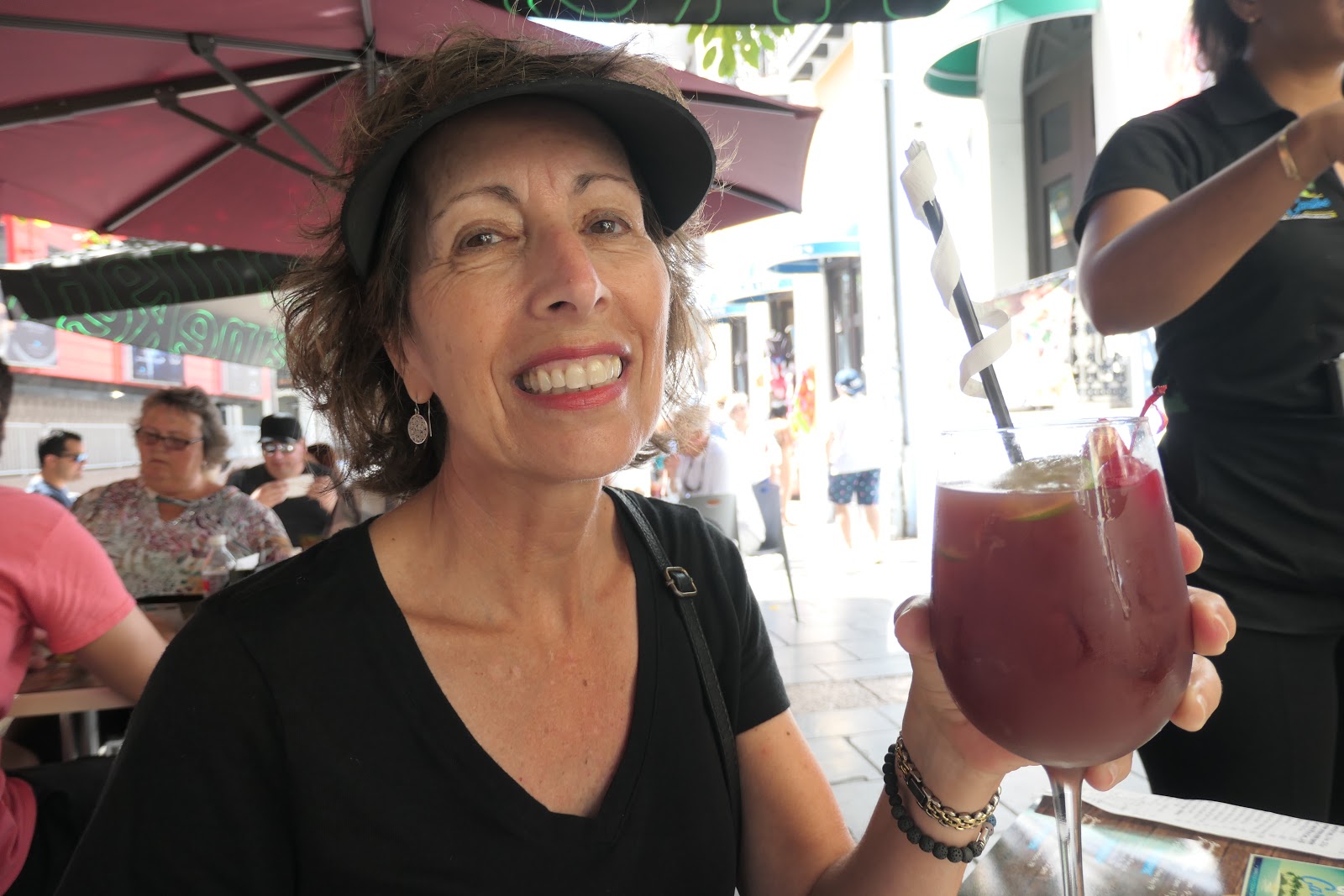
Sharing a carafe of Sangria with Marilyn (her favorite turned out to be Pina Coladas – George and I developed quite a fondness for them too!
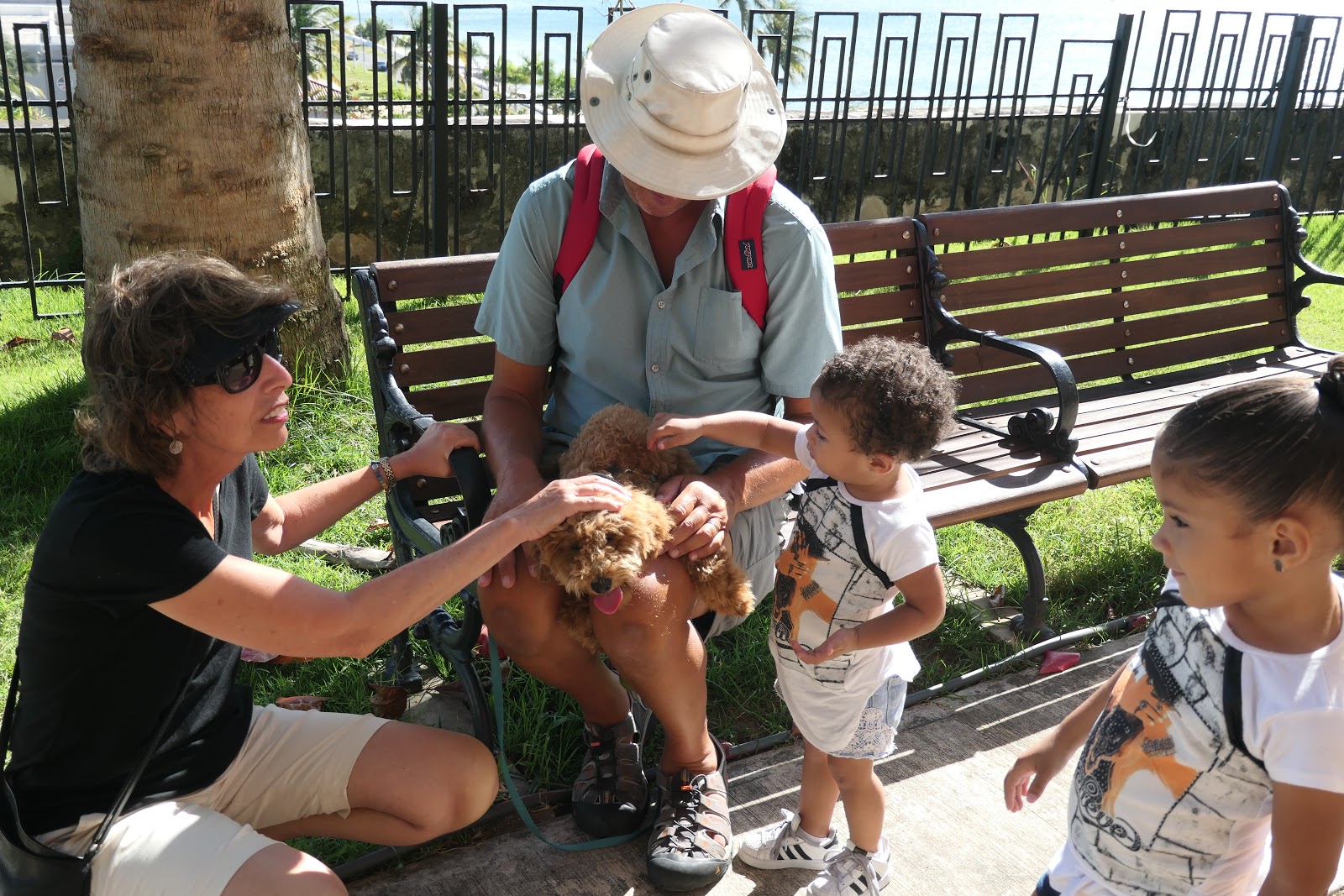
Marilyn managing crowd control for Duhkxy’s adoring fans
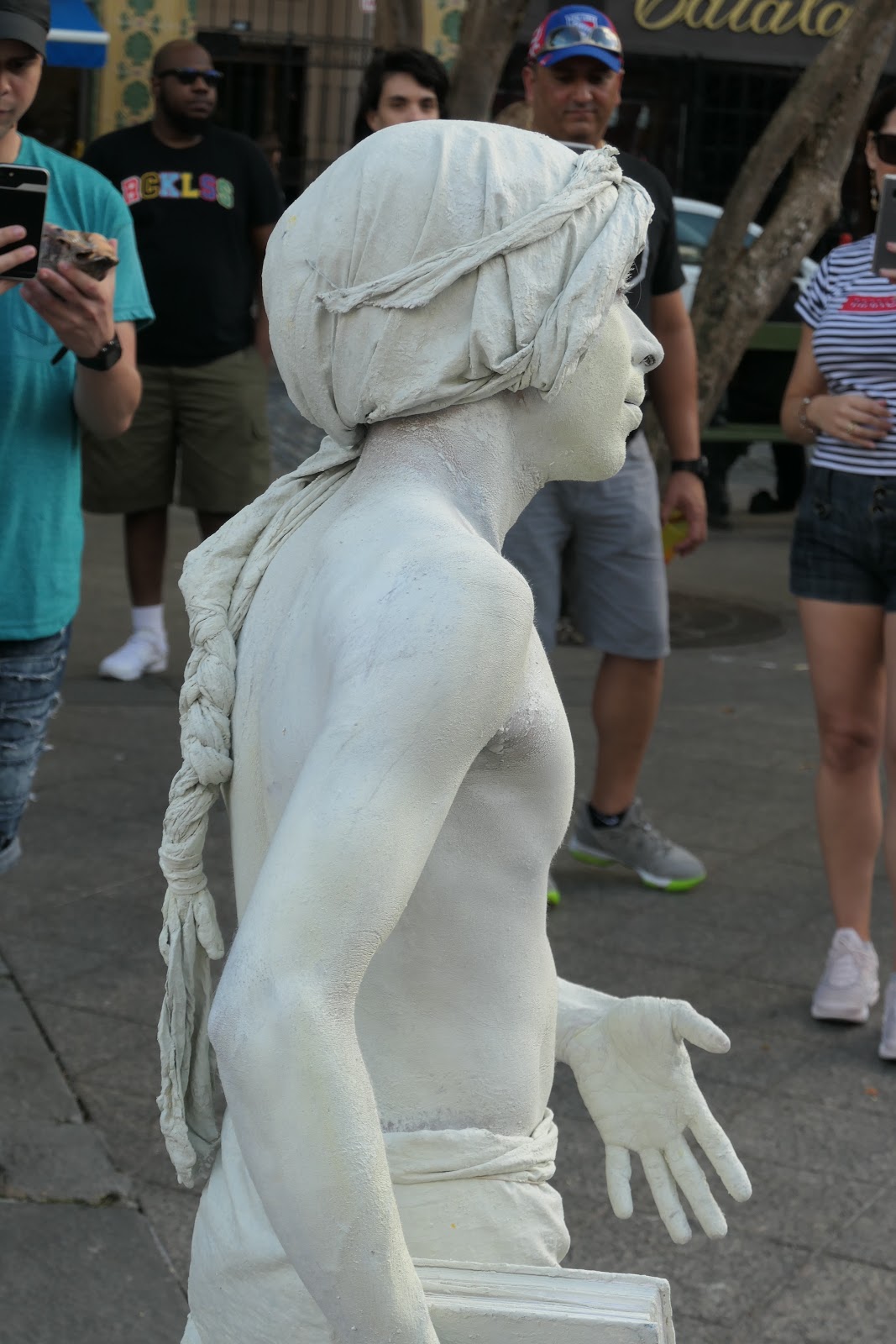
Performance Art in Old San Juan


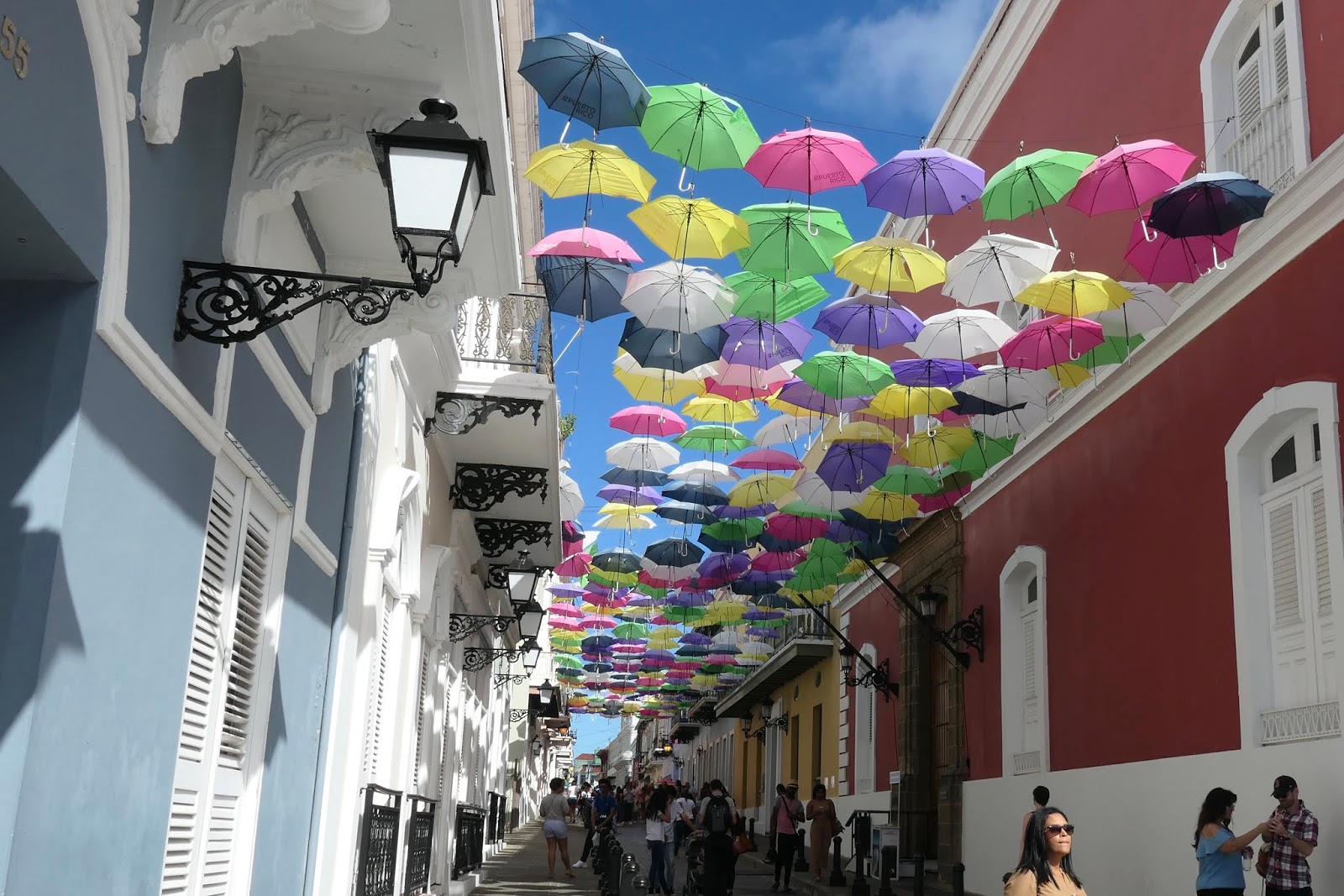
The festive umbrellas on this street on Forteleza Street in Old San Juan memorialize the recovery from Hurricane Maria
On our final day with Marilyn, we visited Ponce, a town that was described as a must see.  Unfortunately, we were not aware almost everything was closed on Mondays, the day we visited.  The boardwalk along the beach was also barricaded due to hurricane damage.  

Traveling and exploring some days are better than others – all part of the experience!  Marilyn took everything in stride – a perfect boat guest and friend.